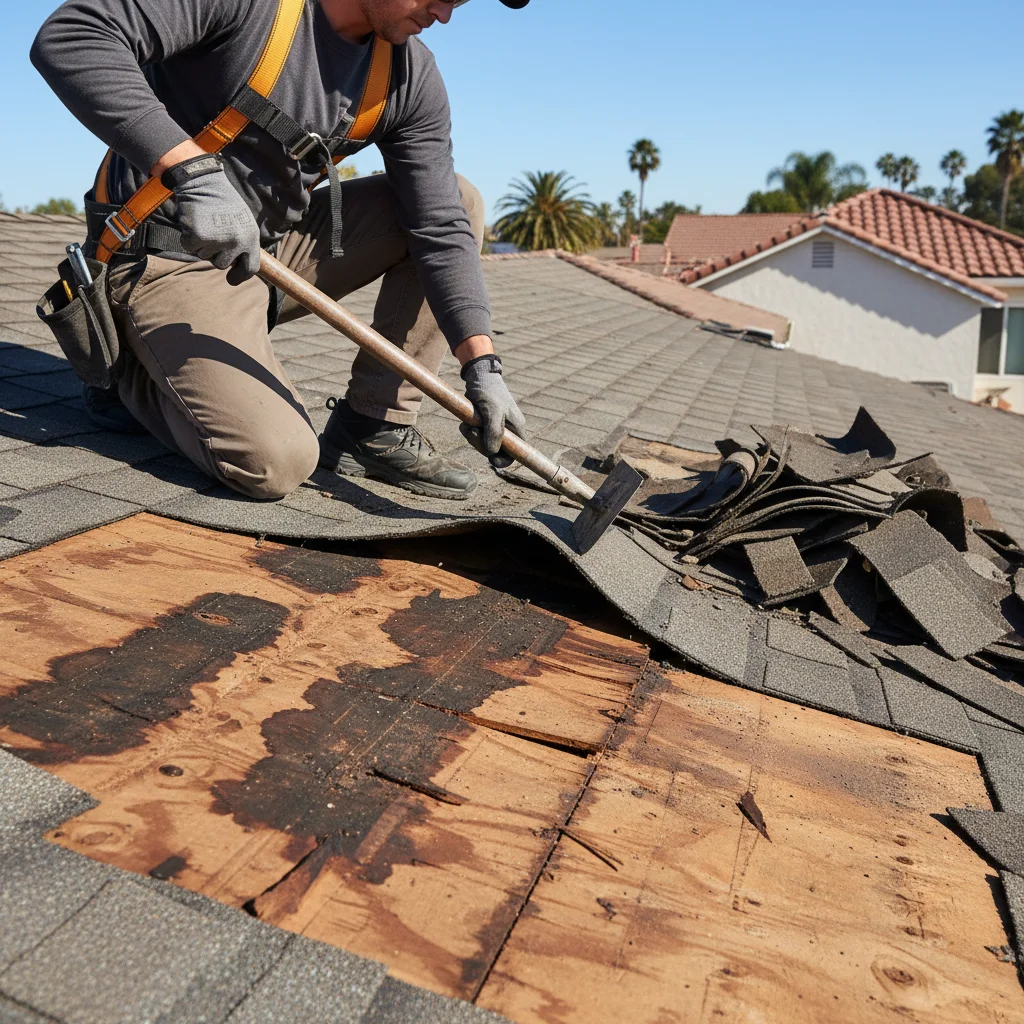
The most common surprise on a San Diego reroof is not the shingle color. It is the wood under the covering. After tear-off, a project manager may show you plywood or OSB that is stained, soft, or coming apart. That layer is roof decking (sheathing). New underlayment and a new covering need a solid nail base. Soft wood is not that base.
Top Pro Roofing SD refers. We do not install. We do not invent per-sheet prices. Call (760) 750-5557.
Vocabulary for the stack: roof sheathing vs decking. Coastal covering choices: best roof material for coastal climates.
What decking is and how it fails
Decking is the wood plane fastened to rafters or trusses. Underlayment, flashing, and the finished covering fasten to it. If it cannot hold nails, wind and water have an easier path.
Most later San Diego houses use one of two sheet products:
- Plywood. Veneer layers glued into a panel. Holds fasteners well when dry and intact.
- OSB (oriented strand board). Engineered strands and resin. Often specified as a cost-saving deck. Prolonged wetting can swell edges and reduce holding power.
Water is the usual killer. A slow leak at a pipe boot, valley, or chimney flashing can wet the same sheets for years before the ceiling shows a stain.
What that looks like:
- Rot. Fibers go soft. Fasteners spin or pull out.
- Delamination. Plywood layers separate.
- Mold on the underside. A moisture history, and an attic air-quality issue if it is widespread.
- Sag between rafters. The plane dips. You may see it as a wavy ridge from the street.
Poor attic ventilation makes it worse. Trapped heat and moisture cook the underside of the deck in this climate. That is a ventilation conversation, not a reason to skip replacing failed sheets.
Signs from the attic before anyone tears off
You can gather clues without waiting for tear-off. Use a flashlight. Do not walk a suspect ceiling or put weight on stained sheathing.
Look for:
- Coffee-colored stains on the underside, especially at vents, chimneys, and valleys.
- Sag between rafters instead of a straight plane.
- Mold or mildew splotches.
- Pinholes of daylight on a bright day, which means the wood has opened through.
Feel (carefully):
From a stable position, press stained areas with a screwdriver or broom handle. Healthy wood is firm. Soft, spongy, or flaking wood is a replacement candidate. Never stand on a sheet you think is gone.
Finding this early lets you ask every reroof bidder how they price discovered sheets, instead of arguing after the dumpster is in the driveway.
Why coastal tear-off is the honest inspection
Near the water, salt and the marine layer attack metal fasteners and flashing first. Nails and drip edge corrode. Moisture then sits on the deck under the covering. Communities like La Jolla, Encinitas, Coronado, and Imperial Beach see this pattern often. Related: will salt damage a metal roof and coastal roof salt damage.
Damage can start from the top of the sheet. The attic side can still look clean while the top face is failing. That is why a full tear-off, not a recover over unknown wood, is the usual honest path on a coastal roof replacement. Overlaying new covering on rotten deck is a short-term cosmetic, not a system.
How replacement should be priced on the contract
You often cannot know how many sheets fail until the old covering is off. Reputable independent roofers treat decking as a contingency with a unit price, not a vague “wood as needed” cloud.
A standard sheet is 4 feet by 8 feet. The contract should name:
- Product: plywood vs OSB, and thickness (many homes land on 15/32 inch or 1/2 inch; match or exceed what code and the inspector require for that roof)
- Price basis: per sheet, including remove, install, fasten, and haul-away
- How many sheets they will document with photos before they bill extras
- Who authorizes work above a stated threshold before they cut more
We will not invent a San Diego per-sheet rate or a whole-house wood adder. Compare unit prices across bids on the same product and thickness. A quote with no decking line is incomplete. Ask how they handle rot.
Full reroof context (still not a decking invoice): San Diego roof replacement cost.
Permits and what inspectors actually check
A tear-off reroof in San Diego County cities and unincorporated areas generally needs a building permit. The deck is part of that inspection, not a side favor.
Code expects a solid, structurally sound substrate. Rotted, delaminated, or broken sheets get replaced. Thickness and nailing have to support the covering and wind uplift. Inspectors commonly look at fastener type, size, and spacing (edge vs field). The matched roofer should state the nailing schedule they will use, not a shrug.
An in-progress deck inspection happens after tear-off and wood repair, before new underlayment hides the work. The inspector signs that stage. Covering should not go down until that happens where the jurisdiction requires it.
County building: San Diego County PDS building. City jobs go through that city’s development services. Verify the contractor at CSLB. We match homeowners with licensed independent C-39s. You contract with and pay the selected professional.
When to call us
If you see attic stains, a sagging plane, or you are already pricing a reroof, get a walk that includes how wood will be handled. Soft decking is not a line you skip to save the covering budget. Call (760) 750-5557 and we will connect you with a vetted local roofer.