Clay and concrete tile roofing in San Diego.
Tile is a common San Diego roof on Spanish, mission, ranch, and Mediterranean-modern homes. The waterproofing that matters is usually the underlayment, flashing, and battens under the tile, not the tile you can see. We match you with licensed independent roofers who can quote new tile or a lift-and-relay after they inspect.
What's included in this service?
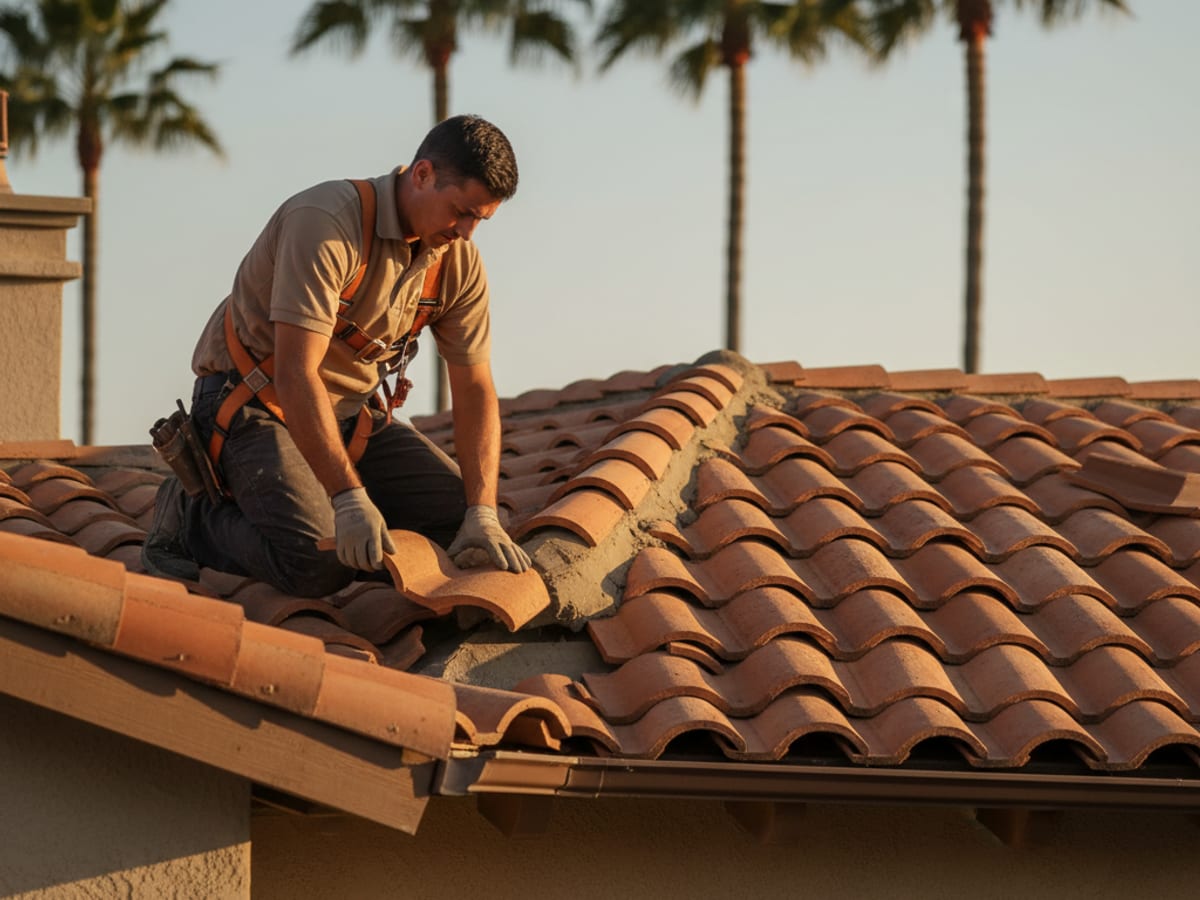
- New tile installation, Spanish S-tile, clay barrel, concrete flat
- Lift-and-relay, reuse existing tile over new underlayment and flashing
- Tile roof repair, cracked and slipped tile replacement, hip and ridge mortar resetting
- Tile matching for partial repairs, salvage sourcing for discontinued profiles
- Proper batten installation per tile manufacturer spec
- High-temperature underlayment (required for tile in inland heat zones)
- Cricket and diverter installation at chimneys and wall junctions
- Valley replacement with proper metal valley liner
- Ridge and hip mortar, mechanical fastening per code
When do you need this service?
- Existing tile roof is leaking but tiles look solid (lift-and-relay candidate)
- Underlayment is 30+ years old (felt) or 20+ (synthetic early gen)
- New construction or major addition needing a tile roof
- HOA requires tile match with neighborhood
- Converting from shingle to tile for aesthetic match to home style
- Hip or ridge mortar failing with loose tiles
What every San Diego homeowner should know about tile roofs
A broken tile is not a leaking roof
A cracked or missing tile looks dramatic from the ground, but it is not the same as a leaking roof. Clay and concrete tiles shed bulk water. The underlayment beneath them is what keeps water out of the house, and it catches whatever gets past the tiles. Most calls that start as a leaking tile roof turn out not to be about the tile at all. The underlayment or the flashing under it has failed, and swapping a few tiles will not stop a stain that is already inside. We match you with a licensed independent roofer. Ask them to confirm the source (field tile, flashing, or underlayment) in writing before anyone starts swapping pieces.
How tiles get cracked and slipped
Tiles get broken more often from people walking on them than from weather. HVAC techs, solar installers and satellite crews walk San Diego County tile roofs and often don't report the pieces they crack or kick out of place. Slipped and broken tiles from that kind of foot traffic show up on almost every tile roof in the county. Failing hip or ridge mortar with loose tiles is another common reason a homeowner calls. Those problems can sit next to a sound field of tile, which is why the first job is to find what actually failed. Confirm who walked the roof, what they found at flashing versus field, and whether this is a spot reset or a larger underlayment job, in writing, before you approve the work.
When tile roof repair is an honest spot job
A spot job means replacing the damaged tiles, resetting any that have slipped, and checking the underlayment and flashing in that area. That is an honest fix when the rest of the tiles are sound and the original profile is still available, or can be sourced as salvage. It is a stopgap if tiles across the roof are cracked, faded or spalling, or if the waterproof layer underneath has already given out. A roofer should walk the roof and pull a representative sample of tiles before calling it either way. What the work costs depends on tile condition, on whether it is a spot repair or a lift-and-relay, and on roof size, and the matched roofer quotes after inspecting, not before.
Matching an older roof, and what to ask first
Ask the matched licensed independent roofer whether they do tile matching for partial repairs and whether they can source salvage for discontinued profiles. A perfect color match is rare on an older tile roof because of sun fading, but a match that reads correctly from the street is often achievable. Before you agree to work, ask the roofer to walk the roof, pull a representative sample, and tell you whether the tiles are cracked, faded or spalling and whether the original profile is still in production. Ask whether they are quoting a spot replacement or a larger lift-and-relay, and get that in a written quote after the inspection. Top Pro Roofing SD matches homeowners with licensed independent C-39 roofers; we do not install.
Clay vs. concrete: the choice that drives the next 50 years
Tile roofs in San Diego are either clay (the original Mediterranean/Spanish profile, made by firing natural clay at high temperature) or concrete (poured, pressed, and cured concrete in a tile shape). The differences matter. Clay typically lasts much longer, holds color because the color is the clay itself, not a coating, handles UV well, and is usually lighter per square than concrete. Concrete is usually the lower-upfront option on a written quote, is heavier per square, and has a colored slurry coating that can fade. Ask the matched licensed independent roofer to put both options in a written quote if both are in play, and to say which your structure was built for. For a Mediterranean estate where the look has to last, clay is the usual request. For most San Diego tract homes built for concrete tile, concrete is the neighborhood match. See concrete vs. clay tile in San Diego for a fuller comparison.
The underlayment is the silent timer on every tile roof
Tile doesn't fail. Underlayment fails. The waterproof layer beneath the tile (historically 30# felt, now synthetic) is what actually keeps water out of your home. Tiles shed bulk water; the underlayment catches what gets past them. Felt underlayment lasts 20 to 30 years in San Diego. Early-generation synthetic underlayment lasts 25 to 35 years. Modern high-temperature synthetic (the current standard for tile in SD inland heat zones) is rated 50 years but unproven that long in field. When a 30-year-old tile roof starts leaking, the call is almost never about the tile, it's the underlayment underneath aging out. The fix is a lift-and-relay: the crew removes the tile, replaces all underlayment, flashing, and battens, then reinstalls the original tile. See tile roof underlayment failure signs for what to watch for.
Lift-and-relay vs. full new tile: how to know which one you need
The decision hinges on tile condition, not underlayment condition (underlayment always needs replacing if you are going that deep). A good roofer should walk the roof, pull a representative sample of tiles, and assess: are the tiles cracked, faded, or spalling (concrete only)? Is the original profile still in production for partial replacement? A lift-and-relay reuses your existing tile: same look, new waterproofing, a long reset on the waterproofing lifespan. Full new tile makes sense when the existing tile is broken, badly faded, structurally compromised, or you want a different profile. Ask the matched licensed independent roofer for both options in a written quote after the inspection, not a dollar range from this page. For most San Diego homeowners with tile in solid visual condition, lift-and-relay is the right first comparison. See tile roof lift-and-relay in San Diego for the full process.
HOA mandates and matching tile profiles
Many San Diego neighborhoods, especially Rancho Santa Fe, Carmel Valley, 4S Ranch, Scripps Ranch, Poway tract communities, Mission Hills estates, have HOA roofing requirements that mandate tile (and often a specific tile profile or color range). Before any replacement, check your CC&Rs. The HOA architectural review committee usually has a list of approved tile manufacturers and colors. Common SD profiles: Eagle Capistrano, Eagle Bel Air, Boral Saxony Slate, MCA Mission, US Tile Classic 'S'. For partial repairs on older roofs with discontinued tile, a good roofer sources from salvage yards or controlled demolition to match. Perfect color match on a 20+ year tile roof is rarely possible (UV fade is uneven), but a visible-from-the-street match almost always is. See Carmel Valley HOA roof requirements and Scripps Ranch HOA roof requirements for two specific examples.
Why finding a real tile specialist matters in San Diego
Most San Diego roofers will quote a tile job. A much smaller number actually specialize in it. The difference shows up in the details: proper batten installation to manufacturer spec (most tile failures trace back to wrong batten size or spacing), high-temperature underlayment for inland heat zones (Poway, Escondido, El Cajon, Ramona) where rooftop temperatures run extreme in summer, cricket and saddle construction at chimneys and wall junctions, mortared vs. mechanically fastened ridge and hip caps done to current code, and broken-tile inventory to match your profile during the install. Ask the matched licensed independent C-39 roofer how many tile lift-and-relays they completed in the past year, and to put batten spec, underlayment product, and ridge method in the written quote. Top Pro Roofing SD matches homeowners with licensed independent roofers; we do not install.
What do homeowners ask about Tile Roofing?
What's the difference between a broken tile and a leaking roof?
A cracked tile is a visible break in the cap that sheds bulk water. A leak usually means the underlayment or flashing beneath the tiles has failed, which is why most leak calls are not about the tile you can see. Replacing a few pieces will not stop a stain that is already inside if that waterproof layer has given out.
How do clay and concrete tiles get cracked in the first place?
Foot traffic from HVAC, solar, and satellite crews can break and slip tiles. Those crews often do not report the damage. Failing hip or ridge mortar with loose tiles is another common reason to call a tile roofer.
What should I ask before I agree to a tile spot repair?
Ask the roofer to walk the roof and pull a representative sample of tiles to check for cracking, fading or spalling, and to say whether the original profile is still in production. Ask whether they can match the profile, including salvage for discontinued tiles, and whether a match that reads correctly from the street is the honest goal on an older, sun-faded roof. The matched roofer quotes after inspecting, because the scope depends on tile condition, roof size and whether this is a spot job or a lift-and-relay.
Can you repair a clay tile roof in San Diego?
The matched licensed independent roofer can quote clay barrel and Spanish S-tile repairs. Ask whether they can source the current profile or salvage. A cracked clay tile can be a matching or spot-repair job, or it can point to a larger underlayment problem. We do not perform the repair ourselves.
How long does a tile roof last in San Diego?
Ask the matched roofer to separate tile condition from underlayment and flashing condition in the quote. Many leak calls are not about the tile you can see. A lift-and-relay replaces failed waterproofing while keeping sound tile.
Can you match tiles on a partial repair?
Ask the matched roofer. For current production tiles they may source fresh. For older or discontinued tiles, ask about salvage. Ask what match they can actually deliver from the street before you sign.
Why are tile roofs more expensive than shingle?
Ask the bid to line-item material, battens, underlayment, and flashing so you can compare it to a shingle assembly. Tile handling and flashing detail are different work. This brand does not publish a price ratio.
Do I need to reinforce my structure for a tile roof?
If you are converting from shingle to tile, ask for a structural check. If the home was already built for tile, ask the matched roofer whether they still want an engineer look. They should say who coordinates that if it is needed.
What about clay tile vs. concrete flat tile?
Ask the matched roofer which profile they can still source and what it costs on your roof. For a Mediterranean estate look, clay is a common request. Confirm the product in the quote.
Where do we offer Tile Roofing in San Diego County?
We connect homeowners with tile roofing pros in every city and community in San Diego County. Pick your city for local climate notes and service specifics.
See tile roofing in all 67 cities
Need tile roofing in San Diego County?
Call and we'll match you with an independent local roofer.