Top Pro Roofing SD is a referral marketplace. We connect San Diego County homeowners with CSLB-licensed roofers. We do not install tile or metal and we do not publish a 2026 per-square-foot rate card. Call (760) 750-5557.
Tile and metal are both long-lived covers here. The useful split is weight, HOA profile, salt, and fire listing, not a blended national invoice. Concrete S-tile, clay barrel, standing seam, and stone-coated steel are four different jobs. How to read unit math: tile roof cost per square foot. Project scope: 2026 tile roof replacement cost.
We will not invent installed dollars per square foot, per square, or a whole-house total.
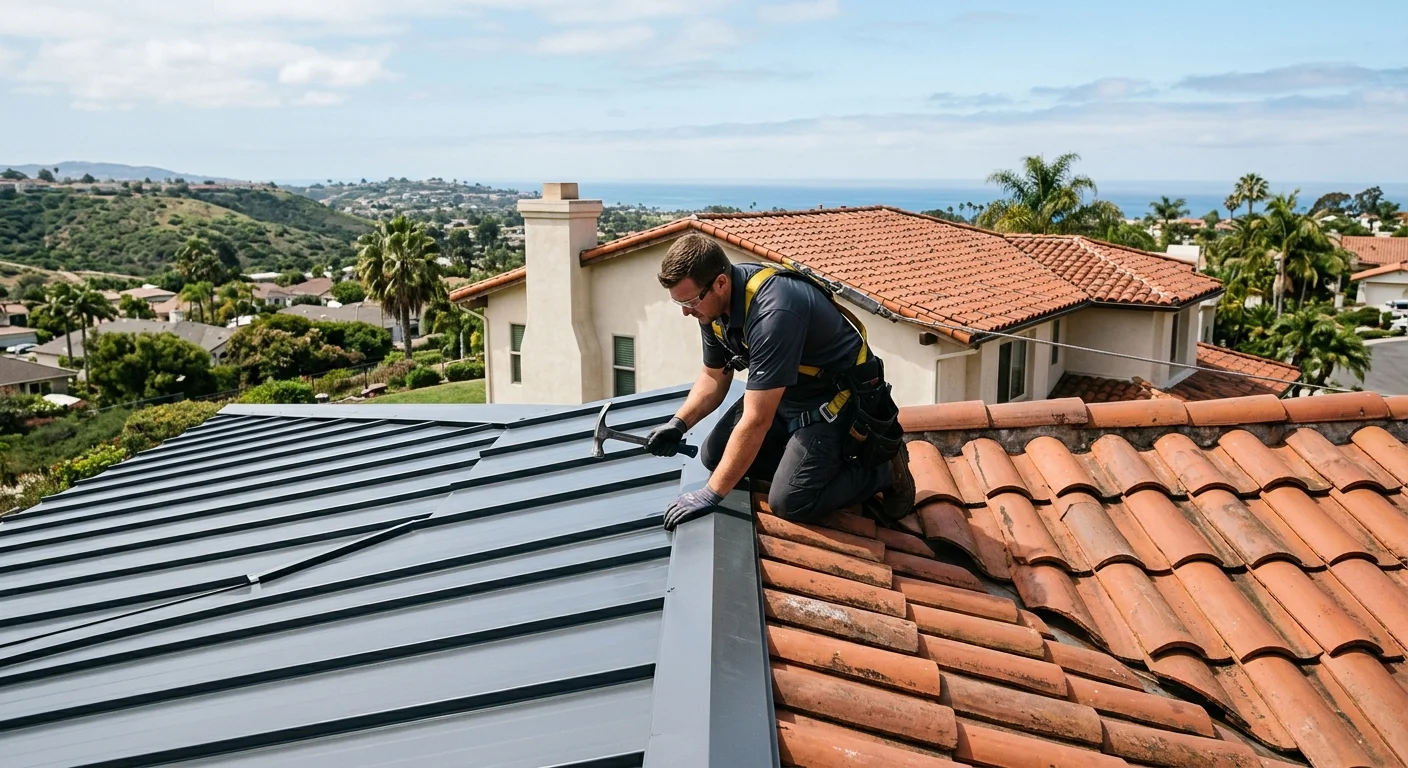
The San Diego context: sun, salt, fire zones, and HOAs
UV is constant. Salt air near the water attacks unprotected steel fasteners and panels. Inland heat and canyon wind change the fire conversation.
Wildland-urban interface rules in the county often want a Class A roof assembly, not a slogan. Tile and metal can reach Class A when the listed product and underlayment match the listing. Confirm the specific product and the local amendment, not a generic “tile is fireproof” line.
HOAs are common from Carmel Valley to older districts. Boards often lock profile and color. Spanish and Mediterranean streets may require a tile look. Some contemporary streets allow standing seam. Read the CC&Rs before you fall in love with a photo. Tile roofing and metal roofing.
Lifespan and durability, without a fake invoice
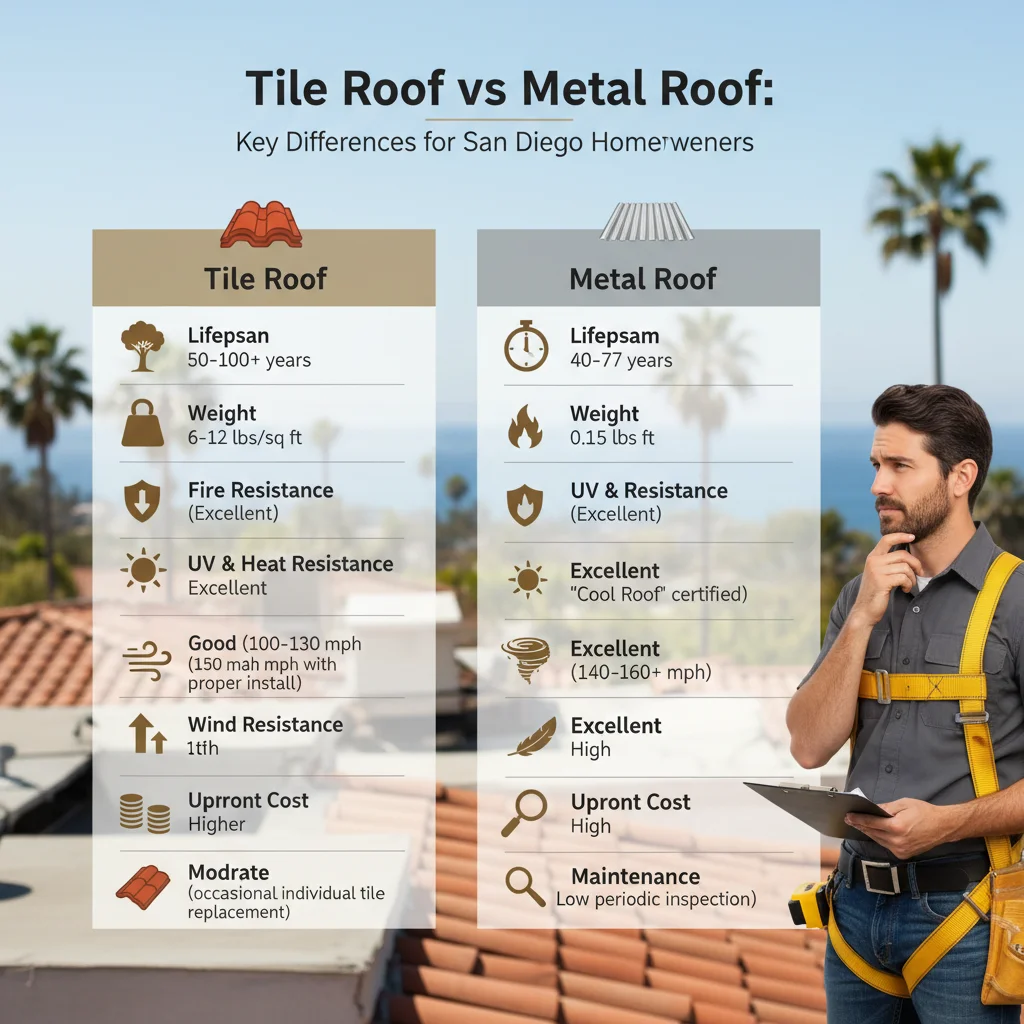
Clay and concrete tile often carry 50-year-plus manufacturer stories when underlayment and flashings are maintained. Individual tiles crack from impact or foot traffic. They can be swapped if a match still exists. Salt does little to fired clay or concrete. The felt or synthetic under them is the usual failure, not the tile itself.
Standing seam steel or aluminum, with a named coating system, often lands in a 40-to-70-year conversation when fasteners, laps, and coastal metal choice are correct. It does not crack like tile. Coatings can scuff. Installation quality decides leaks. Salt on steel vs aluminum: will salt damage a metal roof.
Neither material is “set and forget” if flashings, penetrations, and drip edge are ignored.
Upfront cost: how to compare bids, not a rate table
Both sit above a composition-shingle reroof on most San Diego houses. That is a rank, not a number we will freeze.
Ask every bid for the same columns:
- Roof area from a takeoff, not living square footage
- Tear-off vs overlay (overlay is usually the wrong conversation for a clean job)
- Underlayment product
- Flashing metal (especially at the coast)
- Tile type or metal panel type and coating
- Disposal, permit, and whether an engineer is in scope
- Access, stories, and cut-up (hips, valleys, skylights)
National pages print wide bands for concrete, clay, corrugated, metal shingles, standing seam, and stone-coated steel. Use those pages as a reminder of rank. Clay and mission labor sit above tract concrete. Standing seam is not corrugated. Stone-coated steel is not barrel tile. None of those pages is a San Diego invoice.
Coastal homes often pay more because of access, listed coastal metals, and listed fasteners. Inland tract roofs often sit toward the simpler end of the same product family. Tear-off, skip-sheathing, and structural work are extra lines. We will not invent those adders.
Weight, structure, and what your home can support
This is the split that actually changes the permit.
Manufacturer literature commonly puts concrete and clay in a roughly 6 to 12 pounds per square foot conversation, depending on profile. Standing seam and similar metal panels often sit around 1 to 2 pounds per square foot. Stone-coated steel is still a metal load, not a concrete-tile load.
On an older house framed for wood shake or composition, adding real tile can trigger a structural look. Under the San Diego Residential Code, swapping to a covering over six pounds per square foot is the usual engineering conversation. Confirm with the building department and the matched C-39. We will not invent an engineering fee.
Metal almost never forces that reinforcement for weight alone. A complete tear-off is still the usual clean spec for warranty and inspection, even when the frame can carry metal.
Roof replacement should include a look at the deck and framing, not only the cover photo.
Look and neighborhood fit
Barrel and S-tile read as San Diego on stucco and Spanish Revival streets: Rancho Santa Fe, parts of La Jolla, and similar. HOAs in those pockets often want that silhouette.
Standing seam is a different street: contemporary and some infill. Color range is wide. Stone-coated steel is the tile-profile metal product: it reads as tile from the sidewalk when the HOA cares about profile and the frame cannot take real tile.
Check the board before you price either path.
Stone-coated steel: tile look without tile weight
Stone-coated steel is a metal panel pressed into a tile or shake profile and coated with granules. From the street it can pass as Spanish or Mediterranean tile. On the structure it behaves like metal.
Two common uses:
- An HOA that wants a tile look and will not approve standing seam. Confirm in writing. The board, not a salesperson, decides.
- An older frame that cannot take concrete or clay without engineering. You still need listed underlayment, flashings, and coastal metal choice.
The tradeoff is usually price rank: this product often sits at the high end of metal and can sit above tract concrete. You are buying a look plus metal weight. For salt, ask whether the system is coated steel or an aluminum-based version. Put both on the same takeoff.
How to decide
- HOA and street. Profile and color can end the debate before weight does.
- Frame. If you want real tile on a light old roof, budget an engineer as a possible line. Metal skips that weight problem.
- Coast. Tile is largely indifferent to salt. Metal needs a named coastal spec.
- Fire listing. Ask for the Class A assembly, not a material nickname.
- Maintenance. Tile wants occasional broken-piece swaps and underlayment honesty at year 20-plus. Metal wants coating and fastener honesty.
A matched roofer should quote the two real options on this roof, side by side, with the same area and the same exclusions.
When to call
Call (760) 750-5557. We will connect you with a vetted local C-39 for a written comparison. We do not install the roof.
Frequently asked questions
Is metal or tile cheaper in San Diego?
There is no county rate card we will publish. Tract concrete can undercut standing seam on a simple inland roof. Clay, mission, coastal metals, and engineering for tile can reverse that. Compare complete bids on the same takeoff.
How much heavier is a tile roof than a metal roof?
Often several times heavier per square foot, depending on the exact tile and panel. That is why older frames get a structural review for tile and almost never for metal weight alone. Ask the contractor for the product’s published dead load, not a guess.
Which roof lasts longer, tile or metal?
Clay often has the longer manufacturer story when underlayment is renewed as needed. Standing seam still outlasts composition shingles by a wide margin. Either can be a “one more roof in this ownership” cover if flashings are maintained.
Can I get the tile look without the tile weight?
Stone-coated steel is the usual product for that. Confirm HOA approval and coastal spec in writing.
Which roof holds up better near the San Diego coast?
Tile itself is largely unaffected by salt. Metal depends on the metal: aluminum or a listed coastal system beats bare or poorly coated steel. Inland coated steel is a different conversation. Salt and metal roofs.
Do tile and metal roofs meet San Diego fire codes?
Both can, as listed Class A assemblies. High-fire areas care about the listing and the underlayment, not the nickname. Confirm with the product sheet and the local building department.