You’ve got a flat or low-slope roof that needs work, and two names keep coming up: TPO and modified bitumen. They’re both legitimate membranes. They fail in different places under San Diego sun. The right choice depends on building type, rooftop traffic, drainage, and how you will repair the roof later, not on a slogan about which “lasts longer.”
Top Pro Roofing SD refers licensed C-39 roofers. We do not install commercial roofs and we do not issue warranties. Call (760) 750-5557. Verify the installer on the CSLB license check before you sign.
We will not invent a price per square, a 20-year promise, or a winning brand. Compare named assemblies. Category context: membrane roofing for building owners. Sequence of work: TPO installation in San Diego. Cost drivers (not a bid): 2026 flat roof replacement cost in San Diego.
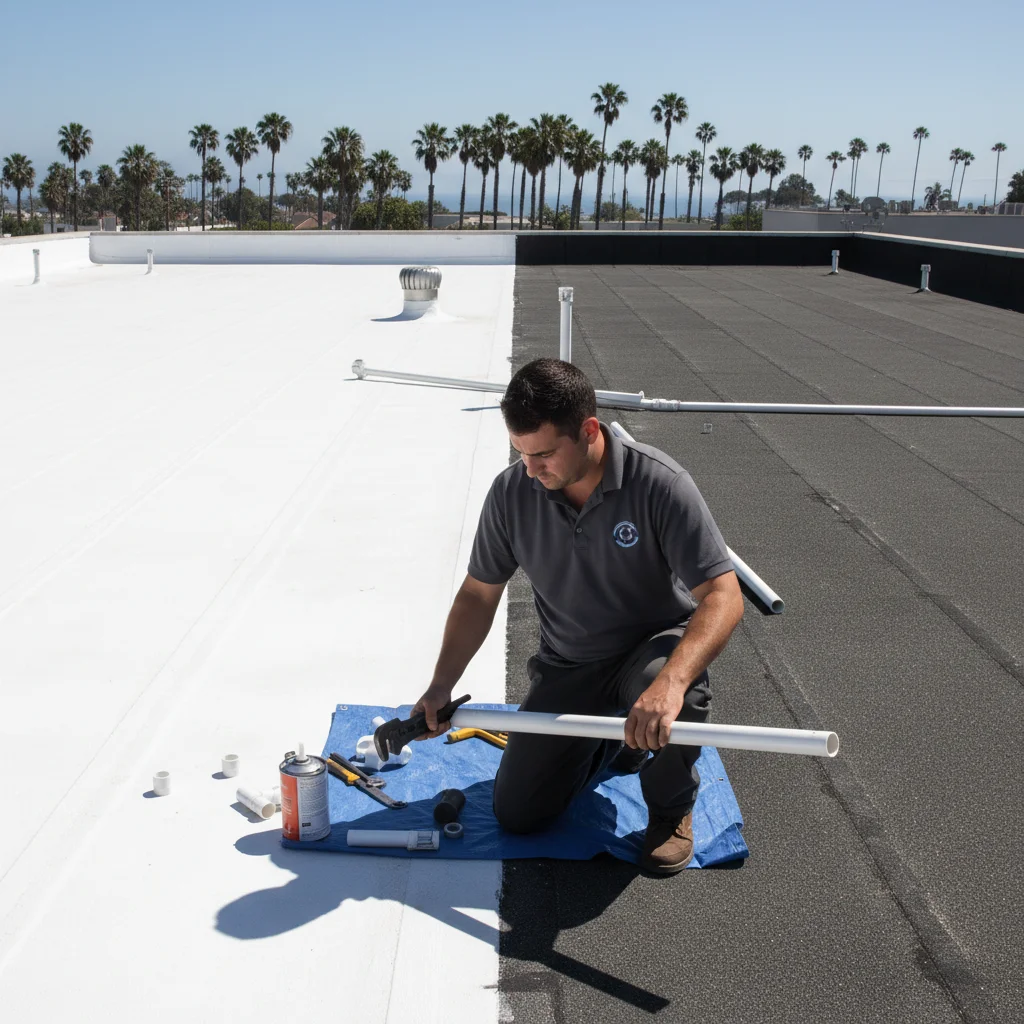
What’s the difference between TPO and modified bitumen?
TPO stands for thermoplastic polyolefin. It’s a single-ply membrane, one factory sheet, usually white or light gray, heat-welded at the seams. Light-colored TPO is often specified where a reflective sheet and welded laps are the point.
Modified bitumen (mod bit) is a descendant of built-up roofing. It’s asphalt modified with polymers, either APP (atactic polypropylene) or SBS (styrene-butadiene-styrene), in rolls that get torched, hot-mopped, cold-adhesive applied, or self-adhered, usually in more than one ply. The result is a layered system. Extra thickness is extra redundancy, not a magic lifespan.
Short version:
- TPO is a single, flexible sheet. Lightweight, typically light-colored, heat-welded seams.
- Modified bitumen is a layered asphalt system. Heavier, tougher underfoot, laps sealed by the chosen method.
Both are flat and low-slope roofing options a qualified independent roofer will install across San Diego County. Neither is universally better.
One thing they share: both need a drainage design that does not pond. If water sits after rain, that’s a separate issue to solve before a new membrane goes down. Details: flat roof ponding water in San Diego.
How San Diego sun and heat affect each membrane
San Diego’s climate is mild on paper and hard on flat roofs. Rain often arrives in a few storms, not a drizzle all winter. Confirm current climate normals on NOAA’s published tables if you need a number. UV is nearly year-round. Inland lots in El Cajon or Santee run hotter than Point Loma. We will not invent a surface temperature for your roof. Ask the bidder what they measured or assumed.
TPO and heat. Light TPO is often chosen because it reflects more solar energy than a dark granule cap. Cool-roof claims belong to a specific SKU. Ask for the CRRC or manufacturer record for that product, then confirm Title 24 with the California Energy Commission and the AHJ. Search listed products in the ENERGY STAR roof products database if the proposal cites ENERGY STAR. A color name is not a listing.
TPO’s weak point is workmanship at seams and flashings. A properly heat-welded TPO seam can be stronger than the sheet. A rushed weld, a dirty lap, or a cold-weather install can lift later. San Diego has daily thermal cycling: cool mornings, hot afternoons. That expansion and contraction works every seam.
Modified bitumen and cycling. Multi-ply systems spread stress across layers. APP-modified sheets are commonly used where heat resistance is the story. SBS-modified sheets are more flexible. Torch-down APP has been a default on many San Diego residential flats for decades. That history is not proof it is the right system on this building.
The trade-off: traditional granule-surfaced mod bit is darker and absorbs more heat. Some owners add a reflective coating later. That coating is another product, another warranty, and another maintenance item. Put it in writing if it is part of the plan.
For rooftop equipment, HVAC curbs, and regular foot traffic, extra ply thickness often gives modified bitumen an edge in puncture resistance. TPO can puncture during a sloppy mechanical visit if workers are careless around penetrations.
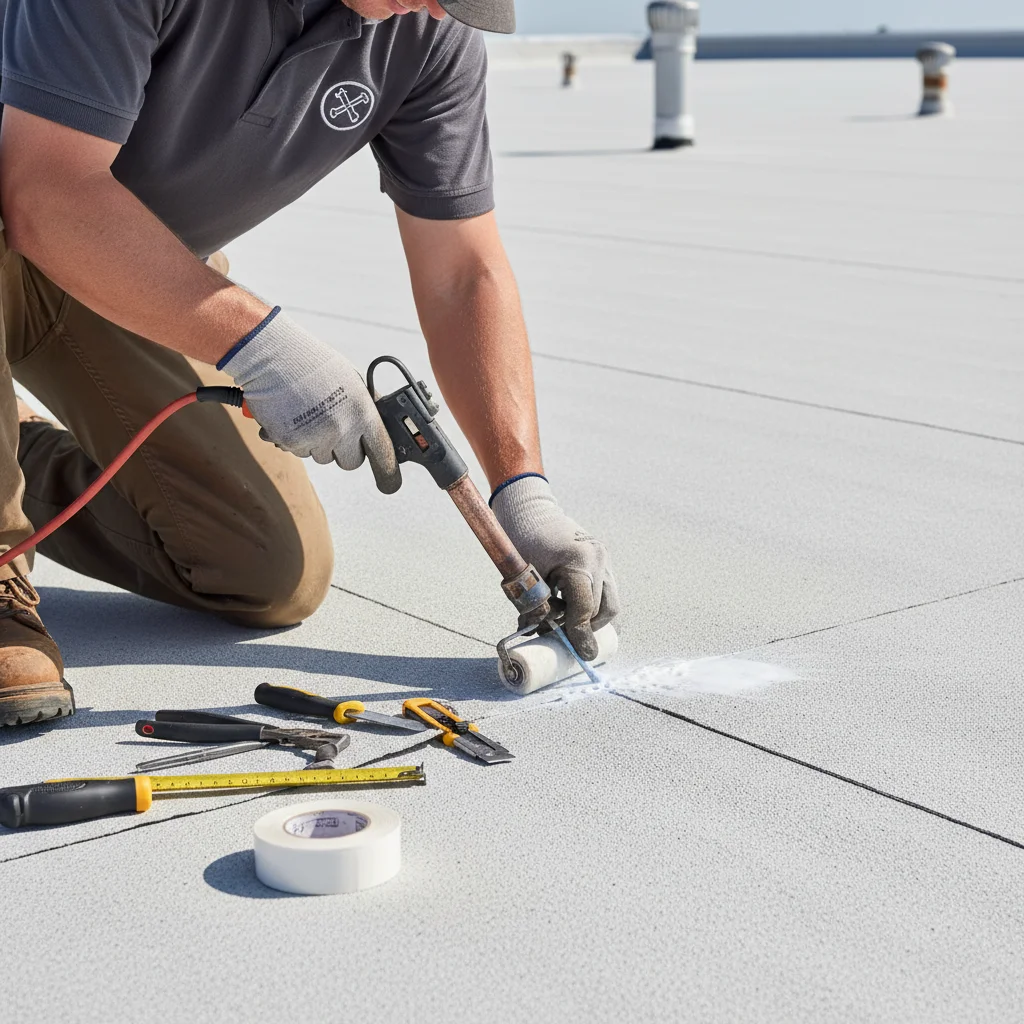
How to compare cost without a fake per-square table
Two “TPO” numbers are not the same roof if mil thickness, attachment (mechanically fastened vs fully adhered), insulation, recover vs tear-off, and penetration count differ. The same is true for two-ply vs three-ply mod bit, torch vs cold adhesive, and whether drain work is included.
Ask each bidder to itemize:
- Existing covering and whether it stays (recover) or comes off
- Deck and insulation condition as observed
- Membrane manufacturer, product, thickness, and color
- Attachment method
- Every drain, scupper, curb, and wall flashing in or out of scope
- Permit, manufacturer warranty path, and closeout documents
San Diego County and City of San Diego both typically require permits for reroofing. Confirm the current fee and path at the San Diego County permit portal or City of San Diego Development Services. We will not invent a permit price.
If cost is the driver, get line-item quotes for both chemistries on the same roof plan. The difference is often smaller than people expect once attachment and drains are equal.
Lifespan, warranty, and repair, without invented year counts
Marketing quotes decade ranges for every polymer. We could not verify a general year count that holds for your thickness, attachment, traffic, drainage, and inland vs coastal exposure. A Kearny Mesa warehouse sheet and a Mission Hills residential addition do not age the same.
What to collect instead:
- Manufacturer warranty document for the named system, including whether it is material-only or includes labor
- Whether the installer must be manufacturer-approved for that warranty to apply
- Written workmanship warranty from the contractor
- Inspection interval the manufacturer actually requires
TPO repair pattern (when it fails): seam issues, shrinkage or stress at penetrations, punctures near HVAC. Early catches are usually a compatible weld. Deferred leaks into wet insulation are a different job. Ask the bidder how they repair TPO and what equipment they bring.
Modified bitumen repair pattern: blistering from trapped moisture, lap failure (especially on poorly timed cold-adhesive work), granule loss on older sun-baked APP. Blisters are not always an active leak. They still need a written monitoring or repair plan.
Repairability. Modified bitumen often patches with materials a C-39 already carries. TPO needs compatible membrane and a heat welder for a lasting repair. Lap caulk on TPO is a delay, not a system repair.
Maintenance. Both systems need inspections and prompt flashing and drain work. NRCA’s national point still holds locally: premature failure is more often deferred maintenance than the wrong polymer name. See NRCA.
Which one’s right for your flat roof?
Lean TPO if:
- Title 24 cool-roof compliance is on the table and a listed light membrane is the path
- You want a reflective field on a larger commercial re-roof
- The roof has relatively clean geometry and a crew that can weld
Lean modified bitumen if:
- It’s a residential flat or low-slope addition with lots of walls and steps
- There’s heavy rooftop traffic or HVAC that gets serviced often
- You want a system local crews can patch without a welder
- The existing roof is already a bitumen family and recover is the honest scope
It’s a tie when:
- You’re comparing two complete, permitted, warranted assemblies on the same plan. Installer quality and drainage then matter more than the brand on the roll.
Whatever you choose, the contractor should pull the permit, carry a current CSLB license you verified yourself, and hand you the manufacturer warranty, not a verbal promise.
When to call us
Flat roof work, replacing a failing mod bit system or moving to TPO for energy compliance, needs an independent licensed contractor who knows the local permit path and the manufacturer’s paperwork. A botched seam or missed flashing can void a warranty. Call us at (760) 750-5557 and we’ll connect you with a vetted local roofer. You still check that roofer at cslb.ca.gov.