The right asphalt shingle roof in Santee is the one that matches this house, not a showroom board. Inland East County sun, valley heat, and whatever is already on the deck decide more than color. A licensed independent roofer should inspect first, then write a proposal that names the product, the tear-off, and the flashing. Top Pro Roofing SD is a referral service. We connect Santee homeowners with licensed local pros. We don’t install roofs.
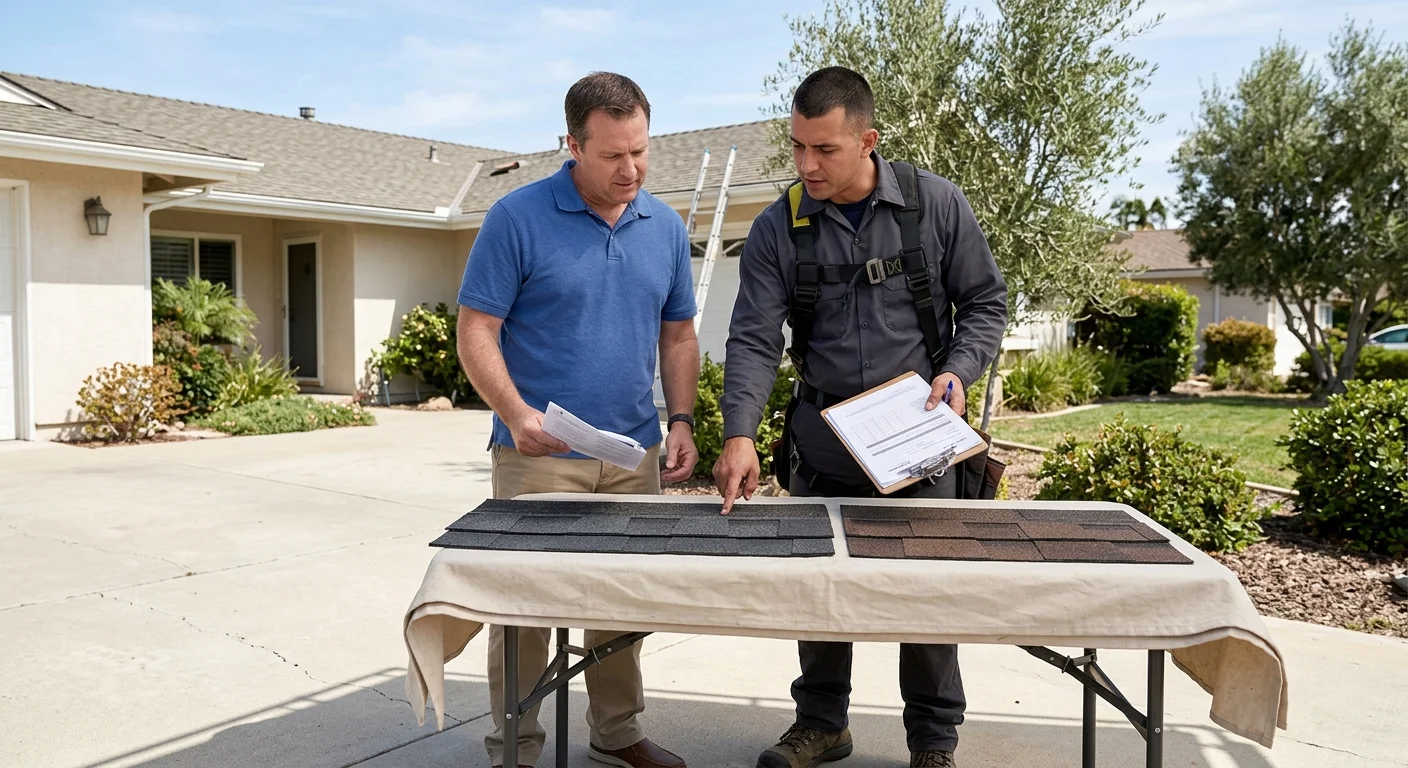
What the existing roof inspection should establish
Don’t pick shingles until someone has been on the roof. An asphalt shingle reroof in Santee is a system decision. The matched C-39 roofer is the person who should make that call, not a photo from the street.
The inspection should say what covering is up there now. Composition shingles, tile, or a mix. How many layers. Whether the deck is solid, skip-sheathed, or already patched. Where water actually moves: valleys, pipe boots, chimneys, skylights, and wall intersections. Whether solar is mounted, and who would have to lift it. Intake and exhaust vents, or the lack of them. Granule piles in the gutters. Curling, cracked, or missing tabs. Soft spots in the sheathing.
That list is not a sales script. It is the difference between a clean tear-off and a surprise deck replacement. City of San Diego Information Bulletin 123 says that where two applications of asphalt shingles or built-up covering already exist, all layers must come off to the deck before a new covering goes on. That bulletin is the City of San Diego, not Santee. Santee is its own city. Its Building Division sets Santee rules. Treat a double-layer finding as a scope question the written proposal has to answer, then confirm the local requirement with the City of Santee, not with a San Diego city handout.
The same inspection should note slope and drainage. Low-slope sections over a patio, garage, or addition often cannot take the same shingle system as the main steep roof. Mixing systems without naming both in the bid is how leaks get built in.
California Business and Professions Code Section 7048 sets a $1,000 aggregate threshold for unlicensed work, with extra limits. A reroof is not casual patch work under that line. The person walking your roof and writing the job should be a licensed C-39 contractor. You can check a license on the CSLB license lookup before you compare products.
If the inspection is only a color chart and a lump sum, it is not an inspection. Ask for photos of layers, deck, flashing, and vents. Ask what would change the scope once tear-off starts. Then decide whether you are replacing an asphalt shingle roof or still guessing.
How shingle type changes the written proposal
Three-tab and architectural asphalt shingles are not the same line item. They change the materials list, the hip and ridge pieces, the look from the street, and often the underlayment and ventilation the roofer wants to pair with them. A proposal that only says “comp shingles” is not finished.
Architectural asphalt shingles are laminated. They read thicker on the roof. Three-tab shingles are a single layer with cutouts. Neither one has a verified calendar life in this site’s claims ledger. Manufacturer “30-year” language is a warranty class, not a promise the roof lasts 30 years in East County sun. If a bid leans on that number, read the actual warranty sheet. Our comparison of asphalt shingle types used in San Diego is the place to sort the product families. Our notes on shingles that fit this climate cover heat and sun without turning a warranty label into a lifespan.
Weight can change the job. City of San Diego IB 123 requires a permit, and structural verification, when wood shakes, wood shingles, or asphalt shingles are replaced with material over 6 pounds per square foot. That is a City of San Diego rule. It is not confirmed here as Santee’s rule. If a product is heavier than what is coming off, the Santee proposal should say whether engineering or a permit path is needed, and the City of Santee should be the authority that confirms it.
Cost talk should stay inside published county ranges, not invented Santee averages. For a typical 2,000 sq ft home in San Diego County, architectural shingle work has already been published on this site in the $14,500-$22,000 installed range. That is a county figure from our own cost post, not a Santee quote and not a 1,000 sq ft unit price. A separate installed cost for 1,000 sq ft of shingles is not in the verified ledger. Do not let anyone “scale” a county range in their head and call it your house.
The written proposal should name brand and product line, color, underlayment, starter, hip and ridge, ice-and-water or equivalent in valleys if they intend to use it, and whether the old roof comes off. Overlay versus tear-off is a scope choice with code consequences. City of San Diego forbids a third layer when two asphalt or built-up layers are already there. Santee’s matching limit could not be confirmed from the ledger. Have the matched roofer write the layer count they found, then confirm with the city.
If you are shopping asphalt shingle roofing against tile or metal, keep that comparison on a separate page of the bid. Mixing “or we could do tile” into one vague number hides the real asphalt job.
Which Santee conditions need verified local evidence
Santee is not coastal Encinitas and it is not downtown San Diego. It sits inland in the San Diego River valley, east of Mission Trails Regional Park, with El Cajon to the south and Lakeside and unincorporated county to the east. Town Center and Mission Gorge Road are the civic and commercial spine. Neighborhoods such as Carlton Hills and Sky Ranch sit on different slopes and exposures. Those are real places. They are not a substitute for an address-level check.
Two climate facts are verified for San Diego, not for Santee as a city. NOAA’s 1991-2020 normal at San Diego International Airport is 9.79 inches of rain a year, with a warmer, drier trend. That station is Lindbergh Field. The same source notes that inland valleys and mountain areas differ from the coast. Santee’s own rainfall and peak heat are not in the ledger. Treat inland heat and UV as the reason the inspection should look hard at underlayment, ventilation, and granule loss. Do not treat airport rainfall as Santee’s number.
Title 24 is similar. San Diego is Climate Zone 7, with Lindbergh as the representative city. Low-slope cool-roof rules in that zone use aged solar reflectance of at least 0.63, thermal emittance of at least 0.75, or an SRI of at least 75. Steep-slope residential cool-roof minima in the Energy Code apply in Climate Zones 10-15. Zone 7 is not in that steep-slope list. Santee’s zone is address-specific. Confirm it with the California Energy Commission climate zone finder before anyone sells you a “required cool roof” or tells you Santee is exempt. Product listings also live on ENERGY STAR roof products. Aged CRRC values, not the new-product brochure, are the compliance metric.
Fire rules are local too. California Building Code Chapter 7A requires a Class A fire-retardant roof covering in designated Wildland-Urban Interface areas when more than 50% of the roof is replaced in a year, and on new structures and many replacements. Asphalt shingles are among the materials that generally qualify as Class A. Wood shakes do not. Whether your Santee lot is in a WUI or elevated fire-hazard area is not a guess from this page. Confirm it with the City of Santee and current CAL FIRE maps.
Permit practice is the last gap. City of San Diego IB 123 is verified. San Diego County unincorporated rules are not in the ledger. Santee, as its own city, is not covered by that city bulletin. Ask the matched roofer to name the Santee Building Division path, then verify it at City Hall on Town Center Parkway. A page that copies San Diego city exemptions onto a Santee house is the wrong page.
How flashing and ventilation enter the system
Shingles fail in the field. Leaks usually start at metal, rubber, and air. A Santee reroof proposal that prices only shingles is incomplete.
Flashing belongs in the scope by location: step flashing at walls, chimney pans and counterflashing, valley metal, drip edge, and pipe boots. Inland heat cooks old rubber boots. A new shingle field over cracked boots is a leak with a fresh paint job. If the home has a skylight, the curb flashing is part of the roof, not an extra the homeowner discovers later. The matched pro should say what gets reused and what gets replaced. Reused flashing should be called out, not assumed.
Ventilation is the other half of an asphalt system in a hot inland valley. Attic heat shortens shingle life in practice even when no public lifespan figure is verified. The inspection should map intake at the eaves and exhaust at the ridge or through existing box vents. Mixing random new vents into a roof that already has a ridge vent can short-circuit airflow. The proposal should describe the plan, not just list a vent count.
If you already know you need roof replacement, ask how flashing and ventilation are priced: included, allowance, or extra after tear-off. Allowances that hide pipe boots and valley metal are how two bids look $3,000 apart and then meet in the middle after the dumpster arrives.
Gutters are adjacent, not the same trade line. Clogged troughs at Carlton Hills or along a tree-heavy lot dump water back at the drip edge. The shingle job can still be right and the eaves still rot. Have the roofer photograph gutter condition. Do not treat gutter work as proof the shingles were specified well.
None of this requires a brand promise about how fast a crew shows up. It requires a drawing or a punch list. If the independent roofer cannot show where water leaves the roof and where attic air leaves the house, you are still shopping samples, not a system.
What product and contractor documents should confirm
Before you choose a color, collect paper. The homeowner’s file should hold the same items the city and the manufacturer will care about later.
Contractor side first. California C-39 is the roofing classification. It covers asphaltum, felt, shingles, and other weatherproofing materials. C-39 contractors must keep workers’ compensation insurance or a self-insurance certificate on file with CSLB under Business and Professions Code Section 7125. Look up the license, the status, and the complaint history on the CSLB site linked above. Top Pro Roofing SD does not hold a contractor license and does not warrant the work. The matched independent pro does. The customer contracts with that pro and pays that pro.
Product side next. The bid should name the shingle product, the underlayment, the starter, the hip and ridge, and the flashing metals. It should attach, or at least cite, the manufacturer’s installation instructions the crew will follow. Warranty documents should say who issues them: manufacturer, contractor, or both. They should say what voids them, including ventilation, overlay, and unapproved accessories. Do not treat a “30-year shingle” headline as a 30-year roof. That claim is retired in our ledger because warranty length is not proven service life.
If insurance is in play, use the California Department of Insurance residential claims guide. Report damage promptly. Make only the temporary repairs needed to stop further harm. Photograph before and after. Keep a call log. The consumer line is 1-800-927-4357. Coverage still depends on your policy. This page cannot promise a claim will pay for a reroof.
Title 24 and fire listings belong in the file when they apply. CRRC aged values, ENERGY STAR listings, and Chapter 7A Class A documentation are the right attachments, not a brochure photo. If solar will return to the roof, the proposal should name who removes and resets the array. Solar-ready rules in Title 24 target certain new buildings, not a typical Santee reroof. Do not let that language get pasted onto your job.
When two written proposals disagree, compare those documents, not the bottom line. Layer count, deck repairs, flashing, ventilation, product name, and city confirmation are the decision. Color is last.
When to call us
Call when you are choosing an asphalt shingle reroof in Santee and you need a licensed C-39 pro to inspect the existing roof, write a product-specific proposal, and confirm City of Santee requirements on the actual house. Call us at (760) 750-5557 and we’ll connect you with a licensed local roofer.