Rancho Peñasquitos homes sit on some of North County’s largest single-family lots, and the roofs are catching up to their age at the same time. First-generation tile from the 1980s and 90s is reaching the point where the underlayment fails before the tile does. Here’s what a 2026 roof replacement costs in Rancho Peñasquitos, broken down by material and neighborhood.
Rancho Peñasquitos roofing costs by material in 2026
Pricing in PQ follows the same per-square-foot ranges as the rest of San Diego County, but bigger lots mean bigger roofs, which shows up directly in the total bid.
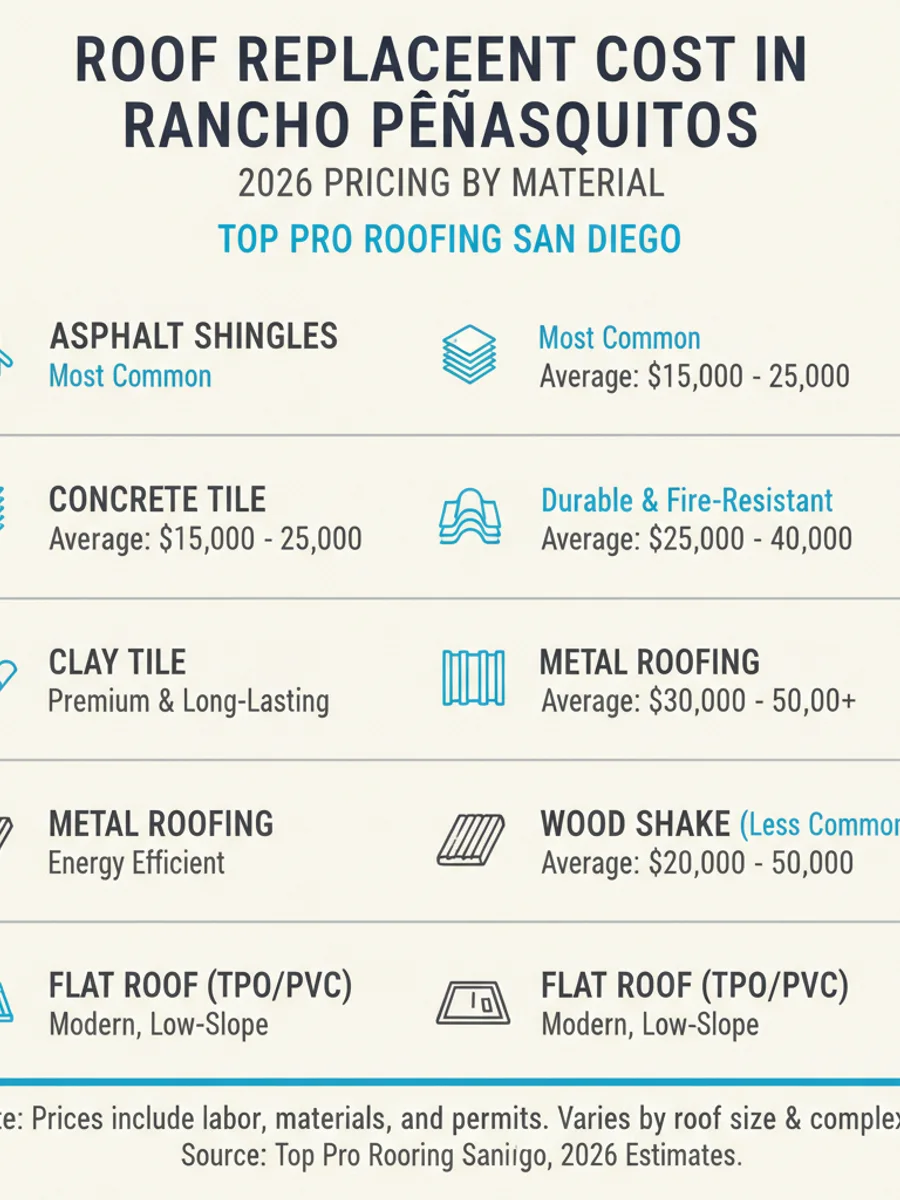
Concrete or clay tile lift-and-relay runs $10.00 to $18.00 per square foot, and it’s the most common scope across PQ proper, Sabre Springs, and Black Mountain Ranch. Architectural asphalt shingle runs $5.50 to $9.00 per square foot, common on the smaller tract homes closer to Park Village and Carmel Mountain Ranch. Standing seam metal, when a homeowner wants a longer-life material on a wildfire-zone property, runs $14.00 to $25.00 per square foot. Flat or low-slope TPO runs $8.00 to $12.00 per square foot on the occasional attached-housing section.
Overlay is rarely an option on tile roofs, and tear-off adds roughly $1.00 to $2.00 per square foot when it’s needed on shingle homes. A City of San Diego reroof permit for a PQ address typically runs $400 to $900, depending on scope and whether the wildfire-zone assembly requires additional review.
Why PQ tile is hitting the replacement window now
Most Rancho Peñasquitos tile went down in the 1980s and 90s, roughly a decade behind Rancho Bernardo’s first-generation stock but on the same trajectory. Underlayment runs 20 to 25 years before it fails, and that clock is up for a large share of PQ’s original tile now. The tile itself almost always salvages fine, which is why lift-and-relay, not full tile replacement, is the right scope for most homes here. We cover the mechanics of that process in tile roof lift-and-relay in San Diego.
Wildfire zone rules on the eastern and southern edges
Homes along PQ’s eastern and southern boundaries sit on the wildland-urban interface, where Class A fire-rated roof assemblies are required by code. That doesn’t necessarily mean a different roof material, but it does mean specific underlayment, fastener, and ventilation details that meet the assembly’s fire rating as tested. We handle Class A compliance documentation as part of the permit package for every home in these zones. For more on how San Diego’s wildfire rules affect material choice, see wildfire-resistant roofing materials in San Diego and San Diego fire code roof requirements for 2026.
Bigger lots, bigger roofs: how PQ sizing changes your bid
PQ’s large-lot single-family homes typically run 2,200 to 3,200 square feet, noticeably bigger than the 1,800 to 2,500 square foot homes common in tighter master-plan suburbs like Mira Mesa or Scripps Ranch. Since roofing is priced per square foot, that size difference shows up directly in the total. A PQ homeowner comparing notes with a friend in a smaller suburb should expect a meaningfully bigger number even at the same per-square-foot rate, simply because there’s more roof to cover.
Roof complexity tracks lot size here too. Larger PQ homes often carry more rooflines, valleys, and dormers than the compact tract layouts nearby, and each of those adds flashing and labor time beyond the base square footage number. When you’re comparing bids, ask each contractor to break out material cost from labor and complexity separately, so you can see what’s driving the difference.
Real bid examples from 2026 PQ reroofs
- Sabre Springs single-story home, 2,200 square feet of roof: tile lift-and-relay bids ran $22,000 to $39,600, with standard underlayment and flashing.
- Rancho Peñasquitos proper, larger two-story home on a wildfire-zone lot, 3,000 square feet of roof: tile lift-and-relay bids ran $30,000 to $54,000, with the Class A assembly upgrade pushing several projects toward the top of that range.
- Black Mountain Ranch tract home, 2,000 square feet of roof: architectural asphalt shingle tear-off bids ran $11,000 to $18,000, a common choice for homeowners on non-tile stock looking for a straightforward budget option.
Every figure includes tear-off or relay labor, underlayment, flashing, and the San Diego permit fee. Final numbers move with roof pitch, decking condition, and whether the property falls inside a Class A fire zone.
Homeowners near the eastern and southern PQ edges sometimes ask whether Class A compliance is optional if their existing roof wasn’t originally built to that standard. It isn’t. Any full reroof triggers current code, including the fire assembly rating for properties in the designated zone, regardless of what was on the roof before.
For comparison against nearby North County tile communities on a similar replacement timeline, see our cost guides for Rancho Bernardo and Poway. For county-wide pricing across every material, check the San Diego roof replacement cost guide.
When to call us
If your PQ roof is showing granule loss, cracked tile, or the first signs of a leak, don’t wait for a full failure. We’ll inspect the roof, confirm whether your property sits in a Class A fire zone, and walk you through material and pricing options that fit your home. Call us at (760) 750-5557 for a same-day estimate, or visit our Rancho Peñasquitos roof replacement page for details specific to your neighborhood.