TL;DR
- There is no single San Diego number. Life depends on membrane (TPO, PVC, EPDM, modified bitumen, BUR, coating, SPF), how it was installed, and whether water leaves the deck.
- San Diego’s mild climate (no freeze-thaw, little hail) is easier on membranes than freeze climates. Confirm current climate normals on NOAA’s published tables if you need a number. That is not a service-life promise.
- The biggest lifespan killer is ponding. Many manufacturer warranties treat water that sits more than about 48 hours as ponding. Standing water ages that bay faster than a draining field.
- Coastal lots add UV and salt on flashings. Inland mesas (Clairemont, Mira Mesa) often see longer membrane life when drainage works. We will not invent a shorter-on-the-coast table.
- Restoration (coating on a dry, attached membrane) can add years. Replacement is the honest talk when the deck or insulation is wet. Prices belong on a bid, not this page.
Top Pro Roofing SD is a referral marketplace. We connect San Diego County owners with CSLB-licensed roofers. We do not install membranes, we do not certify remaining life, and we do not publish per-square-foot rates. Call (760) 750-5557. You pay the contractor.
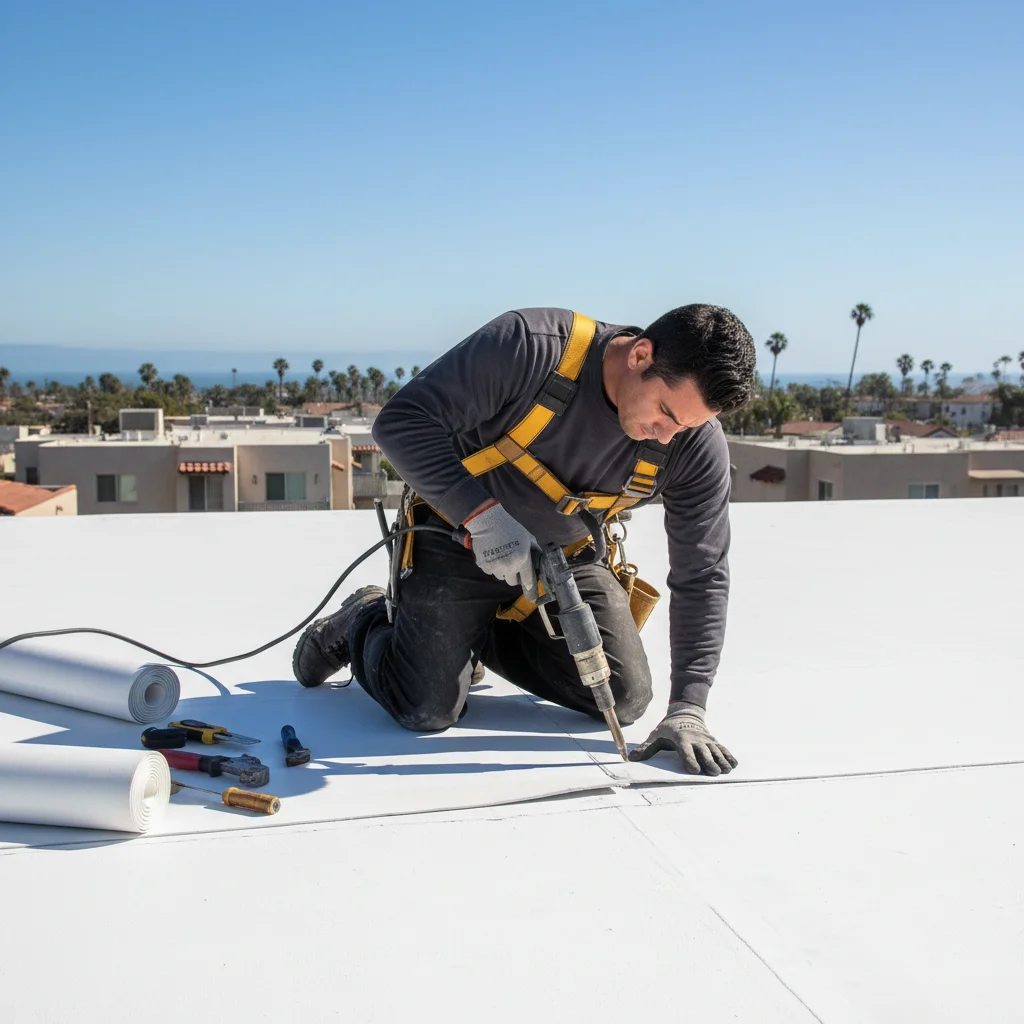
If you live in a mid-century home, an ADU, a commercial property, or a contemporary with a low-slope roof, the answer is different from a pitched shingle roof. Flat roofs are membrane systems. Lifespan depends on which membrane is up there, how it was welded or adhered, and whether water drains.
This page is the decision framework. It is not a manufacturer spec sheet and not a field study we ran. Ask the matched C-39 to name the product, the warranty term, and what they see on this deck.
How long does a flat roof last by membrane type?
Manufacturer ratings and warranties are not the same as years you will actually get. Warranties are prorated, conditioned on install, maintenance, and drainage. We will not reprint a fake “real-world San Diego” year column as if we measured it.
What to ask the bidder, by system:
| Membrane | What it is | Questions that change remaining life |
|---|---|---|
| TPO (thermoplastic polyolefin) | Heat-welded seams; often white or grey for cool-roof work | Common on new San Diego low-slope since the 2010s. Ask seam quality, thickness, and the California energy standards aged-reflectance if the reroof triggers a CEC cool-roof path. Do not treat the California energy standards as a default. Service: flat roof TPO. |
| PVC | Heat-welded thermoplastic | Ask whether rooftop grease or chemical exhaust is in play. PVC is often specified where TPO chemistry is a poor fit. |
| EPDM | Synthetic rubber, often black | Ask color vs the California energy standards for this address, slope, and permit path, and how they detail seams and flashings. |
| Modified bitumen (mod-bit) | Torch-down or self-adhered | Shorter warranty families than modern single-plies on many bids. Still common on 1990s-2000s San Diego add-ons. |
| BUR / tar-and-gravel | Original mid-century stack | Clairemont, Mira Mesa, Linda Vista still have recoated BUR. Ask how many layers are already up there. Ask the AHJ whether another overlay is even a path. |
| Silicone or acrylic coating | Restoration film, not a new deck | Ask dry cores first. Coating wet insulation traps water. Coating vs replacement. |
| Spray polyurethane foam (SPF) | Foam plus coating | Ask coating maintenance cycle and hail or foot-traffic plan. |
For replacement process without a rate card: flat roof replacement cost in San Diego.
California energy standards can require listed cool-roof products on qualifying low-slope replacements. Look up the CEC climate zone for this address. Do not treat typical San Diego steep-slope work as a cool-roof default. Confirm the listed product with the AHJ and the matched C-39. Cool Roof Rating Council.
What changes flat roof lifespan
In rough order of impact:
1. Ponding water (biggest factor)
A “flat” roof should still drain. Many codes and manufacturer details use a minimum slope on the order of 1/4 inch per foot so water leaves within about 48 hours. Confirm the requirement that applies to this permit. When ponding occurs, that bay fails first.
Causes:
- Inadequate slope at design. Common on 1960s-1980s San Diego mid-century homes.
- Sagging deck or insulation. Plywood or rigid insulation compresses or rots.
- Clogged drains and scuppers. Leaves, debris, bird nests.
- Settling. The drain pattern moves.
A roof with chronic ponding will fail at the pond long before the rest of the field. Diagnosis: flat roof ponding water.
2. UV exposure
UV breaks down membranes from the top. Black EPDM is more UV-hungry, which is why coatings exist. White TPO and PVC typically include UV stabilizers. Coastal San Diego UV plus salt on metal flashings is a harder environment than an inland mesa. That is a reason to inspect flashings, not a license to invent a year penalty.
3. Foot traffic and equipment loads
HVAC service, solar work, satellite installs, and building maintenance puncture, scuff, and compress the membrane. Walking pads at access points and around equipment are cheap insurance relative to a puncture. Ask the contractor to include them. We will not invent a pad price.
4. Penetration count
Every vent, drain, HVAC stand, skylight, and gas line is a leak point. More penetrations means more flashing. Simple mid-century flats with few penetrations often outlast busy commercial decks with equipment forests.
5. Original installation quality
A heat-welded TPO seam done right is as strong as the sheet. Under-welded, over-welded, or contaminated seams fail early. Installation quality matters more on single-ply than on a shingle field.
How San Diego microclimates affect the conversation
Do not treat the county as one climate.
- Coast (La Jolla, Coronado, within a few miles of the ocean). Salt on flashings and fasteners. UV. Ask stainless or other corrosion-rated metals, not only membrane brand. Coastal salt damage.
- Inland mesa (Clairemont, Mira Mesa, Linda Vista). Milder UV than the coast in many years, no freeze-thaw. Original BUR that was recoated can still be in service. Cores decide, not the decade the tract was built.
- North County inland (Carmel Valley, Poway). Heat cycling. Sealants and flashings move.
- East County (El Cajon, Santee, Alpine). Heat and UV. Ask product thickness and coating maintenance.
- Mountain (Julian, Palomar). Different load and weather. Do not reuse a Clairemont remaining-life story.
The restoration option
A silicone or acrylic coating on an existing flat roof can extend service life when the membrane is intact, ponding is under control, and cores are dry. It is not a new roof. It is a film on a roof that is still a roof.
When restoration is on the table:
- Existing membrane intact (no major punctures or open field seams)
- Ponding minimal or already corrected
- Substrate dry and structurally sound
- Age still in a range the manufacturer will coat
When it is not:
- Multiple punctures or active leaks
- Wet insulation (you will trap moisture)
- Major flashing or drain replacement needed
- Already stacked layers the AHJ or manufacturer will not recover
Full breakdown: roof coating vs replacement and silicone vs acrylic. We will not invent a coating or replacement band on this page.
Signs your flat roof is at end of life
Earlier warnings: chalking on TPO/PVC, surface cracking at seams, bubbling or fish-mouthing at edges, alligatoring on BUR.
Clear signals: ponding that stays wet for days after rain, visible patches and seam failures, membrane pulling at penetrations, more than one leak per rainy season.
Overdue: multiple active leaks, soft spots underfoot, membrane that cracks when stepped on, wet insulation or stained ceilings.
A flat roof on its original membrane with no recoats and a long leak history is a replacement conversation until cores say otherwise.
How flat roof compares to other San Diego options at replacement time
| Approach | What you are buying | Lifespan after |
|---|---|---|
| Silicone recoat (dry, attached membrane) | Restoration, not a new assembly | Ask the warranty term in writing |
| TPO, PVC, or EPDM replacement | New membrane and details | Ask manufacturer plus workmanship, separately |
| Convert flat to pitched | Rare, structural, expensive | Only when the chronic problem is the dead-level design itself |
We will not invent a 2,000-square-foot cost column. The matched C-39 prices the square, access, tear-off, and the California energy standards product.
What extends flat roof lifespan
- Twice-yearly roof inspection. Fall before rain, spring after. Catches ponding, debris, and small punctures.
- Walking pads where people actually walk.
- Annual drain and scupper cleanout.
- Coat when cores are dry and the manufacturer still allows it, rather than waiting for open seams.
- Fix ponding with slope or drains, not a thicker topcoat on a dead-level deck.
- Restrict HVAC traffic in heat, when membranes are softer.
Frequently asked questions
Is a flat roof really flat? No. Even a low-slope roof should have drainage slope. True dead-level roofs pond and fail early. Tapered insulation or a new slope build is the fix, not hope.
Why does my flat roof leak only after heavy rain? Ponding finally finding a weak seam, or rain volume exceeding drain capacity. Both are diagnosable. Ponding guide.
Can I walk on my flat roof to clean it? Yes, but minimize it and avoid hot afternoons. Smooth soles, not aggressive tread. Install walking pads if you have rooftop equipment.
Should I get TPO or EPDM? TPO is the common residential San Diego bid because it is often white (helpful for the California energy standards low-slope) and heat-welded. EPDM can be a long-lived rubber, but black sheets may not meet cool-roof numbers without a coating or a white EPDM product. That is a bid and code question, not a brand preference on this page.
My roof is 18 years old and has had three leaks repaired. Should I replace? Probably get a full inspection with moisture survey. Three leak repairs in that span is a tipping-point signal. If the substrate is sound, a coating might still be on the table. If it is not, replacement is the call. We will not invent a coating total.
Is roof coating a real long-term solution? Yes when the existing membrane is in shape and prep is honest. A sloppy coat on a wet substrate accelerates failure. Silicone vs acrylic.
Does insurance cover flat roof failure? Insurance covers damage from covered perils (wind, hail, sudden water intrusion). Age-related wear, ponding-driven failure, and deferred maintenance usually are not. Does homeowners insurance cover roof leaks in California.
My ADU has a flat roof. Does the same framework apply? Yes. Smaller roofs often have fewer penetrations, which helps, if they are maintained. They do not get a bonus year chart from this site.
Get a flat roof inspection
If the membrane is aged, an inspection tells you whether a recoat would buy time and what replacement would involve. We connect San Diego County homeowners with licensed local roofers who do low-slope work. Every contractor you hire should hold an active California classification you can verify on the CSLB license check. Call (760) 750-5557 or request a match. Ask that person for the fee, the report type, and whether they will core the roof before anyone names a product.