Concrete roof tiles may be reused during a reroof, but color from the street does not settle it. Changing roof tiles can mean a full new field, a partial swap, or a lift-and-relay that keeps accepted tiles over new underlayment. A licensed C-39 should document the tiles, the exposed assembly, matching stock, and product information before the scope is final.
What reuse means during lift-and-relay
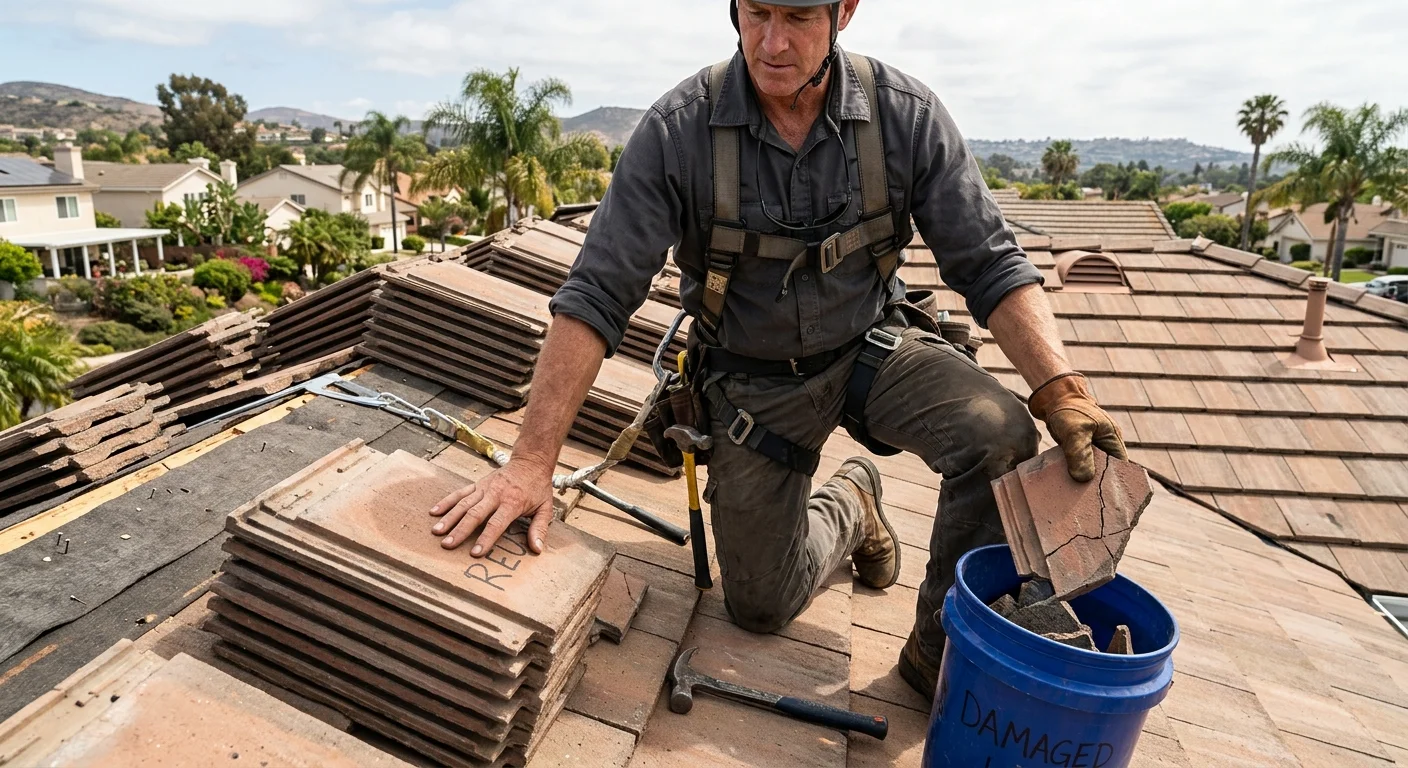
A tile roof lift and relay is a planned removal and reinstallation. The roofer lifts existing tiles, sorts them, reviews the exposed roof, and relays tiles accepted for reuse. Tiles that are not accepted need a separate plan in the written scope.
“Reuse” is not a promise about every tile. It describes one possible outcome for tiles that meet documented criteria. That decision can change when hidden areas become visible.
Ask the roofer to divide the tiles into clear categories:
- Accepted for reuse
- Rejected after inspection
- Held for another review
- Needed as matching replacement stock
The proposal should also explain removal, staging, storage, and final disposition. If tiles will sit on the driveway in Rancho Bernardo or a side yard in Oceanside, ask where and how they are protected. If rejected tiles leave the site, the scope should say who hauls them.
Don’t rely on a verbal reuse percentage without a method behind it. Ask whether the first figure comes from visible conditions, sample areas, or a count after lifting. The final paperwork should distinguish an early planning assumption from an observed quantity.
A lift-and-relay involves more than the visible surface. Review our guide to a tile roof lift and relay in San Diego before comparing proposals. For service routing, see our tile roofing referral page.
Top Pro Roofing SD doesn’t inspect, remove, or relay tiles. We connect homeowners with licensed, independent local roofing pros who assess the property and perform the contracted work.
How a roofer documents tile condition
Useful documentation connects each decision to a visible condition. Ask for dated photos, roof-area labels, and notes that explain why a tile was accepted or rejected. A broad statement such as “reuse existing tile” leaves too much unresolved.
The inspection record can separate what’s visible before lifting from what’s found afterward. Before work begins, the roofer may identify areas with obvious broken or missing tiles. After lifting, the record can be updated with findings that weren’t previously visible.
Ask the roofer to note:
- Which roof slopes or sections were reviewed
- Whether the finding applies to one tile or a larger area
- The condition that led to rejection
- Which tiles remain undecided
- How replacement quantities will be recorded
- Whether photos correspond to specific roof areas
A clear roof map helps when a home has several elevations. It also keeps detached garages, additions, patio roofs, or low-slope sections from being mixed into one vague description. The scope should state which structures and surfaces are included.
Don’t ask the roofer to judge tile condition from street-level color alone. Ask for the inspection method and written acceptance criteria. If two proposals reach different conclusions, compare the reasons and documentation behind them.
Confirm who made the inspection. California’s C-39 roofing classification covers work involving roof tile and other roofing materials. Homeowners can use the CSLB license lookup to review the license status of the independent roofer offering the work.
Keep the first report and the updated record together. The documents should show what changed after removal and why the final scope differs, if it does.
Where underlayment and flashing enter the decision
Tile reuse and roof-assembly work are separate decisions. A proposal can call for relaying accepted tiles while also addressing underlayment, flashing, sheathing, or other exposed components. Don’t let the tile discussion replace a full written scope.
On inland tile in Escondido, Poway, and Rancho Santa Fe, the waterproofing is usually the underlayment, not the tile face. Reusing sound tile over failed felt is not a reroof. It’s a delay. Ask the roofer to identify each assembly item separately: valleys, edges, penetrations, and transitions.
Avoid language such as “repair as needed” without a decision process. Ask what finding would trigger added work, how it will be documented, and when you’ll approve a change. This keeps tile reuse from becoming a blanket explanation for unrelated work.
Permit questions depend on the property’s jurisdiction. For City of San Diego parcels, read the current Information Bulletin 123. Ask the AHJ whether this covering renewal, including reused tile, needs a permit. Do not treat a blog summary as the exemption list.
Those City of San Diego rules don’t automatically govern every county address. Oceanside, Chula Vista, El Cajon, and unincorporated San Diego County may follow their own review processes. Ask the roofer to name the jurisdiction for your property and confirm the current permit path with that authority.
If the project moves beyond relaying accepted tiles, compare the revised work with the scope of roof replacement and reroofing. The contract should make that boundary clear before added work begins.
How matching stock affects the written scope
A reuse plan needs an answer for tiles that aren’t returned to the roof. Matching stock may come from tiles already set aside, owner-held material, or another source identified by the roofer. The proposal shouldn’t assume matching replacements will appear later.
Older San Diego concrete profiles go out of production. A close color from a current line can still read as a patch on a south elevation. Ask the contractor to document the characteristics used for matching: profile, dimensions, edge shape, attachment details, surface appearance, and any visible product markings.
The written scope should answer several practical questions:
- Who is responsible for locating replacement tiles?
- When will a sample be presented for approval?
- What happens if an acceptable match isn’t available?
- Will visible differences require a revised layout?
- Does substituted material change another part of the scope?
- Who documents the final tile count and placement?
Don’t let “match existing” stand alone. Ask whether that phrase means physical fit, visual similarity, a documented product match, or all three. If appearance matters because of an HOA or design review, confirm that process with the organization responsible for approval. No HOA rule for this project could be confirmed from the approved source set for this page.
Concrete and clay roof tiles shouldn’t be treated as a single product description. If you’re sorting out those two categories, read our concrete versus clay tile comparison. Then ask the roofer to identify the existing material in the project documents.
Any fallback plan belongs in the signed scope. It should describe the next decision without promising an unsupported reuse rate, price, product availability, or visual result.
What product documents can confirm
Product documents help turn a general reuse discussion into a product-specific review. Start with any visible name, model, profile, or marking documented by the roofer. Ask for photographs of those identifiers and copies of the materials used to support the proposed installation.
Current manufacturer documents may address product identification, installation details, compatible accessories, fastening methods, and roof-assembly requirements. The roofer should point to the exact document and section being applied. A brochure for a similar-looking tile isn’t a substitute for identifying the existing product.
No product-specific rule for reusing the tiles on your home could be confirmed from the approved source set for this page. The same is true for product-specific warranty coverage. Ask the manufacturer or its authorized representative for a written answer tied to the identified product. Don’t assume that an old warranty, a current brochure, or a contractor’s general statement applies.
Keep these items with the proposal:
- Photographs of visible product markings
- The manufacturer and product name, if confirmed
- The document version or publication date
- Written answers received from the manufacturer
- The roofer’s explanation of how the document affects the scope
- Any unresolved product question
Fire classification may also require project-specific review. Ask the AHJ whether this reused-tile assembly needs a listed Class A covering in a Wildland-Urban Interface area. An unidentified existing tile shouldn’t be treated as proof of the complete roof assembly’s status.
The strongest reuse proposal connects observed tile condition, matching stock, exposed assembly findings, product documents, and jurisdictional review. If one piece remains unknown, the paperwork should say so plainly and identify who can confirm it.
When to call us
Call when a concrete tile roof needs documented inspection, lift-and-relay planning, or a reroof scope from a licensed roofing professional. Call us at (760) 750-5557 and we’ll connect you with a licensed local roofer.