A San Diego flat roof replacement bid is a stack of line items, not a county rate we can print. Membrane type, tear-off versus recover, insulation and slope correction, drains, parapets, coastal metals, and whether Title 24 applies all move the number. We will not invent per-square-foot tables or fake job totals.
Top Pro Roofing SD is a referral service. We connect homeowners and small commercial owners with licensed local roofers. We do not install, we do not hold a C-39, and we do not certify roofs. Call (760) 750-5557. Ask the matched contractor to walk this roof and write what comes off, what goes down, and which product they will register.
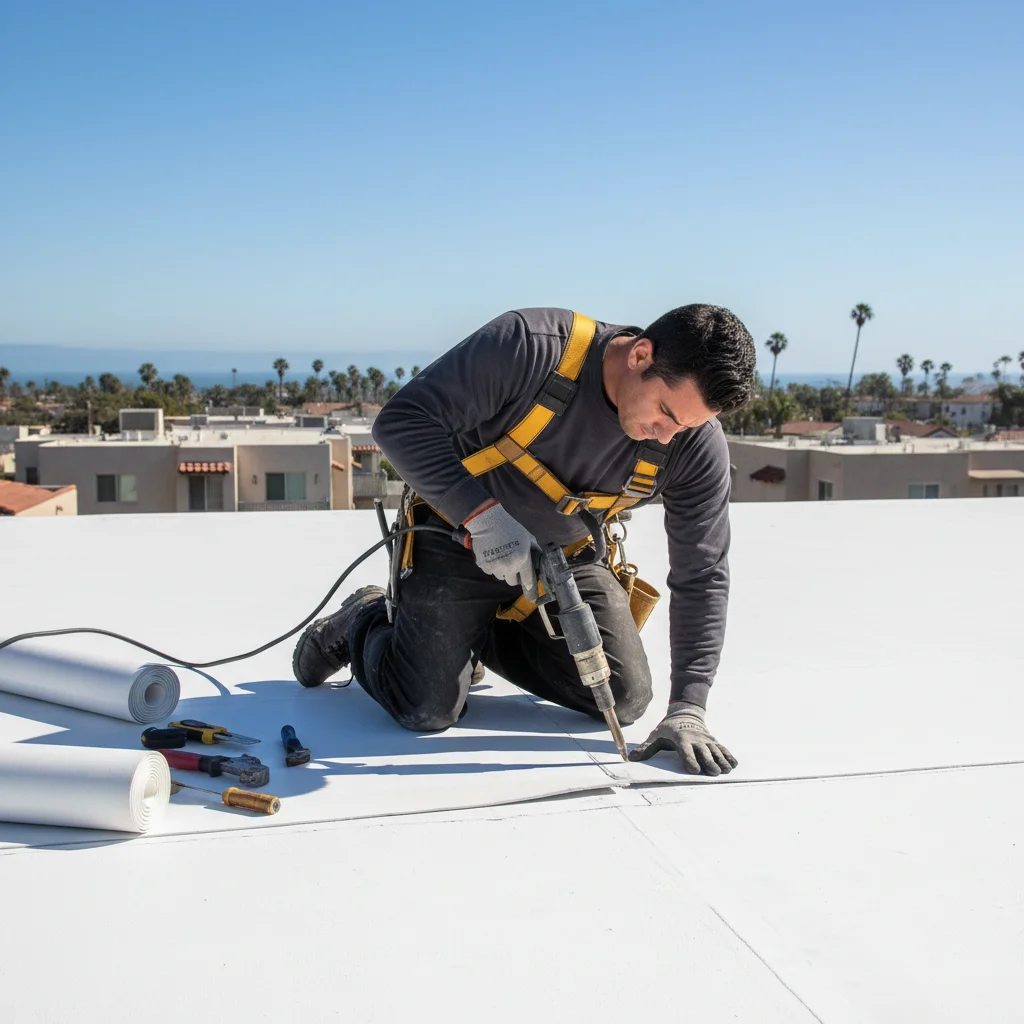
San Diego flat roofs have a few quirks national cost guides miss. Title 24 can require listed cool-roof products on qualifying low-slope replacements. Coastal salt eats fasteners and unprotected metal flashings in Ocean Beach, Imperial Beach, and La Jolla. Older flat-roof neighborhoods like North Park, Hillcrest, South Park, and University Heights often hide undersized internal drains and tar-and-gravel over tired decking. All of that changes the real bid. Confirm cool-roof rules with the AHJ: cool roof Title 24 in San Diego.
Flat roof materials: compare systems, not a blended average
The membrane choice is a large share of the project. Labor, insulation, and tear-off make up the rest. Use the table to make three bids describe the same job. Do not treat it as a price list.
| Material | What it is | Where it often fits |
|---|---|---|
| Modified bitumen (torch-down or self-adhered) | Asphalt-based, often granulated cap | Tight geometries, parapet-heavy bungalows, like-for-like on older asphalt |
| Built-up roof (BUR, tar and gravel) | Multi-ply asphalt with gravel | Historic look-alike; many replacements leave BUR rather than redo it |
| EPDM (rubber membrane) | Single-ply, taped or glued seams | Shaded residential flats and some ADUs, if the listed color meets energy rules |
| TPO (single-ply, heat-welded) | White thermoplastic, welded seams | Common residential and small commercial choice when the crew actually welds |
| PVC (single-ply, chemical-resistant) | Thermoplastic, grease and chemical resistance | Kitchens, grease exhaust, some salt-exposed coastal work |
TPO is the default on many San Diego replacements because a listed white membrane can satisfy cool-roof reflectance without a separate coating, and heat-welded seams hold up under UV when they are actually welded. Ask mil thickness, insulation, and whether the installer can register the manufacturer warranty they described.
Modified bitumen is still common on older bungalow roofs in North Park, City Heights, and Logan Heights. It is familiar on parapet flashings and odd transitions. Dark cap sheets often need a listed reflective coating to meet cool-roof rules when the job is in scope. Ask whether that coating is in the bid.
EPDM can look cheaper in other markets. Local supply and Title 24 on dark membranes change that. Black EPDM typically fails cool-roof reflectance unless you spec a listed white version. Ask which color is on the proposal.
PVC costs more up front on most quotes because of the sheet, not because we published a premium. It resists grease, chemicals, and some coastal exposures better than TPO. It is the right conversation for restaurants, taquerias with rooftop hood vents, and oceanfront buildings where grease or salt is the actual problem.
BUR is the old tar-and-gravel system. Tear-off is messy, insulation values on old assemblies are often low, and the dead weight stresses tired decking. A few historic-district homes still get BUR to preserve the look. Ask the AHJ and any historical reviewer before you assume a membrane swap is allowed.
Membrane comparison in more depth: TPO vs. modified bitumen, EPDM roofing San Diego, TPO installation. Service pages: /services/flat-roof-tpo/ and /services/commercial-roofing/.
Size is not a linear price
Residential flats here often sit between a small addition and a few thousand square feet. Commercial decks run larger. Mobilization, tear-off setup, and dump fees do not scale down on a tiny garage or ADU, so a small job can look expensive per square foot even when the membrane is ordinary. Compare bids on measured squares, not on a neighbor’s total.
Those bids should assume a stated layer count, a named insulation, and whether decking repair is included or excluded. Overlay versus tear-off is not a preference when the code or the deck says otherwise.
What pushes the bid up
Material is only half. The other half is what the crew finds once the old roof is off.
Tear-off vs. overlay. California often limits how many roof layers you can recover. If the existing flat roof already has the maximum layers, tear-off is mandatory, not optional. Confirm with the AHJ and the contractor. On older San Diego homes with hidden tar-and-gravel under later modified bitumen, the layer count surprises owners. Overlay only belongs when the deck is sound and the layer count is legal.
Decking repair. Soft or rotten plywood is a separate line. On flats with chronic ponding, expect at least some sheets to be in play. Ask whether decking is included, unit-priced, or a change-order risk.
Insulation and slope. Adding polyiso is now common practice on permitted replacements, and it matters for energy compliance and comfort. Older flats often have little or no insulation. Tapered insulation is how you rebuild slope toward drains when the 2x6 rafters in North Park have sagged. Ponding context: flat roof ponding water.
Drain work. Internal drains, scuppers, and overflows often need work with the membrane. Cast-iron drain lines on older buildings can be their own plumbing conversation. Adding an overflow to meet current code is a separate item. Coating around a crushed sump does not count as drain work.
Parapet walls. Parapet flashings are the most common leak point on many flats. A proper replacement re-flashes the parapet with new metal cap and counterflashing. Linear footage of parapet can rival the field on a small bungalow. Ask for that footage on the bid.
Title 24 cool-roof compliance. Qualifying low-slope replacements need a listed product with published aged reflectance and emittance for your climate zone and slope. White TPO and PVC often clear that bar natively when the SKU is listed. Modified bitumen and dark EPDM often need a listed coating. We will not invent SRI cutoffs. The contractor pulling the permit should cite the product ID. The AHJ accepts it or not.
Permits and inspection. Ask the AHJ whether this full replacement needs a permit. We will not invent fee tables. Confirm with City of San Diego Development Services or County PDS. Jurisdiction extras: roofing permits by city. If a roofer offers to skip the permit to save money, walk away. Unpermitted work creates resale and insurance problems.
San Diego factors national guides skip
Coastal corrosion. Within a short distance of the ocean (Ocean Beach, Pacific Beach, La Jolla, Imperial Beach, Coronado, Del Mar), salt accelerates failure on uncoated steel flashings, fasteners, and drip edges. Stainless or specified coastal metals and fasteners belong in the spec. Ask whether the inland bid actually includes them.
Ponding in bungalow neighborhoods. North Park, Hillcrest, South Park, and University Heights have a lot of 1920s and 1930s stock with built-up roofs over rafters that have sagged. Those roofs pond after rain. Tapered insulation treats the cause. New membrane over a known pond without slope work is a short roof.
Marine layer. Coastal flats sit damp under morning marine layer. That favors algae, mildew, and seam-tape problems on older single-ply. Ask how the proposed system handles daily wet/dry cycling, not only a desert UV story.
HVAC and solar on the roof. Packaged units, condensers, and inverters add labor, protection, and sometimes crane time. Get that coordination in writing, including who lifts equipment and who is responsible if a curb leaks after.
Climate zones. San Diego County spans more than one CEC climate zone. Cool-roof packages can differ. Look up the address. Do not guess from a blog.
How long each system lasts
Manufacturer warranty maximums are not the same as service life on a coastal or ponding roof. We will not publish a fake San Diego lifespan table. Ask for the product’s warranty PDF, what voids it (ponding is a common exclusion), and what maintenance the issuer requires. Clean drains, a walk path that does not puncture the sheet, and fast repair of punctures keep any membrane at the long end of its range. Maintenance cadence: annual roof maintenance.
When to replace instead of repair
A young roof with one or two leak points is usually a repair conversation. A roof with multiple leaks, ponding, alligatoring, membrane shrinkage, soft spots underfoot, or staining in several rooms is usually a replacement candidate. Insurance non-renewal over roof condition is its own trigger. Selling soon can still be a repair if the buyer and carrier will accept it. That is their call, not ours.
| Situation | Typical direction |
|---|---|
| Roof under 10 years, isolated leak | Repair |
| Mid-age, single leak, no ponding | Repair, and ask what else they saw |
| Multiple leaks or ponding | Replacement conversation |
| Visible alligatoring or shrinkage | Replacement conversation |
| Soft spots underfoot | Open it: deck and insulation may be wet |
| Interior staining in multiple rooms | Replacement conversation |
| Carrier flagged the roof | Replacement or documented repairs they will accept |
| Selling soon | Repair if the recipient accepts it; replace if they demand a new system |
Repair pricing without fake totals: flat roof repair cost. Repair vs replace: roof repair vs replace.
Permits and inspections
Inspections typically check underlayment or insulation, the cool-roof product label, flashings at penetrations and parapets, and the finished membrane. The contractor should call each stage. Keep the permit number on the final invoice and check it against the city’s lookup. County vs City process: roof permit process.
How to vet a flat-roof installer
Flat work is a different skill set from pitched shingle work. A crew that nails shingles all day may never have welded a TPO seam. Before anyone starts, ask:
- Which manufacturer certifications do you hold, and can you register the warranty on this product? TPO and PVC makers (examples homeowners hear: GAF EverGuard, Carlisle, Johns Manville, IB) certify installers on their own programs. This site does not certify those tiers. Ask for current proof from the manufacturer, not a blog badge.
- Show a flat roof you finished years ago. Seams, parapets, and drains tell the truth later. Day-one photos do not.
- How will you handle Title 24 and the permit? If they cannot name the listed product and the AHJ, they should not be doing a permitted California flat.
- What is manufacturer-backed versus contractor-backed? A contractor warranty is only as good as that company staying in business. Read both PDFs.
- CSLB license number and classification. Roofing needs a C-39. Verify at the CSLB license check.
- Workers’ comp and general liability. Ask for current certificates. A contractor without workers’ comp can leave you exposed if someone falls.
Vetting walkthrough: how to choose a roofing contractor.
Get connected with a licensed flat-roof installer
We connect San Diego homeowners and small commercial owners with licensed local roofers who actually weld and flash low-slope work. We do not inspect the roof, we do not certify remaining life, and we do not set prices. Call (760) 750-5557 or use the contact form. You contract with that roofer. Verify the license yourself.
Commercial scale notes: Chula Vista commercial TPO. County replacement overview: San Diego roof replacement cost guide.
Flat roof replacement FAQ
What is the cheapest flat roof material? Modified bitumen is often the lowest membrane line on a like-for-like residential bid, especially when the geometry is awkward. It still has to meet the permit and cool-roof path, which can mean a listed coating. Lifespan and ponding tolerance are the tradeoff. Compare written scopes, not a blog rank.
What is the best flat roof material for the San Diego coast? PVC is the usual conversation within salt spray and grease exhaust. TPO is the usual conversation elsewhere in the coastal zone when the installer welds and the SKU is listed. Both reflect heat when they are the right color and listing. Neither is a certified “best” from this site.
Is it cheaper to overlay or fully tear off? Overlay can cost less if the existing roof has a legal layer count and the deck is sound. Tear-off is mandatory when layers are already at the limit or the deck is rotten. On old ponding roofs, tear-off is usually how you find the damage.
Do flat roofs leak more than pitched roofs? They leak more when slope, drains, and parapets are wrong. A well-drained, well-flashed welded membrane is not automatically a leak machine. Installation quality and flashings, not the word “flat,” are the usual problem.
Are there SDG&E rebates for cool-roof replacements? Rebate programs change and run out. Confirm current amounts and product lists at quote time with SDG&E and the listed product’s paperwork. Look for Cool Roof Rating Council documentation when the program asks for it. Overview: cool roof rebates SDG&E.
What warranty should I expect? Whatever the manufacturer PDF and the contractor PDF actually say for that product, mil, and installer status. We will not invent year counts. Anything described as “NDL” or “system” should be the document, not a verbal.
For broader replacement context, see the San Diego roof replacement cost guide.