Start with the CSLB record, then ask for Oceanside addresses in your ZIP (92054, 92056, 92057, or 92058). Coastal jobs west of I-5 and inland jobs east of College Boulevard are different climates. Get more than one written quote. The Contractors State License Board publishes current home-improvement contract deposit rules. Read the live CSLB and LegInfo text. This page will not restate the cap. Read the current live text. This page will not restate the dollar cap. Top Pro Roofing SD is a referral service. We do not hold a C-39 license or send a crew. Call (760) 750-5557.
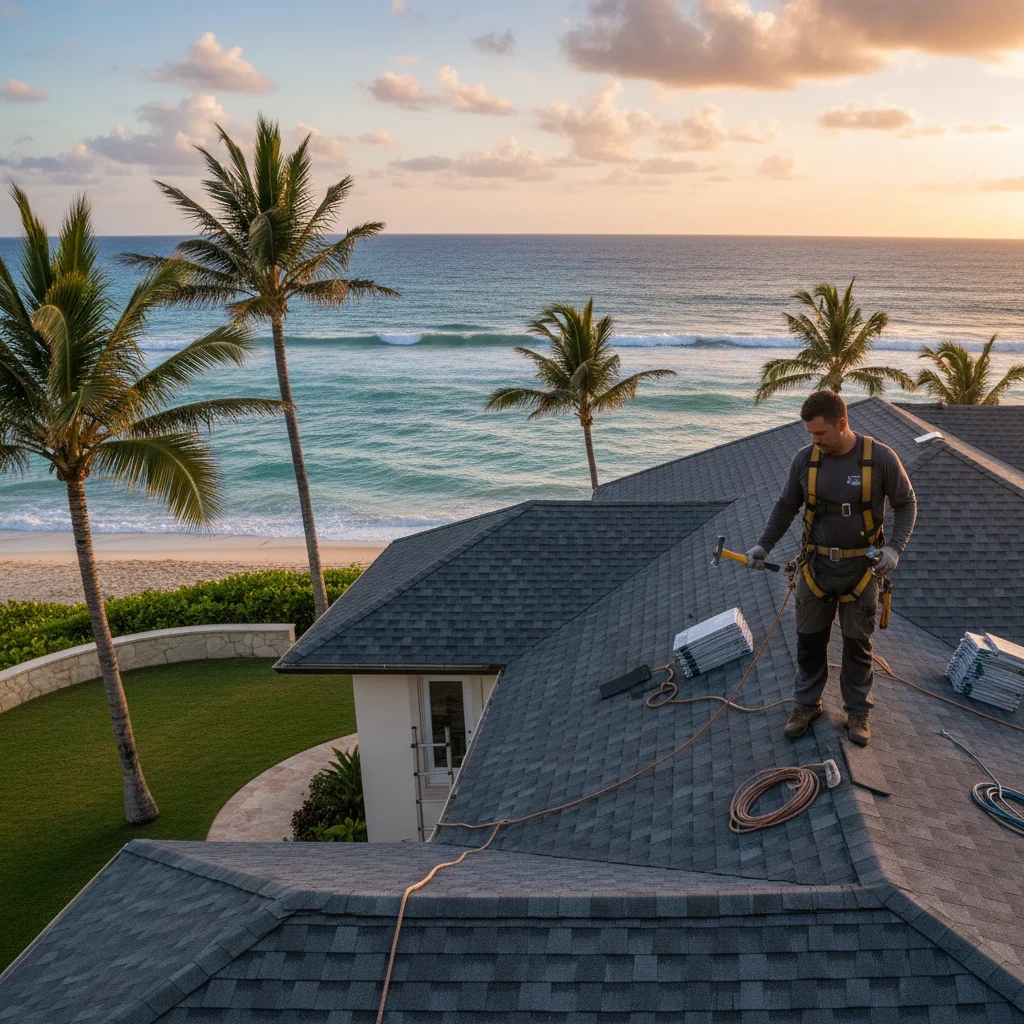
Why Oceanside roofs face a coastal-meets-inland challenge
Oceanside is not one climate. West of Interstate 5 (92054 and the western edge of 92058) you get salt spray, dense morning fog, and metal that fails faster than the same flashing inland. East of College Boulevard, in Rancho del Oro, Henie Hills, Whelan Ranch, and Pacific Ridge, afternoons run hotter and drier, with Santa Ana events and stronger UV on asphalt.
That gradient is why a contractor list for “Oceanside” is not enough. A crew that mostly nails inland tract shingle may not specify stainless or copper flashing on a Pacific Street tear-off. A coastal specialist may overbuild an inland job. The right question is which side of I-5 the house sits on, and whether the written spec matches it.
National “best roofers near me” lists treat the city as one market. A company that covers all of North County may still be the wrong fastener spec 800 feet from the harbor.
Background: coastal roof salt damage and 50-year shingles vs metal.
The Oceanside vetting checklist
Run every bidder through this list yourself. This referral brand does not certify manufacturer programs, job counts, or 90-day re-checks.
| Check | What to look for | Why it matters in Oceanside |
|---|---|---|
| CSLB license | Active C-39, or a B if they are legally taking the job, matching the proposal name. CSLB license check. | C-39 is the roofing classification. Confirm the number on the truck matches the legal name. |
| Workers’ comp and general liability | Comp on the CSLB record plus a Certificate of Insurance emailed by the broker. | A lapse on a steep coastal slope can land on the homeowner. |
| Oceanside job history | Completed addresses in your ZIP, same roof type, recent enough to drive by. | One Vista portfolio does not prove salt-fog flashing habits in South O. |
| Complaint history | CSLB disclosures, recent Google or BBB complaints, how they answered. | Letter grades and paid badges are marketing. |
| Written, itemized quote | Brand and grade, underlayment, flashing metal, labor, tear-off, permit, dump fees. | A one-line reroof total is how change orders start. |
| Local references | Oceanside owners you can actually call, ideally near your street. | An Encinitas reference does not prove a harbor-side tear-off. |
Missing two or more of these is a warning. County-wide questions: how to choose a roofing contractor in San Diego.
Red flags specific to North County coastal
Oceanside has frequent household turnover near Camp Pendleton, a coast that takes Pacific storms, and a lot of 25- to 40-year-old roofs at once. That mix draws door-knock crews.
| Red flag | Where it shows up | What’s actually happening |
|---|---|---|
| Door-knocker after a storm | West of I-5 the next morning | Out-of-area crews with no local warranty path |
| ”Free roof if we run the insurance claim” | 92057 and 92058 near the base | You can lose control of the claim. Read any assignment before you sign. |
| Deposit over the legal cap | Any neighborhood | CSLB home-improvement contract deposit rules. Read the current live CSLB and LegInfo text. This page will not restate the dollar cap. |
| Quote far below the others | Anywhere | Often missing insurance, off-brand materials, or a skipped permit |
| No physical address | P.O. box, or a local number that rings out of state | Hard to find if the job fails six months later |
| Today-only pricing | In-home pitch | A real written bid should survive a second quote |
| Vague material specs | ”Premium architectural shingles” with no brand | You get whatever is cheapest the morning of install |
Take the card, send them away, look them up on CSLB, then decide whether to call back.
Questions to ask before you sign
- What is your CSLB number, and is it C-39 active for this proposal?
- Who is on the roof: your employees or a named subcontractor?
- What underlayment product, and why that one for this ZIP? “15-pound felt” is not a coastal answer by itself.
- What flashing metal: galvanized, painted steel, copper, or stainless? Ask them to put it on the page.
- Who pulls the City of Oceanside permit? Owner-builder permits move liability to you.
- What is in writing for workmanship versus manufacturer material terms?
- If tear-off finds rotten decking, how is that documented and priced before they continue?
- Can I call recent Oceanside customers? Then call them.
Defensiveness on any of these is an answer.
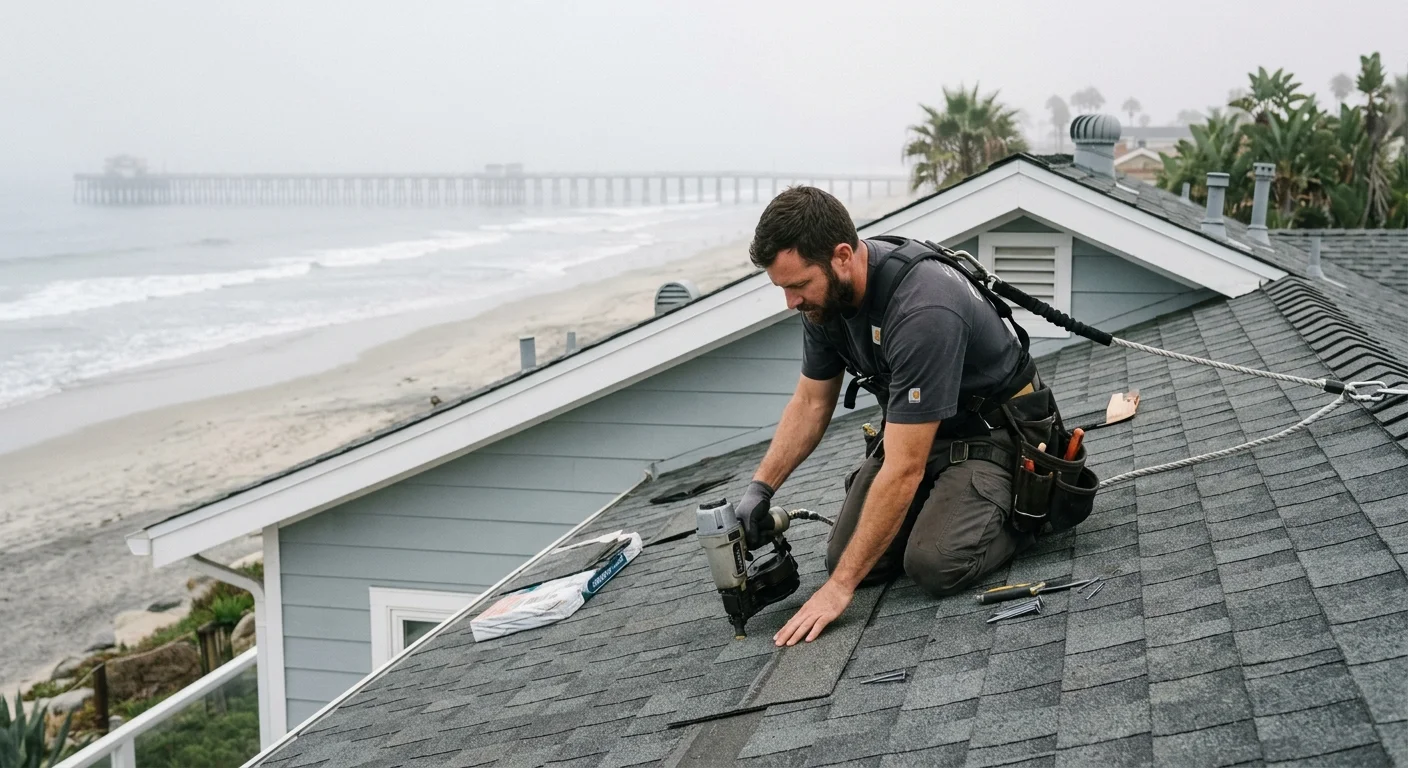
Do not compare Oceanside neighborhoods as a price list
A 2,000 sq ft tile reroof in Fire Mountain is not the same job as Whelan Ranch. Salt-air flashing, tree litter, HOA review, two-story pitch, and river-valley humidity all move a bid. We will not publish neighborhood dollar tables. Use Oceanside roof replacement cost as a line-item checklist, then make bidders price the same written scope.
South Oceanside and Fire Mountain (92054) need an explicit coastal metal spec. Henie Hills, Whelan Ranch, and Pacific Ridge (92056) often add HOA design review. Rancho del Oro (92057) two-story pitches change labor. San Luis Rey and Mission (92058) stay damper. Ask each bidder how those facts show up on your house, not as a ZIP surcharge they cannot explain.
Tile vs shingle in Oceanside
Post-1985 tracts often specified concrete tile for HOA look. Older streets mix shingle. Tile is heavier than asphalt. Switching shingle-to-tile can require structural review. Tile-to-shingle changes look, HOA approval, and load. Do not take a salesperson’s year-count as a lifespan. Ask for manufacturer documents. Related: concrete vs clay tile and best shingles for the SD climate.
Coastal Development Permit zones in West Oceanside
If the home sits in the Coastal Zone, confirm the current rule with the City of Oceanside Planning Division and, if needed, the California Coastal Commission. Read the current live text. This page will not restate which like-for-like reroofs stay on a city building permit or which profile changes trigger extra review. Solar has its own state exemptions; still verify before install.
A contractor who has never flagged a Coastal Zone address west of Coast Highway is guessing. Maps and appealable-area questions belong with the city, not with this page.
How this referral service fits
We match Oceanside homeowners with licensed independent roofers. We do not install roofs, pull permits, or issue warranties. You still run CSLB, read the COI, and compare scopes. When you call (760) 750-5557, have the ZIP, roof type, and whether the job is leak, repair, or replacement. Service pages: roof repair, roof replacement, Oceanside hub, contact.
FAQs
How many quotes should I get for an Oceanside roof?
More than one written quote on the same scope. Two thin specs can agree and still be wrong. Do not pick the low number if flashing metal and underlayment are unnamed.
What insurance should an Oceanside roofer carry beyond CSLB?
Look up workers’ compensation and general liability on the live CSLB record and on a certificate emailed by the broker. CSLB administers the current workers’ compensation filing rules for licensed contractors. Read the live CSLB and LegInfo text rather than this page. Read the current live text. Do not take this page as a restated C-39 workers’ compensation duty. An active license is not proof the policy is in force today.
What’s the best roofing material for the Oceanside coast?
Keep the system the structure and HOA already require unless engineering and the city agree to a change. West of I-5, named stainless or copper flashing and a named high-grade underlayment matter more than a brand slogan. Avoid treating “galvanized” as coastal-grade without a product sheet.
Do I need a Coastal Development Permit to replace my roof?
Often no for like-for-like, and sometimes yes if height or appearance changes. Confirm with the city and read the current live Coastal Commission and Oceanside Planning text. This page will not restate exemption classes.
What’s the legal cap on a roofer’s deposit in California?
The Contractors State License Board publishes current home-improvement contract deposit rules. Read the live CSLB and LegInfo text. This page will not restate the cap. Read the current live text. This page will not restate the dollar cap. Walk away from a larger ask than that live text allows. You can report it to CSLB.
How do I find a roofer near Camp Pendleton without getting scammed?
Never hire a door-knocker. Verify C-39 before talking price. Ask for references on your street, including other military families if that is your neighborhood. A pitch that “handles the claim for you” is not a substitute for a license and a written scope.
Ready to find a licensed Oceanside-area roofer?
Call (760) 750-5557 or use the contact form. You still complete the checklist on this page. We match. We do not warrant the job.