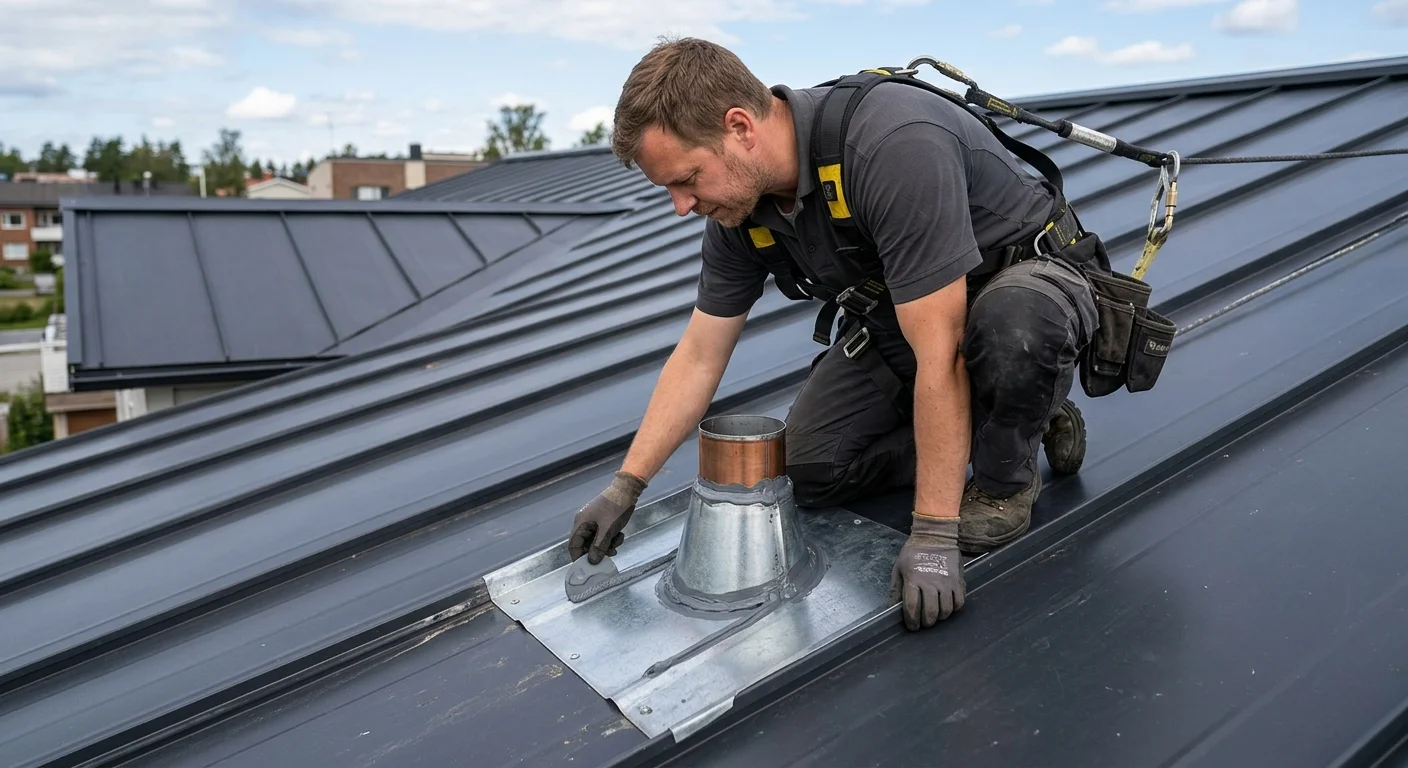
A cracked bead of metal roof sealant around a Vista pipe boot looks like a small touch-up. From the driveway, that joint is often the only failure you can see. On standing-seam and exposed-fastener roofs, the opening can be a symptom of movement, a loose fastener, or flashing that already let water travel.
What changed sealant can and can’t prove
Metal roof sealant is the compound at joints a panel can’t close by itself. You’ll see it at pipe boots, screw heads, sidewall laps, skylight curbs, and some ridge and eave trim. On exposed-fastener roofs in Oceanside and Escondido, it often sits on every washer. On standing-seam roofs in Rancho Santa Fe or La Jolla, it may show only at penetrations.
A changed bead is still information. Cracked, shrunk, or pulled-away material means that joint is no longer closed. Salt film along Imperial Beach and Ocean Beach can stain and dry the surface. Inland heat in El Cajon and Ramona moves metal more than the marine layer does on the coast. None of that names a product. It names a condition.
The opening is real. Sun and movement have acted on that joint. Water could enter there in wind-driven rain. A stain below that detail is worth mapping. What the change can’t prove is the whole leak path. It can’t pick the right sealant from a photo. It also can’t tell rain entry from attic moisture. Coastal homes sit in marine layer. Inland houses run hotter attics. Both can leave marks that look like a leak.
If you already know when a bead of roofing sealant isn’t the right repair, treat this as the metal-system version of that caution. Recaulking a boot on bent flashing isn’t a repair. California’s C-39 classification covers metal roofing systems, not only shingles. The licensed pro should read the whole metal system, not only the caulk line.
Why the visible opening may not be the source
Water on metal doesn’t fall in a straight line. It runs the pan, the lap, and the underside of a panel. A stain in a Mission Valley hallway can start at a ridge in the next bay. A wet spot under a Chula Vista skylight can enter at a curb corner, then travel before it drips.
Exposed-fastener roofs add another trick. A washer can back out two rows uphill of the drip you see. The bead you noticed may be the one that dried and cracked in the sun. The open fastener may still be wet after a storm. Standing-seam roofs hide factory tape and clips under the rib. You can’t see those from the yard.
Wind off the Pacific at Ocean Beach and Coronado can drive rain into a trim joint that looks closed on a calm day. NOAA’s 1991-2020 normal at San Diego International Airport is 9.79 inches a year. That number is Lindbergh Field. Coastal strips, inland valleys, and mountain edges don’t share one rainfall story.
Interior moisture complicates the picture. Warm indoor air against a cool metal underside can leave water that never came through a hole. That’s not a coating problem, and it’s not a job for a hardware-store tube. A licensed roofer maps exterior openings against interior marks. If they don’t line up, the cracked sealant you found may not be the source.
Don’t treat the first open joint as the leak. Ask the pro to say where water could run after it enters. Ask what they’ll open, and what they’ll leave alone.
How roofers examine surrounding metal details
A careful metal roof repair starts with the whole system, not the tube. California’s C-39 roofing classification covers metal roofing systems along with other weatherproofing work. The independent pro you match with should look past the failed bead.
Typical review points sit next to the sealant, not under it. Fastener rows and washer seats. Panel laps and panels that look wavy from movement. Sidewall and chimney flashing. Pipe boots and other penetrations. Ridge and hip caps. Eave trim and drip edge details that belong in a written metal-roof proposal. Solar standoffs and conduit boots, common from Clairemont to Carlsbad. Surface rust is a clue about water and coating wear. It isn’t, by itself, a replacement verdict.
The pro should also see the interior when you can show it. Ceiling marks, damp insulation, and the line of a truss can show travel. Some inspectors use thermal cameras. Those photos are a tool, not a verdict. Cracked caulk plus a stain is still a guess until the path is traced.
You shouldn’t get a ladder-side recaulk with no notes. You also shouldn’t get a pitch for a waterproof coating as the answer to one open joint. A field coating is a different decision from metal roof sealant at a detail. Title 24 cool-roof rules can apply when a covering is replaced in Climate Zone 7. A bead of sealant is not a covering replacement.
If you’re comparing a future metal roofing system, treat the sealant you see now as an inspection issue on the roof you have.
When broader flashing review may be needed
One failed bead at one boot can stay a small repair. Several failed beads in a line usually won’t. If sealant has opened at a sidewall, the peaked flashing behind a chimney, and a pipe in the same drainage path, the flashing itself is under review.
Ask for a wider look when failed beads stack up with bent flashing, fasteners walking out, panels that have crept at the eave, stains that persist after recaulk, or a cluster of solar penetrations and skylights.
That wider look is flashing, vent, and pipe-boot repair, not a shopping trip for roofing sealant. The pro may still use sealant as one material in a flashing rebuild. The written job should say so. It shouldn’t hide a flashing replacement behind a caulk line.
In the City of San Diego, Information Bulletin 123 sets when roof-covering renewal needs a building permit, including structural framing, sheathing, heavier coverings, and historic resources. Some like-for-like covering renewals on single-family homes, duplexes, and townhouses can be exempt. Unincorporated county rules were not confirmed from a primary source for this page, so confirm with the building department that has your address. A sealant-only detail isn’t automatically a reroof. If the scope grows into panels or decking, ask before work starts.
In designated Wildland-Urban Interface areas, California Building Code Chapter 7A requires a Class A covering when more than half the roof is replaced in a year. Metal shingles or sheets can meet Class A. Recaulking a vent doesn’t trigger that rule.
What the written repair scope should identify
A useful proposal is a map, not a product name. It should list each location of changed metal roof sealant. It should list nearby details that were reviewed: flashing, fasteners, laps, penetrations, drip edge, and ridge. It should say whether the work is limited to the joint compound or includes metal flashing or panel work.
It should name the roof type in plain words. Standing seam, corrugated exposed-fastener, and stone-coated panels don’t fail the same way. It should separate rain-entry work from any coating discussion. If insurance may be involved, the California Department of Insurance tells homeowners to photograph damage, keep a log, and report the claim promptly. Temporary cover isn’t the same as a finished metal repair.
For a single project, California Business and Professions Code section 7048 sets a $1,000 aggregate threshold, with extra conditions, before contractor-license rules apply. Splitting a job to stay under that number doesn’t create an exemption. Check the person you hire on the CSLB license lookup. C-39 is the roofing classification. Top Pro Roofing SD doesn’t hold that license and doesn’t perform the work. It matches you with independent licensed local pros. You contract with the pro directly.
The scope should also say what won’t be done. Unopened laps stay unopened unless listed. A “seal as needed” line isn’t a scope. If the pro can’t confirm the source, the writing should say so. Not confirmed is a clean answer. A guessed leak path isn’t.
When to call us
Changed metal roof sealant on a San Diego County roof is a reason to have a licensed C-39 roofer read the whole system, especially when stains, loose fasteners, or flashing sit next to the bead. Top Pro Roofing SD is a referral service. Call us at (760) 750-5557 and we’ll connect you with a licensed local roofer.