Rolled asphalt (roll roofing) is a mineral-surfaced asphalt sheet laid in overlapping courses. The laps do the waterproofing. Peel-and-stick is a self-adhered membrane that bonds across the full face, not only at the laps. Use an exposed-rated self-adhered sheet when the deck has to stay sealed. Do not use an underlayment-grade peel-and-stick as the finished roof. The data sheet says which is which. Top Pro Roofing SD refers. We do not install. Call (760) 750-5557.
The surfaces that push this question are small: a patio cover in Chula Vista, a detached garage in Normal Heights, a shed in Vista, a porch overhang leaking into a doorframe. The pitch is nearly flat. Two aisle names keep coming up. Neither is a house-roof substitute without a deck inspection.
What each product actually is
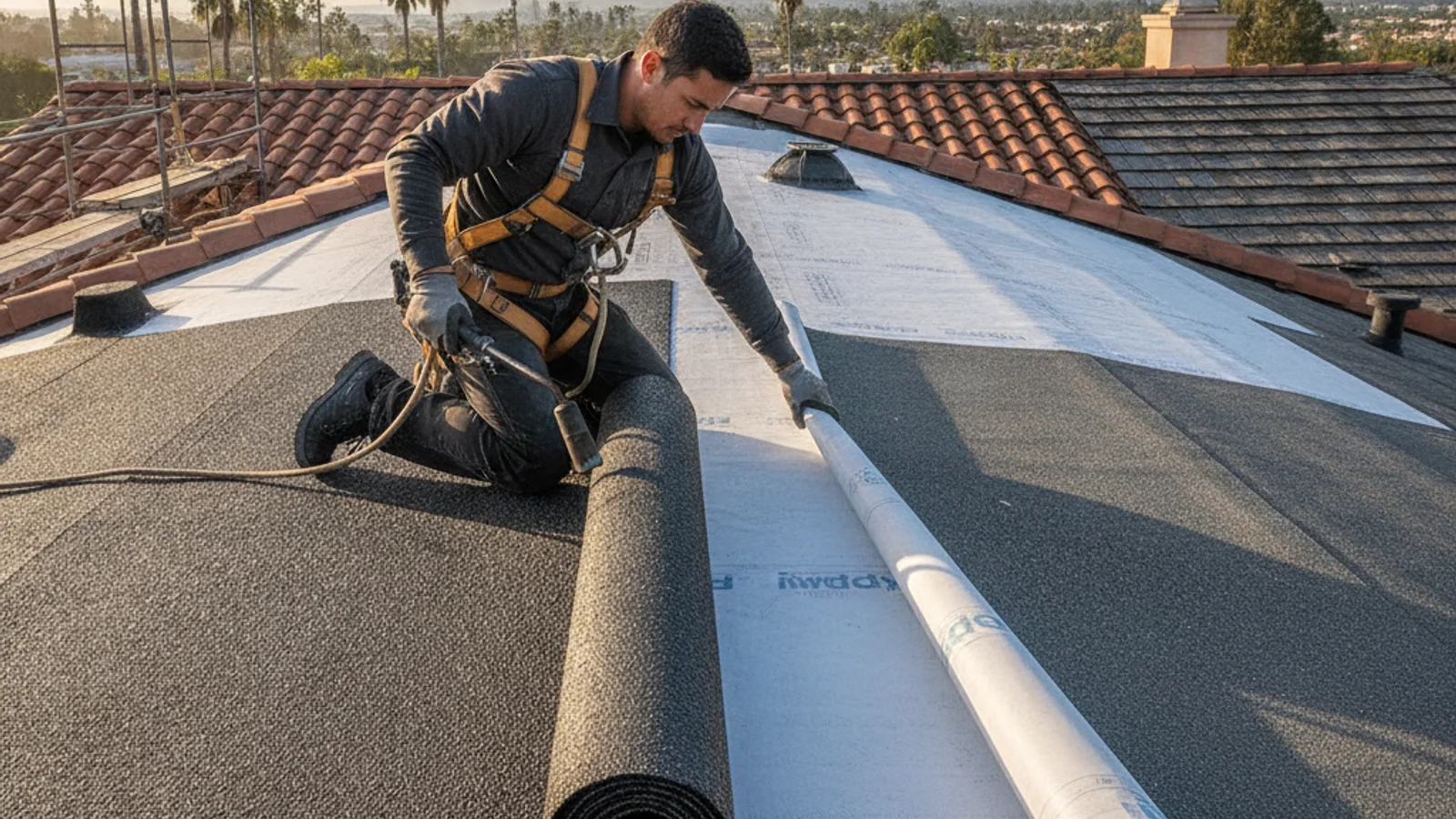
Rolled roofing is asphalt roofing in a roll instead of shingle strips. Same family as an asphalt shingle: a mat saturated and coated with asphalt, usually mineral-surfaced. The CSLB C-39 classification names asphaltum, pitch, tar, felt, and glass fabric among materials a licensed roofer works. Rolled asphalt sits in that group. It goes down in wide courses. Overlaps are bonded and fastened. Atlas and other makers are clear: roll roofing is not underlayment. Do not reverse that either.
Peel-and-stick, more precisely a self-adhered membrane, is a sheet with factory adhesive behind a release film. It is built to bond to a prepared substrate across its face. That is the real difference. Products in this aisle include modified bitumen, underlayment sheets, and some single-plies. Not every self-adhered sheet is a weather-exposed top layer. Using an underlayment product as a finished roof is a common, expensive mistake. The aisle name does not settle it. The manufacturer data sheet does.
Lifespan and heat: what we can and cannot tell you
We will not publish a service-life number for either category. There is no independent standard we verified that assigns a lifespan to “rolled asphalt” or “peel-and-stick” as classes. Manufacturers publish warranties for named products. Those terms depend on installation and substrate. Warranty length is not service life. Ask for the data sheet and the warranty for the exact product on the bid. We will not invent a price either.
Heat we can speak to because California publishes it. Much of coastal San Diego is Climate Zone 7 under Title 24, Part 6. Inland parcels can sit in another zone. For low-sloped roofs, cool-roof rules can apply. The metrics are aged solar reflectance and thermal emittance, or an SRI path. Aged values, not the number on a fresh roll, are the compliance numbers. The Cool Roof Rating Council tests new and weathered products. Confirm whether this patio cover or shed even triggers Title 24. Structure, scope, and how the code defines low-slope for that assembly decide it. The California Energy Commission keeps the standards and a climate zone lookup. A product that fails the aged threshold can fail inspection after it is on.
Seams, edges, and penetrations
Both products fail at the same three places. They fail differently.
Seams. Rolled roofing lives on the lap. Every course overlaps the one below. That bond is doing waterproofing work. Self-adhered membrane is bonded across the sheet, so a single lap is less of the whole story, and surface prep becomes the controlling variable. Dust, damp, or an incompatible substrate is not adhesion.
Edges. On a small structure the perimeter is a large share of the area. A 10-by-12 patio cover has more edge per square foot than a house. Edge metal, drip edge, and the termination at a fascia or wall are where wind gets under a low-slope surface. That is fabricated metal and flashing, not an aisle choice.
Penetrations. A light, a fan, a post, or the wall tie-in to the house interrupts the field. Every one needs a flashing detail. On very small roofs the house-wall tie-in is often the leak that started the project. No membrane covers a bad wall flashing. TPO vs modified bitumen is how those details scale up on larger low-slope roofs.
Drainage. San Diego rain arrives in a few events, not a steady drip. A nearly flat surface that drains slowly will pond in those events no matter which product is on it. Standing water finds every weak lap. Flat roof ponding covers what that does over time.
Where each one tends to belong locally
Along the coast (Oceanside through Encinitas, Del Mar, Ocean Beach, Coronado), salt air is hard on fasteners and edge metal. A mechanically fastened rolled product puts more metal into the exposed assembly. Fully adhered systems reduce fastener exposure. They do not remove the need for perimeter metal.
Inland north county and East County run hotter. Escondido, San Marcos, El Cajon, Santee, Lakeside, Alpine. Daily thermal cycling works every lap and every adhesive bond. Heat is also where Title 24 aged reflectance stops being paperwork, because these are often roofs over space people sit under.
Fire designation can override preference. If the parcel sits in a designated WUI or fire-hazard severity zone, ask the AHJ, the insurer, and the matched C-39 whether a listed Class A covering applies to this scope. Do not treat a Chapter 7A area test as a fact this page can certify. In the backcountry and canyon edges, eligibility comes first. Verify the parcel with the local authority.
Permits, licensing, and what the proposal should say
For City of San Diego jobs, start with Information Bulletin 123. Read the current bulletin. Ask the AHJ and the matched C-39 whether this covering renewal needs a permit. Other cities and the unincorporated county write their own rules. Call the permit desk for the jurisdiction the structure sits in.
Business and Professions Code section 7048 exempts a single project only when the aggregate price for labor, materials, and everything else is under $1,000, the work is casual or minor, and no building permit is required. Splitting a job to stay under the line does not qualify. If the patio cover needs framing, a permit, or the total clears $1,000, it is licensed work. Verify any license through the CSLB license check.
A written proposal should name the specific product and manufacturer, the substrate and how it will be prepared, edge and penetration details, the drainage plan, whether a permit is being pulled and by whom, and what happens if the deck is rotted. A line that only says “install rolled roofing” has not told you anything. Flat roof versus pitched roof is the geometry context.
When to call us
Product selection on a low-slope surface is downstream of a deck inspection. On a patio cover or garage addition, the deck is usually the part nobody has looked at. If the structure needs framing repair, a permit, or a tie-in to the main house wall, that is licensed C-39 work. Our referral list covers low-slope and flat roofing and smaller roof repair scopes. Call (760) 750-5557 and we will connect you with a licensed local roofer.