Fallbrook owners usually start calling after a leak stain, a cracked tile, or a sale inspection that flags the roof. Inland North County takes hard sun, grove debris, and wildland weather, so the next step is a written scope from a licensed independent C-39 roofer. Top Pro Roofing SD matches you with those licensed local pros, and you contract with the professional directly.
What Fallbrook roofs have to handle
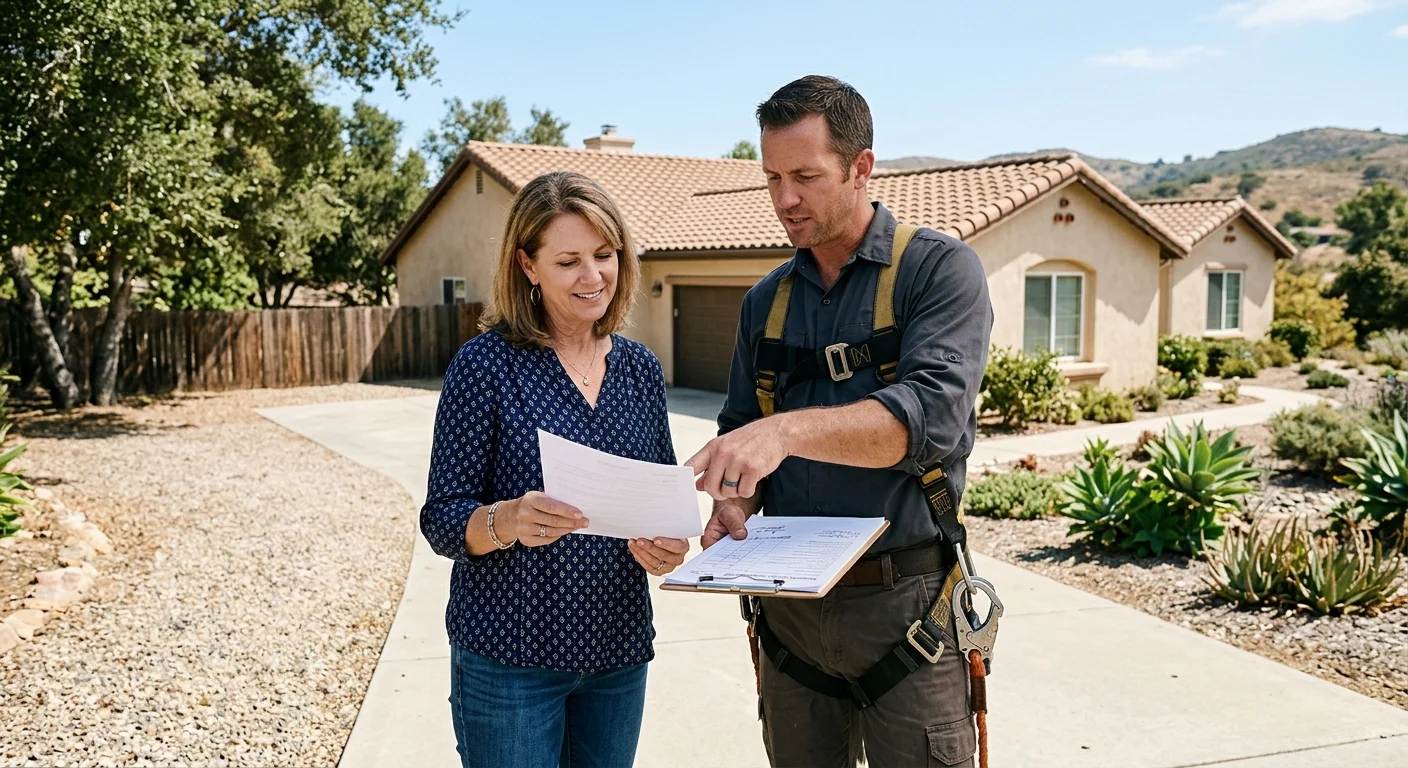
Fallbrook is an unincorporated community in northern San Diego County, inland of Oceanside and set in ranch country. Homes along Mission Road, in Gird Valley, and out toward De Luz, Pala Mesa, Rainbow, and Bonsall share an inland pattern. Long dry stretches. Hard sun. Tree canopy close to the eaves.
That canopy is the look of avocado and citrus country. It also drops leaves, twigs, and fruit into valleys and gutters. Debris holds moisture against underlayment and flashing after rain. It is fuel in fire season. A local inspection should read the roof-to-canopy line, plus the field of tile or shingle.
San Diego International Airport’s 1991-2020 NOAA normal is 9.79 inches of rain a year. That number is Lindbergh Field. Inland valleys and mountain edges run a different microclimate. Fallbrook sits inland, so treat the airport figure as a county baseline. Have the C-39 pro read your slope, drainage, and actual staining.
Heat does quiet work here. Inland North County attics run hotter than coastal ones. Underlayment, pipe boots, and mastic age in that heat while the covering still looks intact. On older tile roofs, the tiles can look fine while the felt below is the part that failed.
Wind is part of the inland story. Santa Ana events can lift aging edges, ridges, and flashing, and they can drive embers. A verified Fallbrook wind-speed figure could not be confirmed from a primary source, so treat any bid that leans on a made-up wind number as incomplete.
When damage is isolated and the rest of the roof still has service life, targeted roof repair is the honest path. When underlayment is tired across the field, or the covering is at the end of its life, roof replacement is the conversation. The independent roofer should show photos and say which job your roof is.
How to read a local repair or reroof proposal
A usable Fallbrook proposal is a scope, not a one-line total. You want the existing system named. You want the work described layer by layer. You want the exclusions in writing.
Look for tear-off versus overlay. Ask how many existing layers they found. In the City of San Diego, where two applications of asphalt shingles or built-up roof already exist, all layers must come off to the deck before a new covering goes on. Fallbrook is unincorporated county land. Confirm the County of San Diego rule for your parcel. The city’s bulletin governs city jobs.
Ask what happens if they open the roof and find damaged sheathing. Searchers call this the 25% rule. In the City of San Diego, a permit exemption can apply to damaged sheathing replacement up to 25% of the entire roof surface on a single-family, duplex, or townhouse job, with other limits. That is a city rule. Read the statewide walkthrough in our 25% rule guide, then confirm the Fallbrook address with the county.
The proposal should list underlayment, wall and chimney flashing, pipe boots, vents, drip edge, and valley metal. It should say who pulls the permit and who meets the inspector. If solar sits on the roof, it should say who removes the array and who puts it back.
Price talk belongs in writing, with units. This site has already published typical San Diego County installed ranges for a 2,000 sq ft home: architectural shingles at $14,500-$22,000, and new concrete tile at $28,000-$38,000. A $30,000 figure can sit inside a tile job of that size. It sits high for a straightforward shingle reroof of that size. Pitch, stories, tear-off layers, decking repair, and fire-zone detailing move the number. A separate Fallbrook average was not confirmed, so use the county ranges as a check and compare line items. For the county walkthrough, see new roof cost in San Diego for 2026.
Ask for the contract before anyone climbs. California Business and Professions Code Section 7048 sets a license exemption for a single project under $1,000 in aggregate, when the work is casual, minor, or inconsequential and no building permit is required. The exemption also drops away if someone advertises as a contractor. A house reroof, and most leak repairs, sit above that line.
What fire-zone questions to confirm with the jurisdiction
Inland North County sits close to wildland and grove fuel. That fact still leaves the mapped zone to the parcel. Pull the CAL FIRE Fire Hazard Severity Zone map for the exact address. Then ask the County of San Diego which wildfire construction rules apply there.
California Building Code Chapter 7A covers materials and methods for exterior wildfire exposure in designated Wildland-Urban Interface areas. Where Chapter 7A applies, the entire roof covering must be a fire-retardant covering that is at least Class A when more than 50% of the total roof area is replaced in a one-year period, when a new structure is built, or when roof covering is applied in alteration, repair, or replacement on an existing structure.
Materials that can meet Class A include asphalt shingles, concrete tiles, brick or masonry tiles, and metal shingles or sheets. Wood shake shingles are not Class A fire-resistant rated. If a bid keeps wood shake on a mapped WUI roof, confirm the rule with the jurisdiction before anyone orders material.
Class A is a fire-test classification under ASTM E108 or UL 790. Ask how the whole assembly is detailed: covering, underlayment, vents, eaves, and valleys. Ember weather finds the gaps. Our guide to wildfire-resistant roofing materials in San Diego walks through those choices in plain language.
Title 24 cool-roof rules depend on climate zone, slope, and whether the job is new construction or a replacement. San Diego (Lindbergh) is Climate Zone 7. Fallbrook is inland, so confirm the zone for the property with the California Energy Commission finder. Low-sloped roofs in Climate Zones 2, 4, and 6-15 have aged solar reflectance, thermal emittance, or SRI minimums. Steep-sloped residential cool-roof requirements in the energy code apply in Climate Zones 10-15. Aged values from Cool Roof Rating Council testing are the compliance metric.
Permit path for unincorporated Fallbrook runs through the County of San Diego. City of San Diego Information Bulletin 123 is a city document. Use our roofing permit by city map as a starting point, then confirm the Fallbrook address with the county.
How to verify the independent roofer
The person on your roof should hold a California C-39 roofing contractor license. C-39 work covers installing and repairing surfaces that seal, waterproof, and weatherproof a structure. Materials in that classification include asphalt, tile, metal, shakes, shingles, foam, and membranes.
Look the license up on the CSLB license check. Confirm the name matches the contract. Confirm the classification includes C-39. Confirm the status is current. Read the complaint history and the bond information on the same record.
Every C-39 contractor must keep a Certificate of Workers’ Compensation Insurance or a Certificate of Self-Insurance on file with CSLB under Business and Professions Code Section 7125. That filing is how on-the-job injuries are supposed to be covered. Homeowners sometimes ask whether a roofer can sue after a fall. That is a legal question for your insurance agent and, if needed, a lawyer. Your practical step is to confirm workers’ compensation is on the license record before anyone climbs.
Use the same checklist we walk through in how to choose a roofing contractor in San Diego: a written contract, a live license lookup, insurance on file, and more than one bid on a replacement. Watch for door-to-door pressure. Watch for anyone who advertises as a contractor without a license.
Top Pro Roofing SD is a referral service. We connect you with licensed, independent local roofing professionals. The matched C-39 pro inspects, writes the proposal, pulls permits in their name when required, and performs the work. The brand holds no trade license and owns no crews. The pro’s contract and the manufacturer’s paperwork are the documents that govern the job.
Which documents to keep after the work
Keep a folder, paper or digital, that a future buyer or an insurer can read without calling you.
Save the signed contract, the final invoice, and every change order. Save the permit, the inspection sign-offs, and the job address as the county recorded it. Save the product sheets: underlayment brand, covering brand and color, and any Cool Roof Rating Council or Title 24 compliance pages the pro used.
Save the workmanship warranty from the independent contractor and the manufacturer warranty. Those come from the pro and the product. Note the dates, what they cover, and whether they transfer on a sale.
If weather damage started this project, keep the claim file too. The California Department of Insurance tells homeowners to report damage promptly, make temporary repairs that stop further harm (plastic or plywood over openings), photograph before and after those temporary repairs, and log every call. Consumer help is at insurance.ca.gov. The department’s consumer hotline is 1-800-927-4357.
Keep photos of the tear-off, the bare deck, and the finished roof. Those photos settle later arguments about what was replaced. Keep the C-39 license number on the same sheet as the permit number.
If an HOA sits on the property, keep the architectural approval with the roofing file. Ranch parcels outside an HOA still benefit from the same packet. The next inspector, appraiser, or buyer will ask for it.
When to call us
Call when a Fallbrook roof is leaking, missing covering, or due for a replacement conversation, and you want a licensed independent C-39 pro to inspect and write a scope. Call us at (760) 750-5557 and we’ll connect you with a licensed local roofer.