A wet ceiling tile in a Coast Highway suite, or a warehouse lease on Melrose with no roof file, is usually what starts this. You need a commercial roof inspection in Oceanside that records the deck you have, not a pitch for work you did not request. Ask the questions below before anyone walks the membrane.
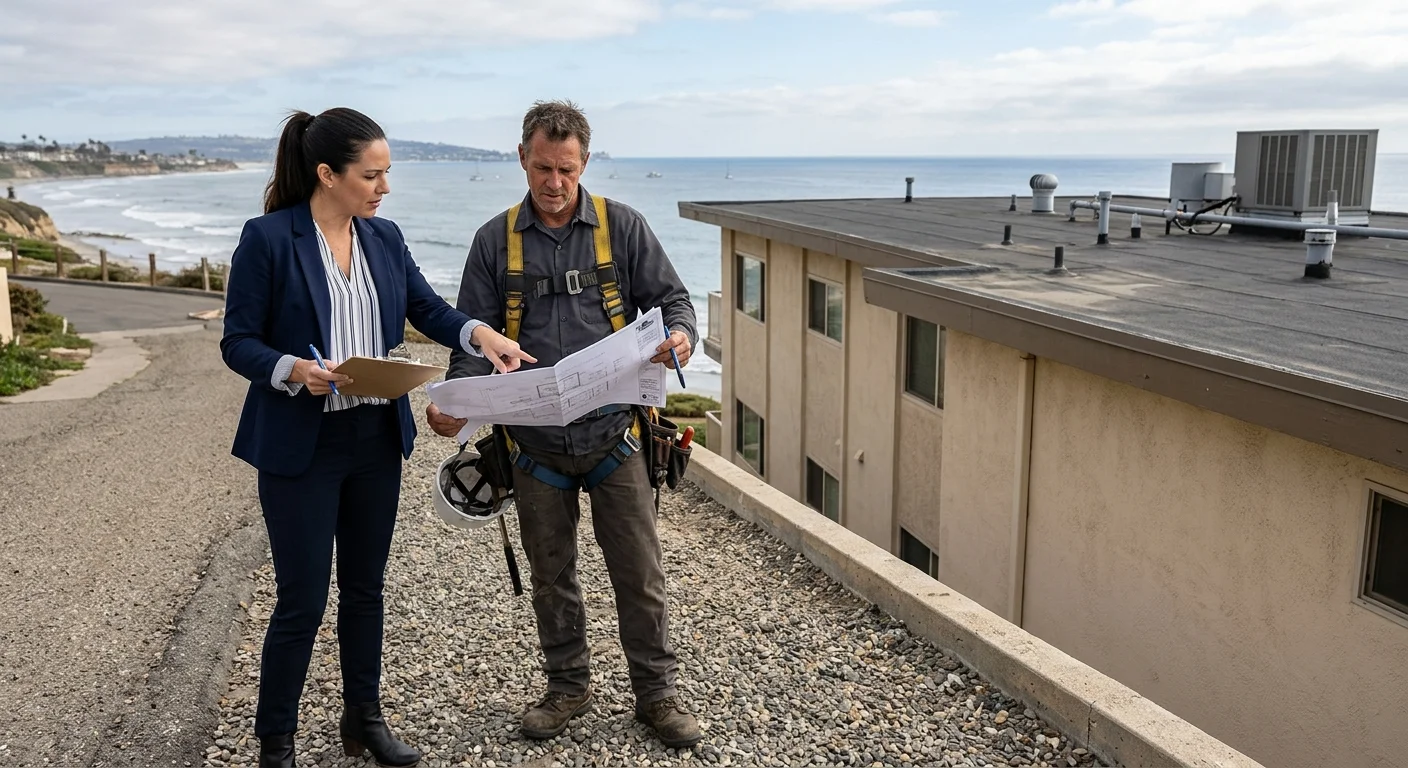
Define why the building needs an inspection
Oceanside commercial roofs live two climates in one city. Along The Strand, Pacific Street, and the harbor, salt and morning moisture sit on membranes, metal flashings, and fasteners. Inland, around Rancho del Oro, College Boulevard, and the parks off Melrose Drive, the same low-slope roof sees more heat and less salt. A report that could have been written for El Cajon or Encinitas is not useful here.
Name the reason before anyone climbs a ladder. A refinance, a tenant improvement, a stain in a suite, a peeling coating, or a five-year capital plan are different jobs. The roof inspection should match that reason. If you only need a condition record for a file, say so. If you are weighing commercial roofing options later, say that too. Mixing those intents is how a walk turns into a proposal you did not ask for.
Ask the pro to put the building address, roof type, and occupancy on page one. A medical office on Mission Avenue, a self-storage building near Oceanside Municipal Airport, and a restaurant on Coast Highway do not share the same traffic, exhaust, or grease load. Buildings along the San Luis Rey corridor also pick up more debris after wind. Those details belong in the opening paragraph, not in a generic cover letter.
California C-39 roofing contractors are licensed to install and repair surfaces that seal, waterproof, and weatherproof structures. Confirm the person walking your Oceanside roof holds that classification, then check the license at the CSLB license lookup. C-39 contractors must keep workers’ compensation insurance on file with CSLB. That matters on a commercial lot with other trades on site.
Top Pro Roofing SD is a referral service. We match you with licensed, independent local roofing professionals. We do not walk the roof, own trucks, or hold a trade license. You contract and pay the professional directly.
Roof inspection services Oceanside owners actually use start with that scope in writing. A verbal “we’ll take a look” is not a commercial record.
Identify the roof areas the report should address
Ask for a roof plan, even a simple one. Number each area: field membrane, perimeter, parapets, equipment curbs, expansion joints, and wall flashings. Oceanside low-slope buildings along Vista Way and Coast Highway often have packaged HVAC units, grease vents, and sign mounts clustered on one quadrant. If the report only says the roof is in fair condition, you cannot budget, and you cannot brief a tenant.
A useful commercial walk names the system you have. Many Oceanside boxes are single-ply or modified bitumen. Some older strips still carry built-up roofing. Steep office fronts on Coast Highway are a different assembly than the warehouse behind them. Your roof inspection checklist for a house will not map one-to-one onto a commercial deck, but the habit is the same. Walk every plane. Then write what you saw.
Coastal north county sun and salt hit south- and west-facing edges harder. Inland Oceanside heat cooks the field. Ask the report to split those exposures instead of averaging them. A parapet on the harbor side can show corrosion while the inland edge still looks intact. Camp Pendleton sits just north of the city, and that open coastal stretch is not the same weather as East County tile country.
If the building may need a cool roof later, keep Title 24 in view without guessing Oceanside’s climate zone. Low-slope replacements in the climate zones listed by the California Energy Commission must meet aged solar reflectance of at least 0.63 and thermal emittance of at least 0.75, or an SRI of at least 75. Confirm the zone for that address with the California Energy Commission. ENERGY STAR lists rated roof products at energystar.gov/products. An inspection is not a Title 24 form. It can still photograph the existing color, slope, and any coating so a later design does not start from memory.
Note occupied roofs, parking canopies, and attached trash enclosures. Those areas fail on their own schedule, and they disappear from reports that only photograph the main field.
Check how drains and penetrations are documented
Low-slope Oceanside roofs fail at water and at holes more often than in the open field. Ask the report to inventory every drain, scupper, overflow, and downspout leader, with a photo and a note on whether water is standing. Ponding after a marine-layer drizzle is a condition. Calling it a leak is a conclusion. Keep those apart.
Penetrations need the same treatment. List HVAC curbs, plumbing vents, electrical goosenecks, conduit, skylights, and sign bases. Coast Highway restaurants add grease exhaust. Harbor-adjacent metal will show salt. Inland units see more UV on gaskets. A line that says flashings are fine is not an inventory.
Ask where the water is supposed to go. Buildings near the San Luis Rey River and older lots off Crouch Street or Mission Avenue may dump to aging leaders that clog with palm debris. If the interior has a stain under one drain, the report should say which drain, which suite, and whether the stain was wet on the day of the walk.
Do not let the walk skip the inside. A commercial inspection that never enters the suite, the restroom chase, or the warehouse high-bay is only half a record. Match interior stains to roof photos. If the pro cannot get into a locked tenant space, the report should say that, not guess.
This site’s verified ledger does not publish Oceanside drain codes, inspection prices, or a City of Oceanside roof bulletin. Confirm any local drainage or permit rule with the City of Oceanside before you treat a report as a permit document. City of San Diego roof-covering rules do not automatically apply here. San Diego International Airport’s rainfall normal is 9.79 inches a year (NOAA 1991-2020), and coastal microclimates differ from inland valleys. Do not copy an inland ponding story onto a harbor-adjacent deck.
Separate observed conditions from repair proposals
A condition is what the roof is doing. A proposal is what someone wants to sell. Keep them in different sections, or you cannot compare commercial roofers later with a clean record.
Observed conditions include splits at seams, open laps, rust at coping, packed drains, cracked pitch pans, blistered membrane, and wet insulation only if they cut a core and you asked for one. Repair language includes overlay, recover, tear-off, coating, and individual flashing repair. If both appear in the same paragraph, you will not know what was seen versus what was pitched.
You do not have to accept a core cut. If you want one, say so in writing and say who patches the hole. If you do not want one, the report should not invent wet insulation. Ask for photos with location tags that match the roof plan. A stack of unlabeled close-ups is not a commercial record. Date the visit. Name who was on the roof. Note weather: marine layer, wind off the water, or a clear inland afternoon.
Do not treat the inspection as a warranty, a certification, or a legal opinion. Those claims are not in this site’s verified ledger, so this page does not state them. If a lender or buyer wants a named certification product, ask that party what form they need, then see whether the C-39 pro can produce it. This brand does not certify roofs and does not warrant anyone’s work.
When two Oceanside buildings share an owner, do not reuse one report. A harbor-adjacent roof and a Rancho del Oro warehouse age differently in the same week. South Oceanside strip retail and an inland industrial box off Melrose are not interchangeable files.
Confirm who receives the final records
Decide the file path before the walk. Property manager, owner, lender, tenant, and insurance file are not the same inbox. Say who gets the PDF, who gets the photo set, and who may share it. If a tenant paid for the walk during a tenant improvement, put that in the work order so you are not fighting over the file later.
Ask for plan notes plus a locked PDF. Commercial files in Oceanside change hands: management companies, 1031 buyers, leases near Camp Pendleton, and national tenants with their own vendor lists. A report that lives only in a salesperson’s phone is not a building record.
Keep the license number, the date, the address, and the roof-area map with the report. Verify the C-39 again if a different company comes back for repairs. The customer still contracts and pays the professional directly. Store interior photos with the roof photos. A stain in a Coast Highway suite is evidence. So is a dry warehouse deck off Melrose the same week. Future you will not remember which marine-layer morning that was.
If work follows, the repair file should point back to the inspection page numbers. That is how you keep the next walk honest, and how an Oceanside owner avoids paying twice for the same description of the same drain.
When to call us
When an Oceanside building needs a licensed C-39 pro to walk the roof and write a record you can keep, we match you with independent local roofers. We don’t inspect or repair the building ourselves. Call us at (760) 750-5557 and we’ll connect you with a licensed local roofer.