The short answer
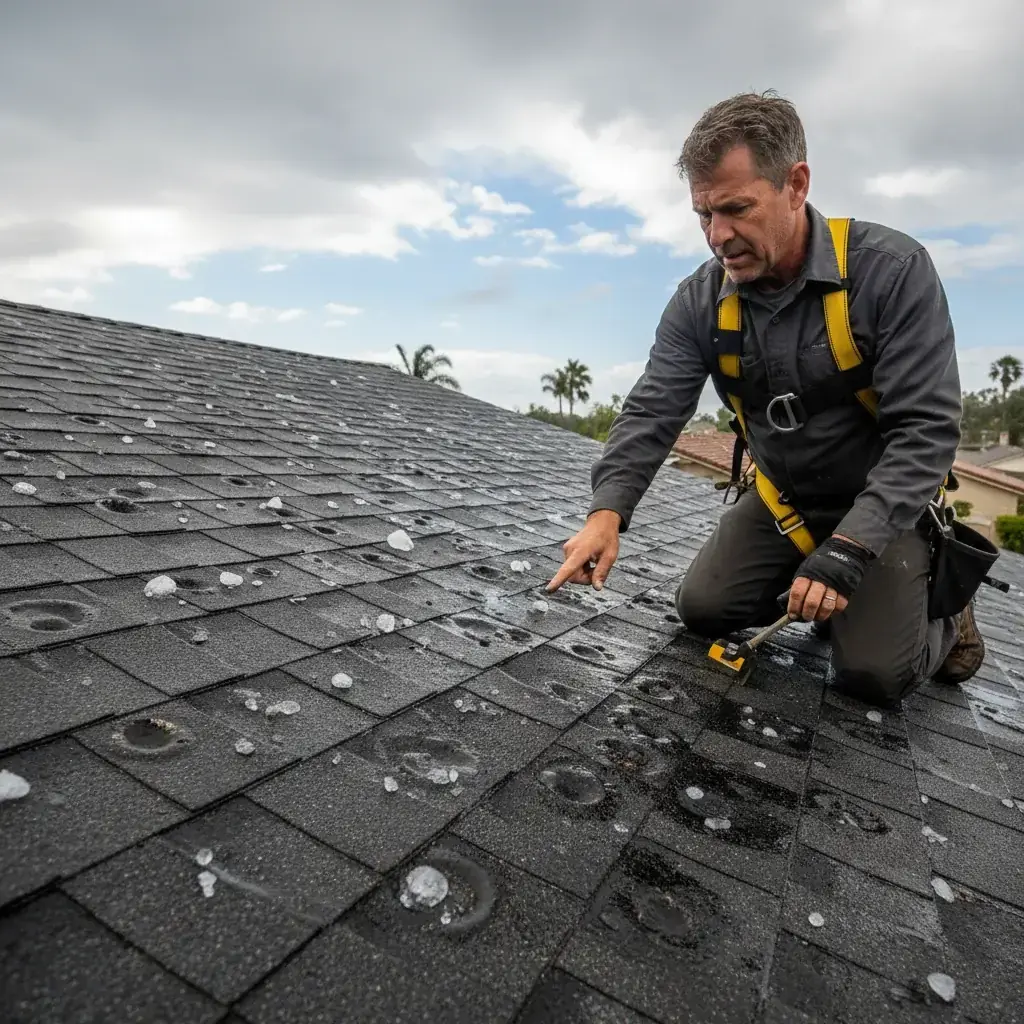
Santa Ana events are dry, offshore winds that regularly lift shingles, slip tiles, and flex flashings in inland and East County San Diego. The opening is often not obvious from the street. Water shows later, when rain finds the seam the wind opened.
After a documented event in your area, walk the perimeter from the ground and get a licensed C-39 inspection if you see lift, missing pieces, or interior staining. Notice, deductibles, and coverage live in your policy, not in a blog countdown. Related: 150 mph wind-rated shingles.
Top Pro Roofing SD is a referral service. We connect homeowners with independent licensed roofers. We do not hold a C-39, climb roofs, or file claims. Call (760) 750-5557.
San Diego County sees recurring Santa Ana wind events, typically strongest from fall through winter, with inland and East County corridors taking more force than the immediate coast. The National Weather Service San Diego office treats this as a known regional pattern. Historic fires in the county (including the 2003 Cedar Fire, the 2007 Witch Creek Fire, and the 2017 Lilac Fire) were driven or amplified by Santa Ana conditions. Ember risk and mechanical roof damage are related weather, not the same repair.
This guide covers what the wind does to common roof types, how to look from the ground, and how documentation and insurance actually split.
What makes Santa Ana wind different
Santa Ana winds are downslope-warmed offshore events. Air flowing off the high desert through inland passes compresses, heats, and accelerates. By the time it reaches Ramona, Alpine, Jamul, Lakeside, Poway, Escondido, San Marcos, and Vista, gusts can be much stronger than the same day at the beach.
What that does to a roof:
- Uplift at edges. Wind over the windward edge creates low pressure above the covering. Corners, rakes, hips, and ridges take the most pull.
- Cycling at fasteners. Tabs and tiles flex for hours. Loose nails get looser. Aged adhesive seal strips on shingles let go.
- Debris impact. Eucalyptus, palms, furniture, and trash cans become projectiles.
- Embers in fire weather. During red-flag Santa Anas, embers travel. A listed fire-class covering and screened vents are a wildfire and permit question for this parcel, not a leak patch and not a countywide Class A fact. See wildfire-resistant roofing.
The leak often waits for the next rain.
How to spot Santa Ana wind damage
Most of this is hard to see from the driveway. Stay off the roof.
Shingle roofs
From the ground with a zoom lens:
- Ridge and windward gable: any tab out of line with the course.
- Lower edges that curl or show a gap to the course below.
- Granules piled in gutters after a long blow, especially on older asphalt.
On the roof (a licensed roofer):
- Lift-test along ridges, hips, and the windward perimeter. A sealed tab should not lift freely.
- Missing or half-detached tabs (common on older 3-tab).
- Ridge cap first. It takes the most force.
Tile roofs
From the ground:
- Tiles rotated or sliding down-slope.
- Broken pieces along edges and ridges.
- Tile fragments on the ground.
On the roof (a licensed roofer):
- Lift along ridge and rake. A fastened or interlocked tile should not lift freely.
- Underlayment under a displaced tile: cracks, tears, or exposed deck are leak paths.
- Ridge mortar cracked from flex.
Flat roofs (TPO, modified bitumen, built-up)
- Seam separation at the perimeter and around penetrations.
- Parapet flashing torn or bent.
- Ballast moved on ballasted systems.
- Skylight and HVAC curb aprons torn at the upper edge.
Flashing and penetrations (any roof type)
- Chimney counter-flashing pulled off the wall.
- Skylight apron flexed up.
- Pipe boot collars torn off the pipe.
- Satellite or solar hardware loosened.
Where exposure is usually higher
Not every ZIP sees the same wind. This is topography, not a ranking of neighborhoods we “serve more.”
| Region | Typical Santa Ana exposure | Why it matters on the roof |
|---|---|---|
| Ramona, Julian, Alpine | High | First high-wind corridor as air descends inland |
| Jamul, Lakeside, Lemon Grove | High to moderate | Foothills plus mature trees |
| Poway, Escondido, San Marcos | Moderate | Valley fetch with some shelter |
| Carlsbad, Encinitas, Del Mar | Lower for the Santa Ana itself | Onshore marine air usually blunts the offshore blow |
| Coronado, Imperial Beach, Ocean Beach | Lowest for this pattern | Ocean-adjacent microclimate |
If you sit in the first two rows, treat a confirmed local event as a reason to inspect even when the street looks fine. We will not invent an inspection fee or a claim-denial percentage.
Insurance: document the event, then read your policy
We will not invent a statewide filing deadline. Notice, proof of loss, and suit limitation live in your contract. The California Department of Insurance publishes the form and Insurance Code text that may apply. Start at CDI claims help and California LegInfo. Read the current text. We will not restate those duties here. Fair Claims Settlement Practices rules in the California Code of Regulations govern how an insurer must handle an open claim. They are not a homemade homeowner countdown.
Practical sequence that still belongs to you:
- Confirm the event with NWS San Diego records and, if relevant, SDG&E PSPS / fire-weather alerts.
- Photograph from the ground. Save dated files.
- Get a written C-39 scope that separates wind lift from wear.
- Notify the carrier the way your policy requires. Do not narrate “it has looked like that for years” unless you know that is true. Adjusters write it down.
Full process: storm damage insurance claim, does homeowners insurance cover roof leaks, does insurance cover roof replacement.
What a repair actually includes (no price list)
Wind work is scoped by what failed: a few lifted tabs, a ridge cap, a run of tiles, underlayment under displaced tile, or deck that got wet. Access, height, material, and how far water traveled all change the bid. Compare written line items. We will not publish repair-cost tables.
If the opening is active, emergency tarping is a separate conversation: emergency roof tarp.
Preventive measures for Santa Ana season
Roof-side prep
- Schedule a roof inspection before peak offshore season. Loose tiles, lifted tabs, and tired flashings are cheaper to name before the event.
- Trim limbs off the roof. Eucalyptus, pine, and oak are the usual impact sources.
- Clear gutters and valleys. A blocked valley plus wind-driven rain is an interior stain.
- Ask the C-39 to check ridge cap and edge metal.
Home-side prep
- Secure anything that can fly.
- Photograph the roof annually from the ground as a baseline.
- Read the deductible and any wind or wildfire percentage on the declarations page. Those numbers are policy-specific.
- Keep NWS screenshots for significant local events.
Frequently asked questions
How fast does wind have to blow to damage a roof?
There is no single mph that fails every roof. Product wind ratings assume a specified nail pattern, sealed tabs, and a roof in good condition. Aged seal strips, 3-tab, and loose mortar fail sooner. Manufacturer listings and the written spec matter more than a blog threshold.
Will my insurance cover Santa Ana wind damage?
Often argued as a wind peril when the damage matches a documented event and the form covers wind. Wear, age, and skipped maintenance are common exclusions. Coverage gets harder as the covering ages. Read the form. We do not adjust claims.
How do I prove the damage was from a specific Santa Ana event?
NWS records by date and location, dated before-and-after photos, and an independent C-39 report. Neighborhood posts are supporting color, not a substitute for weather archives.
Should I get up on my roof after a Santa Ana event?
No. Walk the perimeter. Photograph. If you see lift or missing pieces, schedule a licensed inspection. Displaced tile can break underfoot.
What if my home is in Ramona or Alpine and I see nothing from the street?
Still reasonable to have a C-39 look after a strong documented event. Hidden lift at the ridge is common. We will not invent a hit-rate.
Are some roof materials more wind-resistant than others?
When fastened to the listing: concrete and clay tile with proper clips or screws, standing-seam metal, and architectural shingles with sealed tabs. Older 3-tab is usually the weakest field product. Fastening and edge metal decide more than the brochure name.
The bottom line
Santa Ana season is a recurring inland and East County pattern. Treat a confirmed local blow as a documentation and inspection trigger, especially with tree canopy or a ridge you cannot see.
File on your policy’s notice rules. Catch openings before the next rain if you can. We will not invent a payout odds table.
For a matched C-39 inspection or tarp after an event, call Top Pro Roofing SD at (760) 750-5557. County coverage: contact. Storm and insurance context: California insurance coverage and storm damage claim walkthrough.