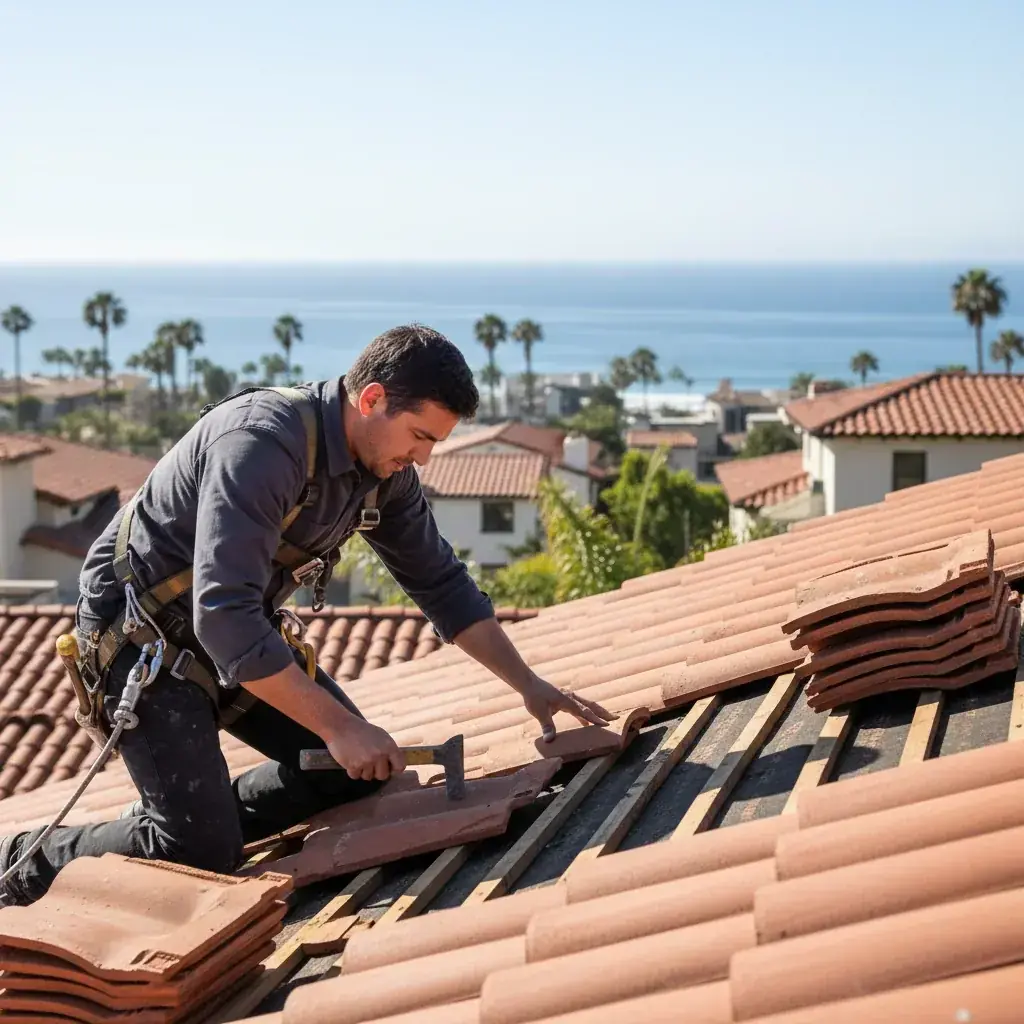
Tile roof replacement in San Diego County runs $11 to $28 per square foot installed in 2026, which lands at roughly $14,500 to $22,000 for a lift-and-relay (reusing the existing tile) and $28,000 to $58,000 for a full new tile install on a typical 2,000 square foot single-family home. The single biggest cost question is not what brand of tile to buy. It’s whether the existing tile is reusable. If it is, you can cut the replacement cost roughly in half by replacing only the underlayment and flashings underneath.
This guide breaks down what tile roof replacement actually costs in 2026, by scope, by tile type, by home size, and by the San Diego factors (HOA, coastal corrosion, Title 24 cool-roof code) that don’t show up in national cost guides. It also walks the lift-and-relay vs. full replacement decision, which is where most of the real money is.
Cost by replacement scope
Every tile roof replacement falls into one of three scopes. The scope, not the tile type, is the first cost driver to nail down.
| Scope | What it includes | Per sq ft installed | Typical 2,000 sqft home |
|---|---|---|---|
| Lift-and-relay (reuse tile) | Remove tile, replace underlayment + flashings, reinstall original tile, replace ~10-15% breakage | $7 to $11 | $14,500 to $22,000 |
| Partial tile replacement | Replace a single slope or section, blend with existing tile | $14 to $22 | $8,000 to $18,000 (one slope) |
| Full new tile install | Tear off, re-deck if needed, new underlayment, new tile | $13 to $28 | $28,000 to $58,000 |
A few notes on this table that matter:
- Lift-and-relay isn’t a “repair.” It’s a real replacement. The waterproofing membrane (underlayment), the metal flashings around vents and chimneys, and the drip edge all get replaced. The tile is reused because tile itself rarely fails in the 30-year window underlayment does.
- Partial replacement only makes sense if the rest of the roof has 10+ years of underlayment life left. Otherwise you’re paying mobilization twice. Get a leak diagnosed first, then decide.
- Full new tile pricing varies more than any other scope because of the tile material spread. Concrete S-tile on a tract home sits near the low end. Two-piece mission clay on a historic home sits near the high end.
For background on when lift-and-relay is the right call, our tile roof lift-and-relay guide walks the diagnostic process and the conditions that disqualify a roof from being a relay candidate.
Cost by tile type
For full new tile installs, the material drives most of the cost spread. Concrete is cheaper to buy and faster to install. Clay costs more and takes more skilled labor. Mission barrel is its own category.
| Tile type | Material cost per sq ft | Installed cost per sq ft | Weight (psf) | Typical lifespan |
|---|---|---|---|---|
| Concrete S-tile | $2 to $4 | $11 to $14 | 9 to 10 | 50+ years |
| Concrete flat tile | $3 to $5 | $12 to $16 | 9 to 11 | 50+ years |
| Lightweight composite tile | $5 to $9 | $14 to $20 | 4 to 6 | 40 to 50 years |
| Standard clay barrel | $4 to $8 | $15 to $20 | 6 to 8 | 75 to 100+ years |
| Two-piece clay mission | $7 to $14 | $18 to $28 | 8 to 10 | 75 to 100+ years |
A few cost dynamics that don’t show up in the table:
Concrete S-tile is the default on tract homes built from 1980 through today in Scripps Ranch, Mira Mesa, Rancho Bernardo, Carmel Mountain Ranch, and most of North County. It’s the cheapest tile option, and most San Diego homes were framed for it. Color fades after 15 to 25 years as the surface coating wears off, which is cosmetic, not structural.
Concrete flat tile is common on newer contemporary builds (Pacific Highlands Ranch, newer Carmel Valley phases, parts of Otay Ranch). Slightly more expensive than S-tile because cuts are tighter and tolerances are narrower.
Lightweight composite tile is the option for older homes where the framing can’t carry 9+ pounds per square foot of concrete or clay without reinforcement. Pricier per square foot, but it skips the $3,000 to $12,000 structural retrofit. Worth the math on most pre-1975 homes.
Standard clay barrel is single-piece terracotta or glazed clay. Spanish Revival look. Heavier underlayment requirement, longer life, color baked in. The catch is that not every San Diego roofing crew installs clay well. According to the Tile Roofing Industry Alliance, correct clay install requires trained crews following the TRI Installation Manual — ask any contractor for their TRI-certified installers list.
Two-piece mission tile is the high end. A concave pan tile plus a convex cap tile in alternating courses. What you see on historic Spanish Revivals in Mission Hills, Kensington, Old Town, and the original Mission Beach cottages. Twice the labor of single-piece. On a 2,500 square foot Mission Hills bungalow with a complex roof, plan for $55,000 to $70,000.
For the concrete-vs-clay choice on its own, our concrete vs. clay tile comparison covers durability, weight, fade, and resale impact in detail.
Cost by home size
Roof square footage drives most of the labor and material cost. A 2,000 square foot house typically has a 2,400 to 2,800 square foot roof once you account for pitch, overhangs, and complexity. The numbers below assume a moderately complex single-story roof, average pitch (4:12 to 6:12), and one layer of existing material to tear off.
| Home size | Approx. roof area | Lift-and-relay | Concrete tile (full) | Clay barrel tile (full) | Mission barrel (full) |
|---|---|---|---|---|---|
| 1,500 sqft | ~1,900 sqft roof | $11,000 to $15,500 | $22,000 to $28,000 | $28,000 to $36,000 | $36,000 to $50,000 |
| 2,000 sqft | ~2,500 sqft roof | $14,500 to $19,000 | $28,000 to $35,000 | $35,000 to $44,000 | $45,000 to $62,000 |
| 2,500 sqft | ~3,100 sqft roof | $17,500 to $23,000 | $34,000 to $42,000 | $42,000 to $54,000 | $55,000 to $78,000 |
| 3,000 sqft | ~3,700 sqft roof | $21,000 to $28,000 | $40,000 to $50,000 | $50,000 to $65,000 | $65,000 to $90,000 |
| 3,500 sqft | ~4,300 sqft roof | $24,500 to $32,000 | $46,000 to $58,000 | $58,000 to $75,000 | $75,000 to $105,000 |
Two-story homes in the same square footage have a smaller roof footprint, but add roughly 8 to 12 percent for scaffolding, fall protection, and longer labor time.
Cost factors that move the number
Two homes on the same street, same size, same tile type can come in $15,000 apart. Here’s why.
Pitch and roof complexity
A 4:12 pitch is walkable. A 9:12 pitch needs roof jacks, more fall protection, and slower labor. Cuts at hips and valleys eat tile and time. A simple gable roof prices at the low end of the per-sq-ft range. A hip-and-valley with multiple dormers, a chimney, and skylights prices at the top. Expect a 15 to 30 percent labor premium for complex roofs.
Site access
If a tile pallet truck can’t get within 30 feet of the house (steep driveway, narrow street, locked HOA gate), tile gets staged at the curb and ferried by wheelbarrow. That’s a day of labor on a typical job. Common on cul-de-sac and hillside homes in La Jolla, Mount Helix, Bonita, and parts of Encinitas.
Deck condition
Once tile and underlayment come off, the plywood or skip-sheathing underneath is exposed. San Diego homes built before the late 1970s often have skip-sheathing (1x6 boards with gaps) rather than solid plywood. Code and best practice want solid decking. Re-decking with 5/8” CDX plywood adds $2.50 to $4.00 per square foot, or $5,000 to $10,000 on a typical home. Rotted sections of existing decking get replaced at $80 to $150 per sheet.
Underlayment grade
This is where contractors hide margin. The cheapest job uses 30-pound felt (20 to 25 year service life). Mid-grade synthetic underlayment lasts 30 to 40 years. Premium peel-and-stick self-adhered membrane lasts 40 to 50+ years and seals around nail penetrations. The spread between cheapest and most expensive underlayment is $2,500 to $5,000 on a typical home. On a tile roof you expect to last 50 years, paying more for underlayment is almost always the right call. The tile is the easy part to replace later. The underlayment is what keeps water out.
Structural reinforcement (clay, especially)
Clay tile weighs 6 to 8 psf. Concrete is 9 to 10 psf. Both materials are heavy enough that older homes (roughly 1940 to 1975) may need structural review before a tile install. A structural engineer report runs $800 to $2,000. Sistering rafters, adding collar ties, or upgrading the ridge beam can add $3,000 to $12,000. On any pre-1940 or 1940s through 1970s home being re-roofed in tile for the first time, factor this in.
San Diego factors that change the math
National cost guides don’t capture these. They’re specific to San Diego County and they matter on most replacements.
HOA mandates in master-planned communities
Scripps Ranch, Carmel Valley, Pacific Highlands Ranch, 4S Ranch, Rancho Bernardo, Rancho Santa Fe, Fairbanks Ranch, and Carmel Mountain Ranch all have HOAs that specify approved tile colors, profiles, and sometimes manufacturers. Application fees run $50 to $300 and approval takes 2 to 8 weeks. On Rancho Santa Fe and Fairbanks Ranch jobs, expect the longer end plus a site visit from the architectural review committee. Carmel Valley homeowners especially: get HOA approval in hand before you sign with a contractor.
Coastal salt corrosion of fasteners and flashings
Within about a mile of the coast (Cardiff, Del Mar, La Jolla, coastal Encinitas, Imperial Beach, coastal Mission Beach), salt accelerates corrosion on standard galvanized fasteners and flashings. The tile itself is inert and unaffected. The metal underneath isn’t. Specify copper or stainless steel flashings and stainless fasteners on any coastal tile job. Adds roughly $1,500 to $4,000 to the project. Skipping it means a 15-year flashing failure on a 50-year roof, which is a leak path you don’t want.
Title 24 cool-roof code
California’s Title 24 energy code requires “cool roof” performance on most residential reroofs. For tile, the workaround is straightforward: any tile with a Cool Roof Rating Council (CRRC) listed Solar Reflectance Index (SRI) above 16 for low-slope roofs (15 for steep-slope) qualifies. Most tile manufacturers offer compliant SKUs at no premium. The catch is when an HOA specifies a dark non-compliant color. In that case, you may need a Title 24 calculation showing whole-house compliance through other means (insulation, windows). Your roofer should know this. Check tile SRI ratings in the CRRC Rated Products Directory.
County permit and inspection variation
Permit cost varies a lot by jurisdiction. These are 2026 ballpark figures for a residential reroof permit including plan check and inspections.
| Jurisdiction | Typical permit fee |
|---|---|
| City of San Diego | ~$600 |
| Chula Vista | ~$550 |
| Carlsbad | ~$700 |
| Oceanside | ~$500 |
| Escondido | ~$450 |
| San Marcos | ~$500 |
| Unincorporated SD County | ~$650 |
If your contractor isn’t pulling a permit on a tile reroof, walk away. Permit-skipping is illegal, voids your warranty, kills your homeowners insurance claim if there’s ever a fire or storm event, and creates a disclosure problem when you sell. Always verify your contractor’s C-39 license through the CSLB license lookup before signing.
Lift-and-relay vs. full replacement: decision matrix
This is the question that swings the cost by $15,000 to $40,000. The decision is mostly mechanical once you have the facts on tile condition, underlayment condition, and ownership horizon.
| Factor | Lift-and-relay | Full new tile |
|---|---|---|
| Tile age (concrete) | Less than 35 years | 35+ years or heavy spalling |
| Tile age (clay) | Less than 60 years | 60+ years with cracking, color failure |
| Tile breakage | Less than 15% cracked or broken | 15%+ broken, missing, or delaminated |
| Underlayment status | Failing (this is the trigger to act) | Failing AND tile is at end of life |
| Tile matching for repairs | Hard or impossible (older clay) | Less critical when replacing entirely |
| Deck condition | Sound | Heavy rot, full re-deck needed anyway |
| Ownership horizon | 15 to 30 more years | 30+ years, want longest possible life |
| Look change desired | No (keeping current tile) | Yes (different profile or color) |
| Budget | Tight; difference between $18K and $35K matters | Open; longest life is worth the premium |
| Solar panels | Either works | Either works (factor in disconnect cost) |
The shorthand: if the tile is sound and you’re keeping the house another 20 years, lift-and-relay every time. If the tile is at end of life, or you want a different look, or the deck is failing too, full replacement.
For a deeper dive on the lift-and-relay decision specifically, see our tile roof lift-and-relay guide and the Rancho Santa Fe tile repair walkthrough, which covers Covenant-specific tile matching challenges.
Permits, inspections, and timeline
A typical tile roof replacement in San Diego follows this sequence:
- Quote and contract. Three quotes recommended. Verify each contractor’s CSLB C-39 license. Never pay more than 10 percent up front in California (state law).
- HOA approval (if applicable). 2 to 8 weeks. Pick tile color and profile before you sign.
- Permit pull. Contractor handles. Adds 1 to 3 weeks depending on jurisdiction.
- Material delivery and staging. Tile gets pallet-delivered, loaded onto the roof or staged at curb.
- Tear-off and deck inspection. Day 1. This is when surprises (rotted decking, skip sheathing, structural concerns) surface.
- Inspection 1 — underlayment. Some jurisdictions require a midpoint inspection before tile goes back down.
- Underlayment, flashings, battens, tile install. 3 to 7 days for a typical single-family home depending on size and complexity.
- Final inspection. Required for permit close-out.
- Warranty paperwork — workmanship years and manufacturer years should be stated separately.
Total elapsed time: typically 1 to 3 weeks from contract to final inspection on a straightforward job. Add weeks for HOA review, custom-order tile, or structural retrofit.
The National Roofing Contractors Association publishes installation guidelines that any reputable tile contractor will follow. Ask your contractor if they’re NRCA members and if their crews follow the NRCA Roofing Manual for tile.
When tile isn’t the right replacement choice
Sometimes the right replacement isn’t tile at all, even on a house that currently has tile. Three cases where switching makes sense:
Switching to asphalt shingle. If budget is the dominant factor and the house was originally framed for tile but the homeowner can’t afford a full new tile install, architectural asphalt shingles cost roughly one-third to one-half of new tile and last 20 to 25 years in San Diego’s climate. HOA permitting (or its absence) is the gating factor. Most master-planned communities won’t allow it. Older neighborhoods and unincorporated areas usually do. See our tile vs. shingle comparison for the full math.
Switching to standing-seam metal. Modern standing-seam metal lasts 50+ years, weighs roughly one-third of tile (so no structural concerns on older homes), and qualifies for Class A fire ratings in WUI zones. Cost is in the same range as clay tile. The visual change is significant — not all HOAs allow it, and not all neighborhoods welcome it. See tile vs. metal in San Diego for the tradeoffs.
Switching from clay to concrete (or vice versa). Going from heavy clay to lighter concrete is fine structurally. Going from concrete to heavier clay needs a structural review on most homes. Profile changes (S-tile to flat, barrel to S) also affect the look enough that you should mock it up before committing.
How to vet a tile-specialist roofer
Not every roofer installs tile well. The labor skill curve on tile is steeper than on shingle. A bad shingle install shows up in 5 years. A bad tile install shows up in 18 months — slipped tiles, leaks at valleys, broken hip-and-ridge mortar. Ask any contractor:
- How many tile reroofs have you done in San Diego in the last 12 months? Less than 20 is a red flag for a “tile-capable” but not “tile-specialist” crew.
- Do you have TRI Alliance certified installers on the crew that will do my job? Not the company — the actual crew foreman.
- What underlayment do you specify by default, and what does the upgrade cost? A specialist quotes synthetic or peel-and-stick by default. A non-specialist defaults to 30-pound felt.
- What’s your tile breakage allowance on lift-and-relay? 10 to 15 percent is normal. Higher than 20 percent is either a sloppy crew or a roof that wasn’t a good relay candidate in the first place.
- Can I see three lift-and-relay jobs you completed 5+ years ago? A reputable contractor has driveable references and recent photos.
- Are flashings copper or stainless on coastal jobs? Yes is the right answer within a mile of the coast.
Verify the C-39 license at the CSLB license lookup. Confirm general liability and workers’ comp insurance with a current Certificate of Insurance naming you as the additional insured. Skip any contractor who can’t produce both.
FAQ
What’s the cheapest tile to install in San Diego?
Concrete S-tile, at roughly $11 to $14 per square foot installed. It’s the default on tract homes, every roofer in San Diego carries it, and most homes are framed for it. Lightweight composite tile is more expensive per square foot but can save money on older homes by avoiding structural reinforcement.
Why does clay tile cost so much more than concrete?
Three reasons. Material cost is higher (kiln-fired clay vs. cast concrete). Labor is slower (clay is more brittle and the installation tolerances are tighter). Skilled clay installers are a smaller labor pool. Mission barrel two-piece clay roughly doubles the labor time of single-piece, which is why it lands at $18 to $28 per square foot installed.
How much does a tile roof lift-and-relay cost in San Diego?
For a typical 2,000 square foot single-family home, $14,500 to $22,000. That’s roughly half the cost of new tile. The work includes removing tile, replacing underlayment and flashings, replacing 10 to 15 percent of broken tile from a salvage stockpile, and reinstalling the original tile. The right move if the tile is sound and the underlayment is failing.
Do I need a structural review before a tile reroof?
If the home was built between roughly 1940 and 1975, and especially if the original roof was wood shake or composition shingle rather than tile, yes. A structural engineer review runs $800 to $2,000 and tells you whether the framing can carry the dead load. If reinforcement is needed, budget $3,000 to $12,000 for the work. Skip the review on tile-framed homes (most pre-1940 and most post-1980).
Can I switch from tile to asphalt shingle to save money?
In most cases yes, structurally, since asphalt weighs roughly one-third of tile. The constraints are HOA rules (most master-planned communities won’t allow the switch) and resale value (tile is a feature on most San Diego homes that buyers price in). See our tile vs. shingle comparison for the cost and longevity math.
Will my HOA approve my new tile color?
In most master-planned San Diego communities (Carmel Valley, Scripps Ranch, 4S Ranch, Rancho Santa Fe, Fairbanks Ranch, Pacific Highlands Ranch, Carmel Mountain Ranch), the HOA has an approved tile palette. You pick from it. Application takes 2 to 8 weeks and costs $50 to $300. Get the approval in writing before signing your roofing contract.
How long does a tile roof replacement actually take?
For a straightforward 2,000 to 2,500 square foot single-family home, 3 to 7 working days on the roof, plus 1 to 3 weeks of permit and material lead time before work starts. Add 2 to 8 weeks if HOA approval is needed. Complex hip-and-valley roofs, two-story homes, and mission barrel installs trend longer.
We connect San Diego homeowners with vetted tile roofers
Tile roof replacement is one of the biggest one-time costs a San Diego homeowner faces. The difference between a $35,000 quote and a $48,000 quote on the same house often comes down to who’s bidding the job, not what’s being installed. We connect you with vetted tile-specialist contractors in your San Diego ZIP code, pre-checked for active CSLB C-39 license, insurance, and recent verifiable tile-replacement work. No charge to you. No obligation. Get connected with a vetted San Diego tile roofer and we’ll match you with two or three local specialists for free quotes.
For more on tile-specific topics, our service page on tile roofing in San Diego, our San Diego roof replacement cost guide, and our tile roof cost breakdown by tile type cover the related decisions in detail.