TL;DR
- Clay and concrete tile bodies last a long time in San Diego. We will not publish a 50 / 75 / 100 year chart. Manufacturer warranties and this roof’s inspection are the numbers that matter.
- The waterproofing is the underlayment. Felt and tired synthetics fail while the field still looks fine from the street. That is why people hear “replace the tile roof” when the honest job is often lift-and-relay.
- Coastal salt shortens flashing and fasteners, not the tile body. Inland UV and East County heat cook the sheet. Julian freeze-thaw is a different job than Clairemont.
- Ask for a tile lift, attic photos, and a named underlayment before you buy a new field.
Top Pro Roofing SD refers. We do not install. Call (760) 750-5557.
If you live in San Diego County, there is a good chance the house has tile. You have also been told two opposite things: “tile lasts forever” and “you need a new tile roof every couple of decades.” Both skip the assembly. The covering is a hat. The sheet is the raincoat.
County-wide aging without a fake year table: how long does a roof last in San Diego. This page is tile only.
How long does a tile roof actually last?
There is no honest single year. There are components with different clocks.
| Component | What to believe | What fails in San Diego |
|---|---|---|
| Clay barrel or flat tile | Color in the body, long-lived ceramic | Cracks from foot traffic and impact, matching when a unit breaks |
| Concrete S-tile or flat tile | Color often a surface coat | Fade vs spall: fade is not automatically end of life |
| Lightweight concrete or composite | Different weight class | Confirm it is the product on this roof |
| Asphalt-saturated felt | The classic 20th-century sheet | Heat cycling under tile, tears at fasteners |
| Synthetic underlayment | High-temp listing for hot attics | Product name on the bid, not “felt” |
| Self-adhered membrane | Valleys, eaves, penetrations | Still needs a field sheet that matches the system |
| Galvanized flashing | Cheap default | Salt near the water |
| Copper or stainless flashing | Coastal ask | Upcharge is real; we will not invent it |
Mission Hills and Kensington still show old clay that looks like clay. Tierrasanta, Mira Mesa, and Clairemont still show original concrete doing its job as a hat. When those roofs “fail,” lift a tile. The sheet is usually the story.
Searchers asking about clay roof tile life expectancy in California are asking this same fork: the unit vs the felt. California does not publish a county lifespan statute. The matched C-39 reads this deck.
Why underlayment fails first
Water gets past tile laps and penetrations. The underlayment is what catches it. UV does not hit the sheet the way it hits shingles. It still ages.
- Heat cycling. The cavity under tile gets hot inland and on west slopes. Asphalt felt goes brittle.
- Moisture that cannot drain. Wrong battens, flashing, or eave details keep the sheet damp after rain.
- Foot traffic. HVAC, satellite, solar, and re-bedding crush the sheet under cracked units.
San Diego has little freeze-thaw on the mesas and light annual rain. That is gentler on tile bodies than Midwest ice. It does not make 30-lb felt immortal. Do not use a Texas or Florida year as yours, and do not use a blog year as yours. Use an attic photo.
Lift-and-relay is the lifespan tool
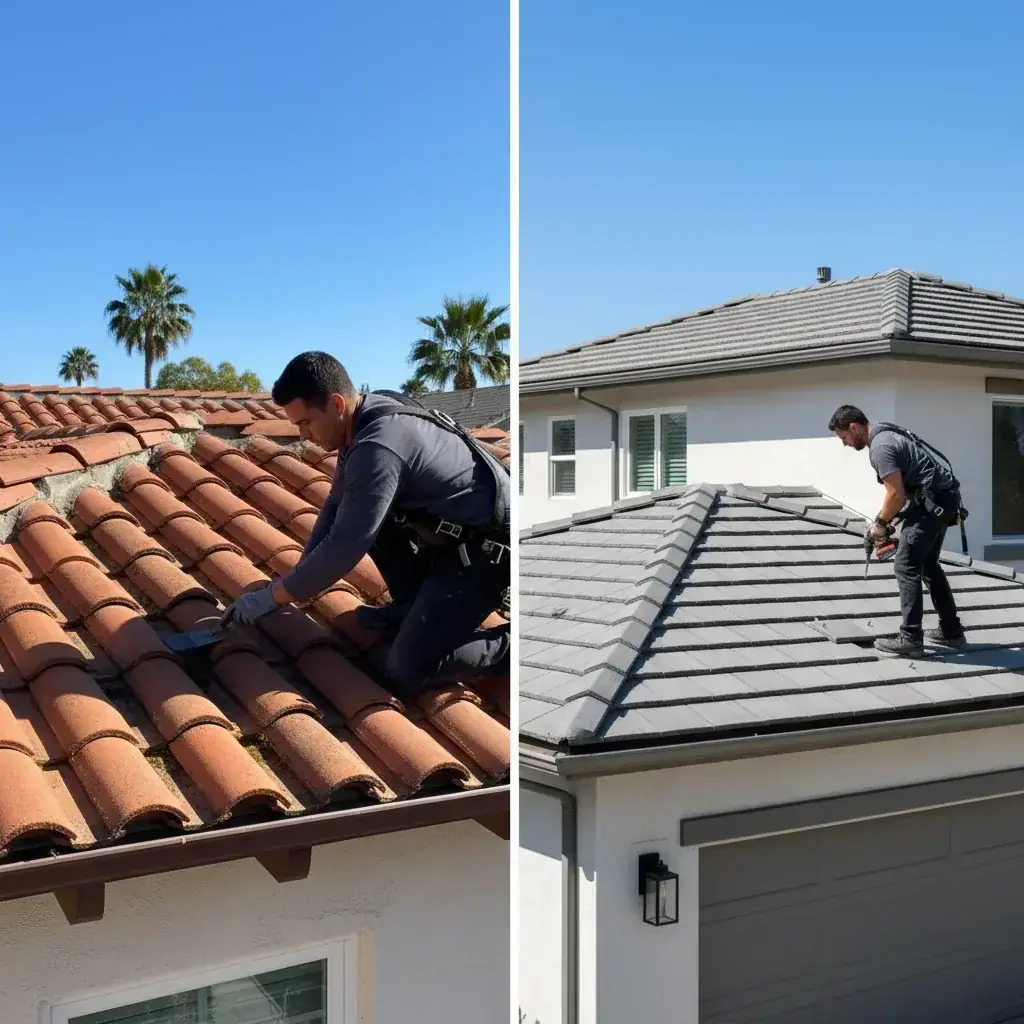
When the sheet is tired and the tile is sound, lift-and-relay is how you keep the field: stack tile, new underlayment and flashings, deck repairs, relay. You buy another cycle of the sheet, not a new ceramic order.
Ask for two columns: lift-and-relay vs new concrete or clay on the same measured roof. We will not invent those totals. Tile roof replacement cost. If the profile is discontinued and breakage is high, new tile may be the honest job.
Microclimate: what actually changes the math
Coast (La Jolla, Pacific Beach, Coronado, Carlsbad, Encinitas, Oceanside, Imperial Beach). Salt eats galvanized flashing and nails. The tile body is not a metal. Specify stainless fasteners and copper or better flashing on new work and on relay. Coastal salt damage.
Inland mesa (Clairemont, Mira Mesa, Mission Valley, Tierrasanta, Linda Vista). Mild, dry, little freeze. Sweet spot for tile bodies. The sheet still ages. Ventilation still matters.
North County inland (Rancho Bernardo, Carmel Valley, Scripps Ranch, Poway). More heat and UV on west slopes. Ridge and underlayment details matter. Tract felt of the same era often comes due together.
East County (El Cajon, Santee, Lakeside, Alpine). Heat and Santa Anas. Concrete color fade is usually cosmetic. Fasteners and battens take the mechanical stress.
Mountain (Julian, Pine Valley, Palomar). Freeze-thaw and rare snow. Porous concrete that holds water is a different risk than a Clairemont S-tile. WUI assemblies dominate material choice. See mountain notes on the lifespan hub linked above.
Clay vs concrete: the real difference
| Factor | Clay | Concrete |
|---|---|---|
| Body life | Long, color through the unit | Long body; surface coat can fade |
| Weight | Varies by profile; still a structural question | Often heavier S-tile on later tracts |
| Foot traffic | More brittle, more cracked units | Tougher in the field, still not a walkway |
| Matching repairs | Salvage hunts on old patterns | Easier on common S-tile |
| Look | Heritage on Spanish Revival streets | Tract default |
Clay is not “better” in every job. It is a different product. Concrete is not “worse.” It is cheaper to make and easier to source. Per-year math on a blog is invented. Concrete vs clay tile.
Signs the assembly, not the tile, is ending
The field rarely tells you first. The attic does.
Early: first-rain leaks after a dry summer, felt edges curling at the eaves, shifted or sagging courses (battens), unexplained ceiling stains.
Clear: leaks on more than one slope, daylight at chimneys and vents from the attic, wet decking, compressed or rotten battens.
Late: torn sheet at corners, many slipped tiles, crumbling hip and ridge mortar, interior damage.
A drone inspection plus an attic look, while the house is still dry, is how you plan a relay before drywall. Emergency pricing after a stain is a different conversation.
What actually extends tile life
- Gutter cleanouts. Backed-up eave water rots the sheet edge. How to maintain a tile roof.
- Minimize foot traffic. Pads and roof ladders. Solar before a tired sheet is a common mistake. Do solar panels damage your roof.
- Re-bed tired hip and ridge mortar when it is the leak, not the field. Ask for a named scope.
- Replace cracked tiles promptly so water is not hitting felt in a column.
- Inspections on the sheet’s schedule, not the curb’s. Annual roof maintenance.
- Coastal: upgrade flashing metal at relay time.
We do not invent re-bedding or single-tile repair prices. Get them on a written ticket.
FAQ
Will my tile roof last a century? Clay can on a well-detailed San Diego roof. The sheet will not go that long without at least one replacement. Flashing may not either. That is not a promise on your address.
Why do people say “25-year tile roof”? They are describing felt, or they are selling a new field. Ask what they lifted.
Is concrete cheaper because it is worse? It is cheaper to manufacture. Impact and matching are often easier. Fade is not the same as a failed body.
How do I tell clay from concrete? Tap gently: clay rings, concrete thuds. Chip the edge: clay is the color through; concrete often shows a grey body under a colored face.
I am a mile from the beach. What shortens? Flashings and fasteners, unless upgraded. Tile body: much less. Sheet: heat and detailing more than salt.
Can I add solar on a tired tile roof? You can. The expensive path is mounting first, then lifting panels to replace felt. Talk relay before the array. Preparing a roof for solar.
How do I know which underlayment I have? A roofer lifts a field tile and looks. Pre-2000 San Diego is often organic felt. Later jobs may be heavier felt or synthetic. Post-2015 is often synthetic. Confirm on this roof.
Are lift-and-relay jobs common here? Yes, especially North County tracts whose felt is aging together. Tile lift and relay.
Get a tile lifespan inspection
If the roof is old enough that you are guessing, an inspection that lifts tile and photographs the attic is the useful next step. It tells you whether you are on maintenance, relay, or new tile, and whether anything is leaking now.
We connect San Diego County homeowners with independent C-39 roofers for tile inspections, lift-and-relay, and repair. Verify any contractor at CSLB. Call (760) 750-5557 or request an estimate.