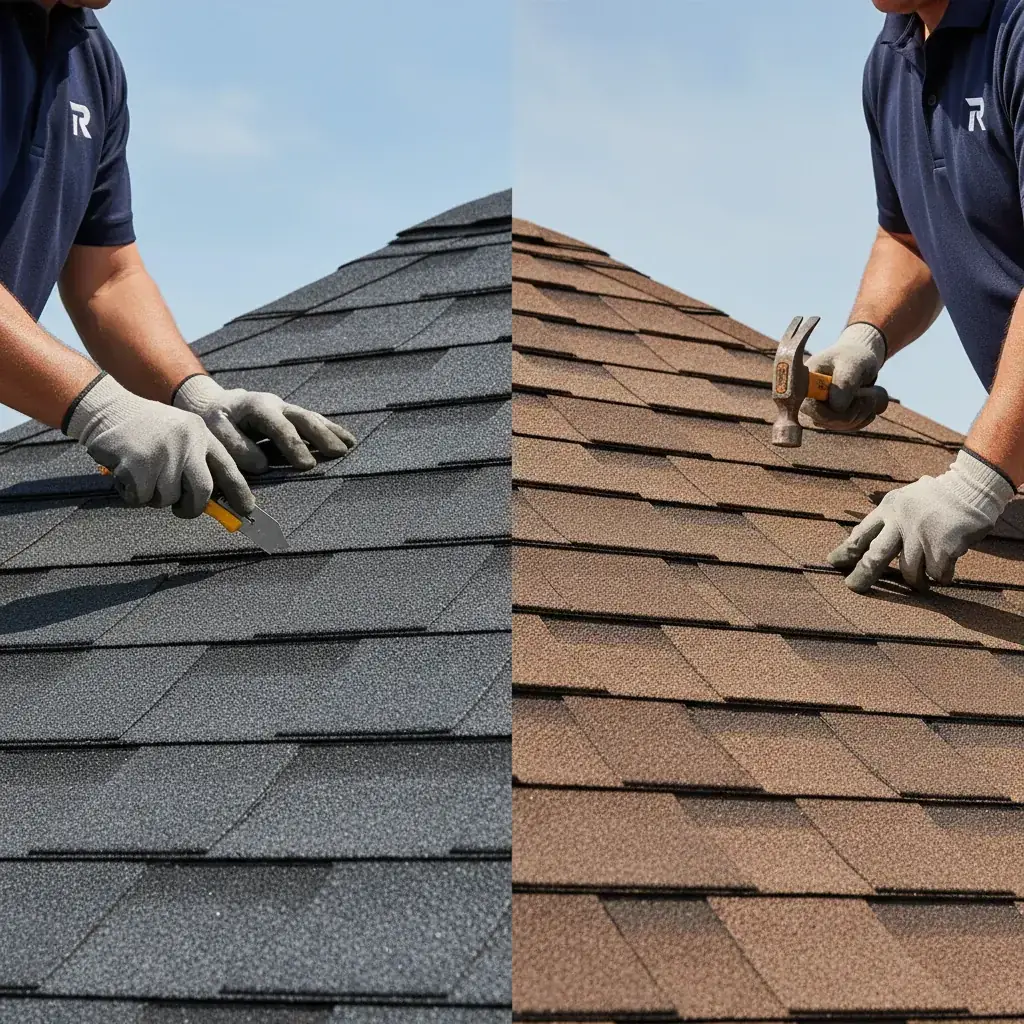
TL;DR
In San Diego, the 30-year vs 50-year shingle choice is a product-tier decision. It is not a promise of 30 vs 50 years of watertight life. The 50-year class is usually a thicker laminate, a higher published wind rating, and built-in algae resistance. The 30-year class is the standard architectural line. Keep those two bids as two products. Do not merge them into “just shingles.”
The upgrade is worth asking for if you will stay, you sit in a Santa Ana or hard-UV setting, you want algae resistance, or solar is on the roof. It is a weaker spend if you are on heavy salt fog (the system around the shingle often fails first) or you will sell soon. Ask the matched roofer for both tiers on the same measured roof. Call (760) 750-5557. Top Pro Roofing SD refers. We do not install.
Do 50-year shingles really last 50 years?
No. The number is a warranty class. Manufacturers do not promise 50 years of a dry attic. Coverage is usually full material for an early window, then prorated, and it covers the shingle, not the underlayment, flashing, or valleys that actually open first.
So the honest read: a 50-year tier buys a heavier mat, a longer non-prorated window on many lines, and extras like algae granules and a higher wind listing. It does not buy a second generation of ownership by itself. Ask the matched roofer what they expect for this ventilation, this slope, and this exposure, and to show it on the warranty PDF.
What are the cons of 50-year shingles?
You pay the premium on day one. The extra thickness and listings show up now. The extra years, if you get them, show up later, and only if you still own the house.
On the coast the shingle is not always the weak link. Salt fog hits granules, flashing, and fasteners. A thicker mat does not make galvanized valley metal last. Ask for the metal spec beside the shingle tier.
The warranty is worth less than the headline. Proration, labor limits, and registration windows eat the number. Read the table before you treat “50-year” as value.
What “30-year” and “50-year” actually mean
Both are warranty terms, with prorated tables most people never open.
A 30-year class shingle is a standard architectural laminate: two-piece look, basic coverage window. A 50-year class shingle is usually sold today as “limited lifetime”: thicker mat, longer non-prorated period on many lines, often algae and a higher wind rating in the published spec.
The standalone “30-year” print has faded. GAF, CertainTeed, and Owens Corning put their mid and premium architectural lines under lifetime-limited language. When a San Diego quote says 30-year vs 50-year, they almost always mean:
- 30-year tier: standard architectural laminate, thinner mat, baseline warranty
- 50-year tier: premium architectural or designer laminate, thicker mat, longer listed coverage, often algae resistance and a higher wind listing
Neither number is a climate test for your street. That is a separate conversation, and it is the one that matters here.
What are 30-year architectural shingles?
A 30-year architectural shingle is a laminated asphalt shingle: a fiberglass mat with a second cut layer bonded on top, sold under a 30-year-class or baseline lifetime-limited material warranty. It is the standard tier on many San Diego re-roofs. Architectural means laminated and dimensional, not three-tab. The 30 is coverage language, not a stopwatch.
Two details beat the number. Laminated tabs have more sealant area than three-tab, which is why they list higher wind. They also hide deck waves that three-tab telegraphs. If the wrapper does not say “30-year,” the quote still means the maker’s standard laminate line unless they named a premium product.
Real San Diego exposure: keep 30 and 50 distinct
The county is not one climate. A Coronado roof and a Ramona roof do not age the same. We will not invent a year table. Use this as a question list for both tiers on the same house.
| Setting | Cities (examples) | What to ask on the 30-year bid | What to ask on the 50-year bid |
|---|---|---|---|
| Heavy salt fog | Coronado, La Jolla, Del Mar, Encinitas, Carlsbad, Oceanside | Flashings, fasteners, algae line | Same metals. Does a thicker shingle change the first failure, or only the look? |
| Coast-to-inland | Solana Beach, Cardiff, Carmel Valley, Mira Mesa | Ventilation and valley metal | Algae granules, wind listing, underlayment |
| Inland valley | Escondido, Vista, San Marcos, Santee | UV on south and west slopes | Whether the premium mat is the right spend vs better ventilation |
| East County UV and Santa Ana | Ramona, Alpine, Poway, El Cajon, Lakeside | Uplift nailing pattern | Published wind rating and the fastening pattern that honors it |
Coastal underperformance is often metal and granules, not the fiberglass mat. East County underperformance is UV on asphalt plus repeated wind events. That is why the printed 20-year gap between 30 and 50 is marketing. The real gap is product spec plus install. Ask for both products, same underlayment and flashing, then decide.
Cost difference: how to compare the two bids
Pricing moves with neighborhood, slope, tear-off, and how booked the crew is. We will not invent per-square or whole-house numbers.
Ask for two columns on one proposal:
| Line | 30-year tier | 50-year tier |
|---|---|---|
| Product name | Standard architectural, named | Premium or designer, named |
| Installed square count | Same measured roof | Same measured roof |
| Underlayment | Named | Same, unless they upgrade it and say why |
| Wind listing and nailing pattern | On the page | On the page |
| Algae feature | Included or extra | Usually included on flagship lines |
| Workmanship vs manufacturer | Separate | Same, plus any system-plus paperwork |
A “square” is 100 square feet. Ask them to show how they counted yours. The upgrade decision is the delta between those two columns, not a blog’s typical home.
Cost per year of real life is only honest if someone has inspected this roof’s ventilation and exposure. Ask the matched roofer to talk in remaining service, not in wrapper years. Designer lines cost more because you are buying a look. Do not pretend that is extra life.
30-year vs 50-year shingles at a glance
Keep this as a side-by-side. Do not collapse it.
| Attribute | 30-year tier (standard architectural) | 50-year tier (premium architectural) |
|---|---|---|
| What the number means | Warranty class | Warranty class, often “limited lifetime” |
| Typical mat | Thinner laminate | Thicker, heavier laminate |
| Wind listing | Lower published mph on many standard lines | Higher published mph on many premium lines |
| Algae resistance | Often extra or skipped | Often built in (copper or zinc granules) |
| Non-prorated window | Shorter on many standard warranties | Longer on many premium warranties |
| Curb look | Dimensional, flatter shadow | Heavier profile, deeper shadow |
| Best-fit conversation | Coastal system limits, shorter stay, tight budget | Long stay, wind/UV, solar, HOA or street look |
Is the 50-year upgrade worth it in San Diego?
Worth asking for on long-stay inland and wind-corridor homes, and when solar is involved. Often not the first extra dollar on a coastal house where salt will take the metals, or if you are selling soon. You are buying mat, wind listing, and algae, not a 50-year clock.
| Your situation | Lean 50-year? | Why |
|---|---|---|
| Staying long, inland or East County | Ask for it | UV and time are harder on a thinner mat |
| Santa Ana corridor (Ramona, Alpine, east Poway) | Yes, if the listing and nails match | Uplift is a real local load |
| Solar now or soon | Usually | You do not want an early tear-off under panels |
| Coastal salt fog | Maybe not, unless algae and look matter | Ask for metals first |
| Selling within a short window | Usually no | You will not harvest later years |
| Tight budget, hidden roof | No | Put money in underlayment, ventilation, or flashing |
| HOA or street-facing custom | Often | Profile and algae hold the look longer |
If two or more of the “yes” rows fit, price the premium line. If you are coastal or short-term, keep the 30-year tier as a serious option, not a compromise you should be talked out of.
What you actually get for the upgrade
Strip the year marketing and four things remain.
Mat thickness and weight. Premium laminates carry more fiberglass and asphalt. That is real in wind and in how the shingle feels on the roof.
Granules. Heavier, better-stuck stone. Granule in the gutters is an early age signal here. Ask how the two products compare on the spec sheet, not for a made-up extra-year count.
Wind rating. Standard architectural lines often list a lower mph than premium lines. Owens Corning Duration, GAF Timberline HDZ, and CertainTeed Landmark Pro publish their own numbers and their own nailing strips (SureNail, LayerLock, and similar). The listing only counts if the pattern on the roof matches the page. For Santa Ana streets, that is the conversation.
Algae resistance. Copper or zinc granules on most flagship 50-year lines. Marine layer keeps many coastal roofs damp. Black streaking is why people reroof early for looks. On a 30-year line, ask whether algae resistance is included or an add-on.
What you do not get: a 50-year dry attic by decree.
When 50-year makes sense
Price the upgrade when at least two of these are true:
- You plan to stay a long time
- Santa Ana corridor (Ramona, Alpine, east Poway, Jamul, parts of Escondido)
- Hard UV (south or west field, little shade, East County)
- Curb appeal is part of the job (HOA, street-facing custom)
- Solar is on the roof or coming, and you do not want an early panel pull
- Your carrier actually credits an impact-rated product, and that product only exists in the premium tier (confirm with the carrier, not the brochure)
Solar timing: pulling and resetting an array is its own line. Compare that line to the shingle-tier delta. See solar panel removal and roof replacement.
When 30-year is enough
The standard tier is the right roof more often than premium marketing wants.
- You are selling on a near horizon and need an honest inspection, not a designer roof
- You are coastal and salt will write the first failure on metal, not on mat thickness
- The upgrade money buys better insulation, ventilation, or a cooler color instead
- The roof is not seen from the street
- You already plan metal or tile at the next replacement
A standard architectural shingle in Chula Vista or El Cajon, installed with named underlayment and flashing, is a complete system. Do not pay for warranty years you will not be here to use.
Warranty fine print (read this part)
Proration. Many “50-year” or lifetime tables pay full material for an early block of years, then a shrinking fraction. Late in the table you may be looking at a slice of wholesale shingles, not a free roof. Labor, tear-off, and flashings are often outside that number.
Labor. Labor coverage, when it exists, is usually a short window. After that you pay labor to install whatever discounted bundle the warranty names.
Transfer. One transfer is common, with paperwork, inside a stated window. After that the next owner may get little. If you are buying a house with a new roof, ask for the registration and transfer file.
Defect vs weather. Warranties cover manufacturing defects. Granule wear, UV, salt on flashings, and wind outside the listed conditions are often excluded. Those are the usual San Diego failure modes.
Registration. Many premium warranties need registration shortly after install. Miss it and you may drop to a thinner table.
Ask for the PDF before you sign. Read proration, labor, and what counts as a defect.
GAF, CertainTeed, and Owens Corning
Three flagship 50-year-class products show up constantly in this county. Compare the current spec sheets, not a remembered price.
| Spec to request | GAF Timberline HDZ | CertainTeed Landmark Pro | Owens Corning Duration |
|---|---|---|---|
| Warranty class | Lifetime limited | Lifetime limited | Lifetime limited |
| Nailing / wind feature | LayerLock | Published wind listing on the sheet | SureNail strip |
| Algae line | StainGuard Plus on the current sheet | StreakFighter on the sheet | StreakGuard on the sheet |
| Why crews pick it | Wide stocking, LayerLock pattern | Heavier feel on many lots | Installer-friendly nail line |
Install quality still beats brand. A careless HDZ job loses to a careful Landmark Pro job. These three are worth considering because specs are public, warranty desks exist, and the products are stocked locally. Off-brand savings can vanish in callbacks. Verify C-39 at CSLB and ask whether the crew is certified for the brand they are selling.
More: CertainTeed vs Owens Corning, GAF vs Owens Corning.
Related reading
- Asphalt shingle types compared
- Asphalt shingle vs architectural
- 50-year shingles vs metal
- Best roofing shingles for San Diego climate
FAQ
Do 50-year shingles really last 50 years?
No. The label is a warranty class. UV, salt fog, Santa Ana wind, and ventilation decide service life more than the wrapper. Ask for a product-specific, house-specific answer.
Is the 50-year upgrade worth the price?
Often for mat, wind listing, algae, and look. Not because the warranty says 50. Worth pressing on long-stay inland and wind-corridor homes and with solar. Often skip on coastal metals-first jobs and on a short stay.
How much does a 50-year shingle roof cost in San Diego?
Ask for a 30-year-class column and a 50-year-class column on the same square count. Steep, cut-up, and coastal tear-offs sit at the high end of whatever that crew is charging. We will not invent a county average.
Does the warranty cover labor when shingles fail?
Usually only inside a short window. Read that section of the PDF.
Does the warranty transfer if I sell?
Often once, with paperwork, inside a stated period. After that, assume little. Buyers should ask for the file.
Are algae-resistant granules on 50-year shingles?
On most flagship lines, yes. On many 30-year lines they are extra or absent. In marine-layer San Diego, that feature is one of the practical reasons to upgrade.
Does the brand matter?
Less than the installer. Still, GAF, CertainTeed, and Owens Corning document what they sell. Verify license and brand certification.
Get both tiers quoted
The 30 vs 50 decision is real, and it is not the only decision. Underlayment, flashing, ventilation, and who nails the roof move more than the year on the wrapper. We connect you with an independent roofer who should quote both tiers, walk the exposure, and hand you the PDFs. Call (760) 750-5557 or contact. Process: roof replacement.
Sources: