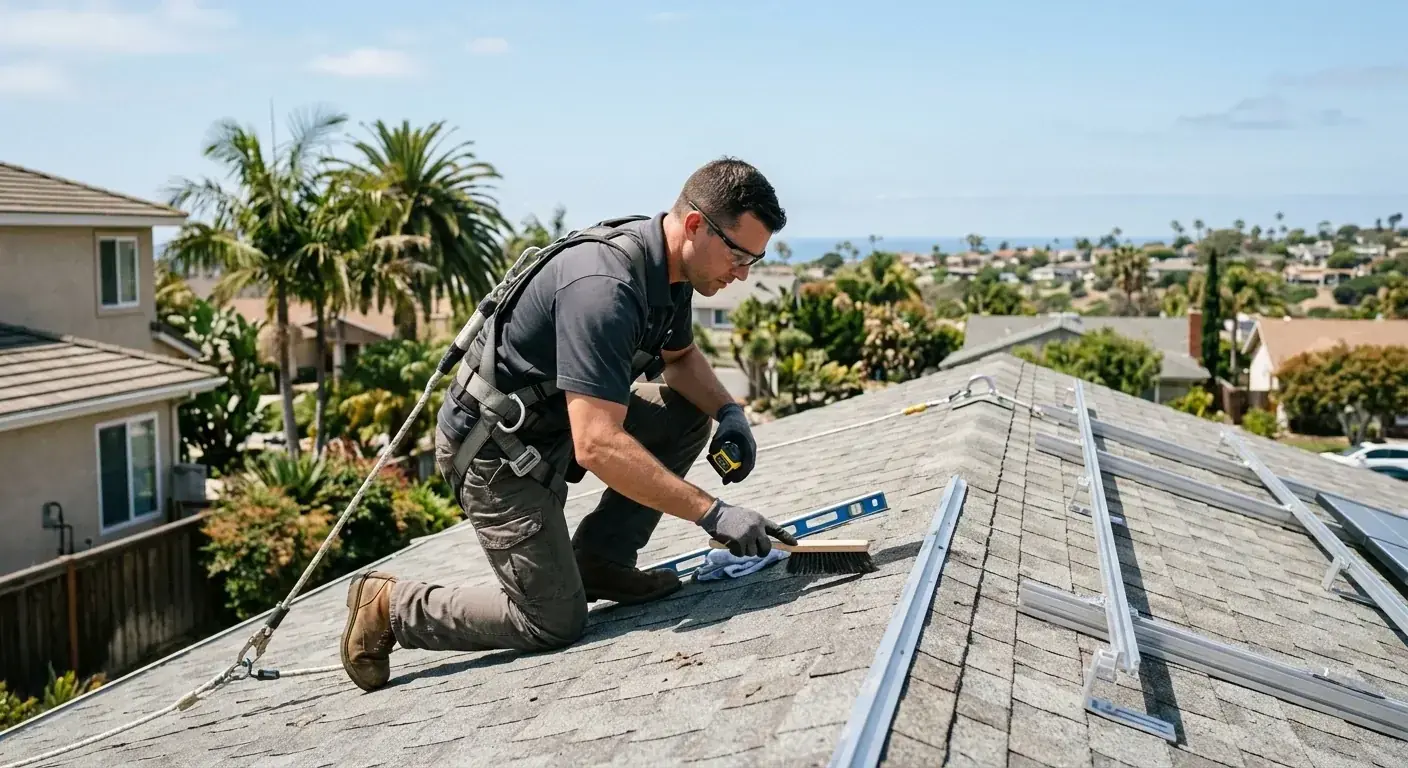
If your roof’s reaching the end of its life and you’ve got solar panels on top, you’re about to learn one of the least-talked-about costs in the home improvement world. Detaching and resetting a solar array for a roof replacement isn’t cheap, and the number you’ll pay swings wildly based on one factor most homeowners don’t think about until it’s too late: who installed the panels in the first place. The full breakdown on why San Diego homeowners are getting rid of solar panels goes deeper.
TL;DR
For a typical 5-7 kW residential array in San Diego (roughly 15-22 panels), detach-and-reset pricing in 2026 runs anywhere from $750 to $5,500. The original installer with a service agreement is on the low end. A third-party solar service company doing the work cold is on the high end. Most homeowners pay somewhere between $2,500 and $6,000 once you fold in array complexity, hardware replacement, and any conduit or electrical re-permitting. If your original installer is out of business (and many of San Diego’s 2010-2018 solar companies are), you’ll pay more and have to do more legwork.
Why this cost surprises so many San Diego homeowners
San Diego has one of the highest residential solar penetration rates in California. Neighborhoods like Carmel Valley, Scripps Ranch, Carlsbad, Encinitas, and Poway saw aggressive solar adoption between 2012 and 2020, when NEM 1.0 and NEM 2.0 made the math obvious. A lot of those installs happened on roofs that were already 10-15 years old.
Fast forward to 2026, and those roofs are now 20-30 years old. The asphalt shingles are curling. The tile underlayment’s done. The flashing’s failing. So homeowners call out a roofer for an estimate, and that’s when the conversation gets interesting.
A roofer can replace the roof. They can’t legally touch your solar panels. The electrical work, the racking, and the panel handling all fall under a CSLB C-46 solar contractor license, which most roofing companies don’t carry. That means you need two crews coordinated across the same project window. And the solar crew’s invoice is the one nobody warned you about.
The surprise factor is real. Most homeowners didn’t budget for it because the solar salesperson 10 years ago didn’t bring it up. Why would they? They were selling you a 25-year system. The fact that your roof had less life left than the panels they were bolting to it wasn’t their problem.
Cost from the original installer with a service agreement
This is the cheapest path by far, and it’s the one most people don’t have access to. If you bought your solar system with a service agreement that included future detach-and-reset coverage, or if your original installer is still in business and offers a loyalty rate, you’re looking at the bottom of the price range.
In 2026, a still-active San Diego solar installer servicing their own legacy customers typically charges $50-$150 per panel for detach-and-reset. For a 20-panel system, that’s $1,000-$3,000 all in, often with a single mobilization fee folded in.
The reason it’s cheap: they know the system. They installed the racking. They have the documentation. They don’t need to spend time reverse-engineering whose hardware is on your roof or which inverter model handles what. They also have a financial incentive to keep you as a customer for future upgrades.
The catch: a lot of the original installers from San Diego’s solar boom years are no longer in business. Companies like Sungevity, NRG Home Solar, and several regional outfits closed between 2018 and 2023. If your system was financed through a third-party PPA or lease, the leasing company may or may not still service the array. Check your paperwork before you assume.
| Original installer status | What it means for you | Typical 2026 detach/reset cost |
|---|---|---|
| Still in business, you’re a customer | Best case scenario | $50-$150/panel |
| Still in business, no service plan | Decent case | $100-$200/panel |
| Out of business, parts brand still supported | Third-party can source hardware | $150-$250/panel |
| Out of business, proprietary or obscure hardware | Worst case | $200-$300/panel plus hardware replacement |
Cost from a third-party solar service company
If your original installer is gone, or if they’re around but won’t take the job, you’re calling a third-party solar service company. San Diego has a handful of these. They specialize in operations and maintenance, troubleshooting, repairs, and detach-and-reset work for orphaned systems.
Third-party pricing in 2026 typically runs $150-$250 per panel, with a minimum job fee somewhere between $1,500 and $2,500. For that same 20-panel system, you’re looking at $3,000-$5,000 before any complications.
What you’re paying for here is expertise, not just labor. The crew has to inspect your existing racking, identify the inverter and the optimizer or microinverter setup, document the layout for reinstall, handle the disconnect with the utility properly, and re-commission the system once the roof’s done. Half the cost is administrative and engineering. The actual physical removal of panels is a couple hours of work.
A reputable third-party company will also flag any aged hardware that should be replaced rather than reinstalled. Twenty-year-old roof mounts and lag bolts that have been baking in San Diego sun shouldn’t go back on a fresh roof. You want stainless or properly coated hardware on a new install, and that’s an extra cost most homeowners don’t see coming.
Cost as part of a roofing company subbed project
Some roofing companies in San Diego have relationships with solar service contractors and will bundle the detach-and-reset into the overall roof project. The pricing isn’t usually cheaper, but the coordination headache disappears.
When a roofer subs the solar work, you’re typically still paying $150-$250 per panel, but it appears on the roofer’s master invoice rather than as a separate line item from a separate company. The roofer manages the scheduling so the solar crew’s there the morning of demo and back the day the new roof’s buttoned up.
The upside: one point of contact, one project manager, one timeline. The downside: you might pay a small coordination markup, usually 5-10%, and you have less direct visibility into the solar crew’s qualifications. Always ask your roofer who they sub solar work to, verify the sub’s C-46 license on the CSLB website, and ideally talk to the sub before signing.
What’s included in a proper detach-and-reset
The term “detach and reset” gets thrown around like it’s a single line item, but it’s actually a chain of separate operations that have to happen in sequence. Understanding what’s included tells you whether the quote you’re holding is complete or has gaps.
A complete detach-and-reset scope of work includes:
- Utility coordination and shutdown. The system has to be properly disconnected from the grid before any work begins. SDG&E requires notification for any system that’s coming offline for an extended period.
- Panel removal. Each panel gets disconnected electrically, unclamped from the racking, and carried down. Panels weigh 40-60 pounds each and have to be handled to avoid microcracks.
- Rail and racking removal. The aluminum rails and roof attachments come off. On a tile roof, this means lifting tiles and removing the mounting brackets underneath. On asphalt, the lag bolts come out and the holes get sealed for the roofer to demo over.
- Conduit and wiring handling. Conduit running across the roof gets disconnected and either removed entirely or set aside for reinstall. If it runs through the attic, that section usually stays in place.
- Panel storage. Panels need to be stored flat, off the ground, and protected from theft and weather. Most crews tarp them in the driveway or stack them in the garage.
- Reinstall after roof completion. New flashing, new mounts (or reused mounts if they’re in good condition), rails go back, panels go back, electrical reconnects.
- Monitoring re-commissioning. The inverter and monitoring platform (Enphase Enlighten, SolarEdge, Tigo, etc.) get re-paired. Sometimes the monitoring resets and needs a full re-registration.
- Electrical re-permitting if required. Most cities in San Diego County don’t require a new permit for a like-for-like reinstall, but if any electrical components change or if hardware updates are needed, you may need a new permit and a final inspection.
| Service tier | What’s included | When you’d choose it |
|---|---|---|
| Basic detach/reset | Removal, storage, reinstall, basic reconnect | Newer system, hardware in good shape, simple array |
| Standard detach/reset | All basic items plus new flashing, new lag bolts, full system re-commissioning | Most San Diego homes, 8-15 year old systems |
| Full service detach/reset | All standard items plus hardware audit, conduit rerouting if needed, permit pulled, final inspection | Older systems, defunct installer, any electrical updates |
Hidden costs most quotes don’t mention
Here’s where the bill grows. A clean detach-and-reset quote is the floor, not the ceiling. Budget for these contingencies before you sign.
Panel damage during removal. Solar panels are surprisingly fragile. The glass laminate cracks if a panel gets dropped or torqued wrong, and even microcracks invisible to the eye can degrade output. If your crew breaks a panel, you may be on the hook for replacement, which runs $300-$600 per panel in 2026 plus the labor to swap it. Confirm the crew’s insurance covers panel damage before they start.
Replacement of aged hardware. Lag bolts, clamps, and flashing that’s been on a roof for 15+ years often shouldn’t be reused. Quality stainless lag bolts and proper flashing kits cost $20-$50 per attachment point, and a typical 20-panel array has 40-80 attachment points. That’s another $800-$4,000 if your installer recommends a full hardware refresh, which a good one will.
Conduit rerouting. If your conduit runs across the roof surface (which a lot of older San Diego installs do), the roofer may need it moved to do their work properly. Rerouting conduit costs $300-$1,500 depending on how much has to move and whether it needs to come down off the roof and run through the attic.
Monitoring re-registration. Some monitoring platforms charge a re-registration fee or require the system to be inspected before re-enabling. Enphase Enlighten is generally free to re-pair. Some legacy SolarEdge setups can require firmware updates and a paid service call.
NEM 3.0 implications. California’s net metering rules changed in 2023. If you’re on an old NEM 1.0 or NEM 2.0 agreement, a major system modification can trigger a forced rollover to NEM 3.0, which has significantly lower export credits. A like-for-like detach-and-reset usually doesn’t trigger this, but any system expansion or substantial change does. Ask your solar contractor in writing whether the scope of work will impact your NEM agreement.
How original installer status affects your pricing
The biggest variable in your final cost is whether the company that put your panels up is still around. San Diego’s solar landscape went through significant consolidation, and a lot of homeowners are caught in the middle.
Many regional installers from the 2010-2018 boom closed, were acquired, or stopped servicing legacy customers. If your installer is gone, you have three options: call the manufacturer of your panels and inverter to ask for a service network referral, search the NABCEP certified professional directory for a certified installer near you, or call a third-party O&M company directly.
Manufacturer referrals are sometimes the best path. Enphase, SolarEdge, LG, and Panasonic all maintain networks of approved service partners. The work won’t be free, but the quality bar is higher than picking a random company off Google.
Pre-arranging detach pricing at solar install time
If you haven’t installed solar yet, here’s the move that saves the most money: lock in a detach-and-reset rate as part of your original solar contract.
Some San Diego installers will agree, in writing, to a future detach-and-reset price (often expressed as a per-panel rate, escalated for inflation) as part of the original install. This is rare but not unheard of, and it costs nothing to ask. If the installer’s confident they’ll still be around in 15-20 years, they’ll consider it.
The other angle: if you’re about to install solar on a roof that’s already 10+ years old, the smarter play is almost always to replace the roof first. The math runs cleanly. A new roof costs $15,000-$40,000 in San Diego for a typical home (see our new roof cost breakdown for current numbers). Avoiding a future $3,000-$6,000 detach-and-reset, plus a few weeks of lost solar production, plus the risk of panel damage during removal, usually justifies doing the roof first.
Coordinating roof and solar work in a single window
When you do need to do both, the project window matters. A typical asphalt roof replacement in San Diego takes 2-4 days. A tile roof can take a week or more. Your panels are off the roof that entire time, which means zero solar production and a higher utility bill that month. For more on this, see 2026 tile roof replacement cost in San Diego.
The tight choreography: solar crew detaches on day one, roofing crew demos and replaces, solar crew returns on the final day (or the day after) to reinstall. Both crews need to be booked weeks in advance to hit the same window. Mid-week scheduling is usually easier than Mondays or Fridays.
Some homeowners try to save money by doing the roof first and the reinstall a few weeks later. That doesn’t save money. The solar crew’s mobilization fee gets charged twice, and your system’s offline longer. Don’t split the project.
How to verify the reinstall is done correctly
Once your panels are back on the roof, here’s how you make sure the work was done right. Don’t skip these.
- Check production within 48 hours. Log into your monitoring app and confirm every panel is reporting. If a microinverter or optimizer doesn’t come back online, it’s a 30-minute fix if you catch it fast and a much bigger headache if you don’t notice for months.
- Inspect every flashing point. Walk around the house, look up at the roof. Every penetration should have visible flashing integrated with the new roof. No raw lag bolts sticking out. No caulk-only seals.
- Confirm the array layout matches the original. Sometimes panels get reinstalled in a slightly different position than they came off. That’s usually fine, but it can affect string voltages on string inverter systems.
- Get the inspection sign-off in writing if a permit was pulled. A new permit means a new inspection card. File it with your home records.
- Wait through the first heavy rain. San Diego’s first significant rainstorm of the season (usually November or December) is the real test. If there’s going to be a leak, it’ll show up then. Check the attic for moisture within 24 hours of the first big rain.
FAQ
Can my roofer do the solar work themselves?
Only if they hold a CSLB C-46 solar license. Most don’t. A general B contractor or C-39 roofer can’t legally remove or reinstall solar panels in California. Always ask.
Does my home insurance cover panels damaged during a roof replacement?
Usually no. The damage happens during a planned home improvement project, which insurance considers a contractor liability. Your solar contractor’s general liability policy should cover it, which is why you verify their insurance before they start.
How long are my panels off the roof during a typical project?
For asphalt shingle, 2-4 days. For tile, 5-10 days. Plan for one full SDG&E billing cycle of higher-than-normal usage.
Will my solar production warranty still be valid after a detach-and-reset?
Panel manufacturer warranties (typically 25 years on production) usually transfer through a proper reinstall. Workmanship warranties from the original installer usually don’t carry over. Your new installer or solar service company should provide their own workmanship warranty on the reinstall work.
Do I need to tell SDG&E?
Yes, but it’s usually a notification rather than a permit. Your solar contractor should handle the utility communication.
Is it cheaper to abandon the panels and start fresh after the roof?
Almost never. Even old panels usually have years of useful life left, and a fresh installation costs $15,000-$30,000 versus a few thousand for a detach-and-reset. Unless your panels are first-generation tech (pre-2010) or visibly damaged, reuse them.
What if my original installer went out of business and I can’t find documentation?
A good third-party solar service company can reverse-engineer most installs in an hour. Inverter brands, panel brands, and racking systems all have visible markings. Expect a small assessment fee ($150-$300) for the documentation work.
How Top Pro Roofing handles solar-roof projects
Roofers in our network don’t touch the solar work themselves. What a good project does is coordinate the entire timeline with a vetted solar service partner who handles the detach-and-reset, so both crews are choreographed and your home is only buttoned up for a couple of days.
Our typical solar-roof project flow: we do a free roof assessment, give you a written quote for the roof replacement (whether it’s tile or asphalt), and provide an introduction to our solar partner for the detach-and-reset quote. You get two separate contracts (so you know exactly what each crew’s responsible for) but one coordinated project window.
If you’re looking at a leaking roof and trying to figure out whether to repair or replace before dealing with the solar question, our roof repair versus replace guide walks through the decision tree. And if you’re curious whether your existing solar install is damaging your roof underneath, we covered that too.
The bottom line: budget realistically. Don’t let a solar removal cost surprise you in the middle of a roof project. Get the quote in writing before demo starts, verify the contractor’s license and insurance, and plan the window so your system’s only offline for a few days. When it’s done right, you’ve got a fresh roof and a solar array set up to outlast it.