Top Pro Roofing SD is a referral marketplace. We connect San Diego County homeowners with CSLB-licensed roofers. We do not install metal, we do not fabricate panels, and we do not approve HOA colors. Call (760) 750-5557.
The chip you liked in the showroom is small, viewed under indoor light, and held close. The roof spreads that same paint across a broad, sunlit plane seen from the street. Those two views can look very different, and the gap between them is where most color regret comes from.
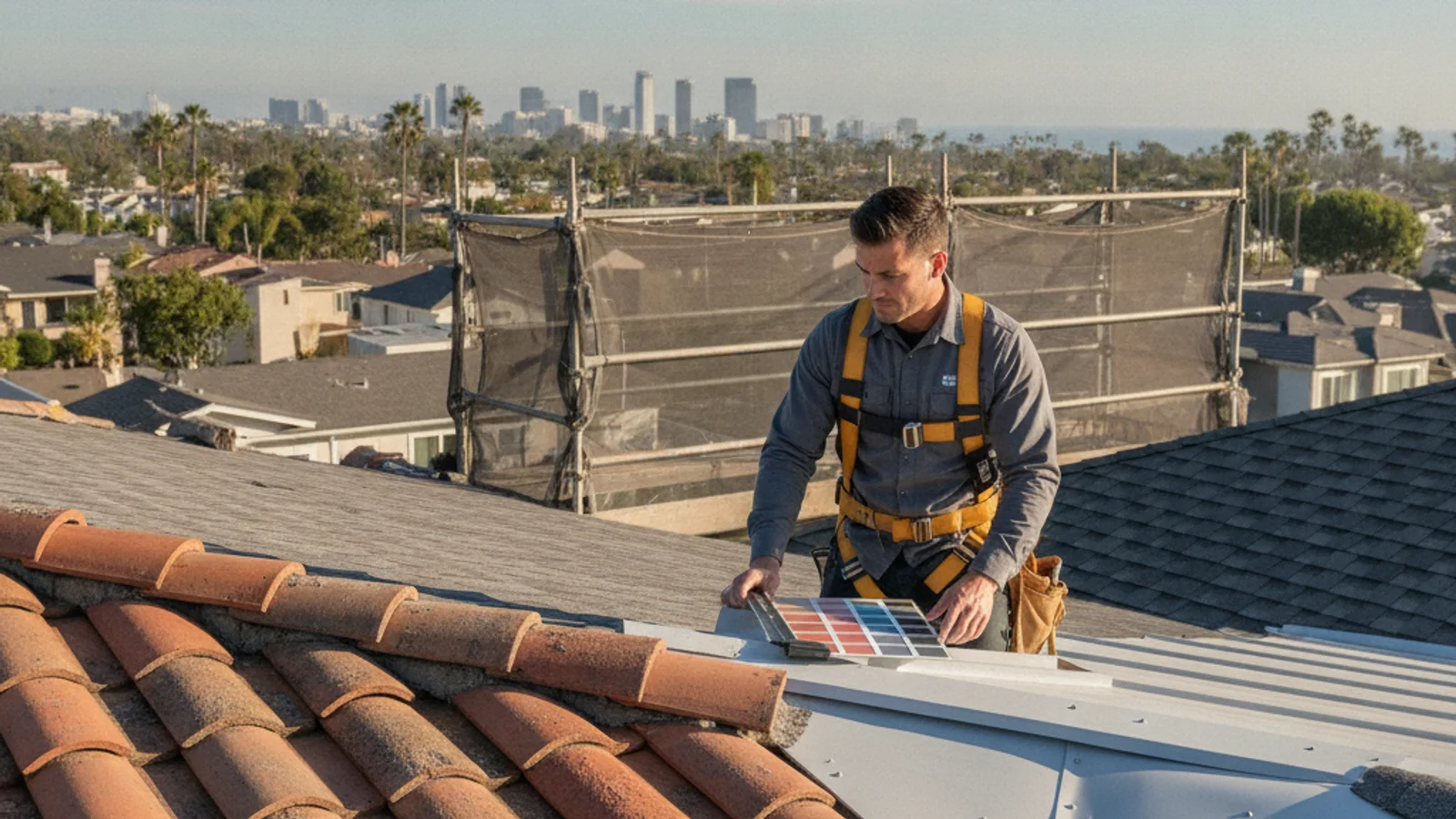
Start with the house, not the sample chip
A roof color is the second largest color decision on a house after the walls, and the one you will change least often. Pick from what is already fixed: stucco color and texture, stone or brick veneer, window frames, garage door, fascia and trim, hardscape. Those are the constraints. The roof either resolves them or fights them.
San Diego County architecture gives real direction. Match the roof to the home’s existing lines, materials, and palette. Terracotta, weathered bronze, and deep clay tones can complement warm stucco and tile-shaped profiles. Low-contrast neutrals can suit a restrained exterior palette. Charcoal, slate grey, and matte darks create sharper contrast against off-white stucco.
Two filters cut the list fast. Contrast: a roof much darker than the walls pulls the eye to the roofline and can make a low, wide house look heavier, while close-value combinations flatter a large or busy roof plan. And permanence: a bold color has to survive the next wall repaint and the next owner’s taste. If the panel type is still open, our standing seam guide covers how profile interacts with the look, since metal roofing gets color and profile specified together.
How fade and chalking actually show up
Two different things happen to a painted metal roof over time, and they look different. Fade is loss of color intensity as ultraviolet light breaks down pigment. Chalking is degradation of the resin at the very surface, which leaves a fine powdery haze that dulls the finish and can wash down onto walls in streaks. A roof can chalk without fading much, and it can fade evenly while staying glossy.
It shows most on saturated colors. Reds, deep blues, and bright greens carry their identity in pigment, so any loss reads as change. Very dark colors show chalk haze more, because the powder is light and the background is not. Light greys, tans, and mid-tone earth colors hide both effects, which is why they dominate long-run commercial metal. If you want a strong color to hold, the finish system matters more than the color name.
The two finish families you will see quoted are PVDF, sold under brand names like Kynar and Hylar, and SMP, a silicone-modified polyester. PVDF is the coating specified where color retention over decades is the priority. SMP is the common choice on budget-driven and outbuilding work. We will not publish fade rates, chalk limits, years, or a price gap, because those values are manufacturer- and color-specific. Get the numbers from the paint warranty for the exact color. A licensed roofer who cannot produce that document is quoting a finish they have not confirmed.
Solar reflectance, Title 24, and what applies here
Color and heat are related, but the code question is narrower than most homeowners assume. Look up the CEC climate zone for this address. Cool-roof requirements for low-sloped roofs, when they apply, use aged solar reflectance, thermal emittance, or SRI thresholds on the current Energy Code tables. Those numbers live in the code and on the CRRC product page, not as a figure we should freeze in a blog.
Do not treat typical San Diego steep-slope metal as a cool-roof default. A low-slope metal roof or a low-slope addition can still sit inside a different package. Raise that distinction with the licensed roofer and the permit set before you lock a dark color on a flat addition. Verify your building. Slope, scope of work, and the code cycle in effect control the answer.
Aged values are what count, not a fresh panel. The Cool Roof Rating Council tests products new and after outdoor weathering, so aged reflectance is what a product is judged on. When a rating sits near a threshold, read the aged number. Our roof color and cool roof guide goes deeper across materials.
Where coastal and inland exposure differ
The same panel in the same color has two different lives depending on where the house sits. In the marine layer band, from Imperial Beach through Coronado, La Jolla, Del Mar, Encinitas, and Oceanside, the finish deals with salt aerosol, humidity, and long stretches of diffuse overcast. Salt sits on the surface between rains and concentrates at panel edges, fasteners, and cut lines. That is a substrate and detailing conversation as much as a color one. See salt exposure and metal roofs.
Inland, from Escondido and San Marcos east through Poway, Ramona, El Cajon, and Alpine, the pressure is heat and hard direct sun with little overcast relief. A dark inland panel runs hotter than the same panel in Del Mar. That is where a lighter or higher-reflectance option earns its keep for attic temperature.
Light behaves differently in the two zones. Diffuse coastal light flattens contrast and cools tones, so a warm bronze reads greyer near the water than it did on the sample. Hard inland light raises contrast and warms everything, so a mid-grey picks up a beige cast. Look at samples in the light your house lives in, not a showroom in another ZIP code.
HOA palettes, coastal communities, and the approval step
In much of the county the decision is not entirely yours. Master-planned communities in eastern Chula Vista, 4S Ranch, Del Sur, Santaluz, Carmel Valley, and Rancho Bernardo run architectural review with approved exterior palettes, and roof color is usually on the list, as do many associations in Rancho Santa Fe and Fairbanks Ranch. Some tile-dominant communities restrict material as well as color, which can rule metal out or push you toward a tile-profile stone-coated product.
Some coastal communities also have design guidelines on reflectivity and view corridors. That is a city-by-city question. Ask planning staff and the association before ordering.
Sequence it this way. Shortlist colors, confirm the product and color are on the approved palette or submit for approval, get that approval in writing, then order. Metal panels are made to order in the color you pick, so a rejection after fabrication is a real problem rather than a swap. Build the approval window into the roof replacement schedule rather than discovering it after tear-off.
How to compare colors without guessing from a screen
Never choose from a monitor. Screens are backlit, calibrated differently, and cannot show sheen or how a rib pattern breaks up light. A photo of a finished roof online is worse, since it carries someone else’s camera processing and someone else’s sky.
Ask for metal samples in the actual product and finish, not printed cards, and large enough to see. Look at them on site, against the wall color, in morning light, at midday, and near sunset. Watch the sheen when the sun is low, which is when semi-gloss and matte stop looking alike.
Also account for pitch. A steep roof shows its field color to the street and behaves like a vertical wall of color, so a bold choice reads bold. A low-slope roof is mostly seen at a glancing angle or from above, from a neighbor’s second story or a hillside, and it reflects sky rather than showing color, which mutes almost everything. On low slopes the eyeline color that matters is often the fascia and the edge metal, not the field. Ask which colors the licensed roofer has installed nearby and whether you can drive past a few. A several-year-old roof in your own climate zone tells you more than any sample.
When to call us
Color, finish system, and panel profile get specified together, and the finish warranty for the exact color needs to be in the submittal before anyone orders material. A licensed roofing pro should walk the roof, confirm the slope condition and the applicable energy requirement, and hand you the product documentation rather than a paint chip. Call (760) 750-5557 and we will connect you with a licensed local C-39. Verify the license at CSLB.