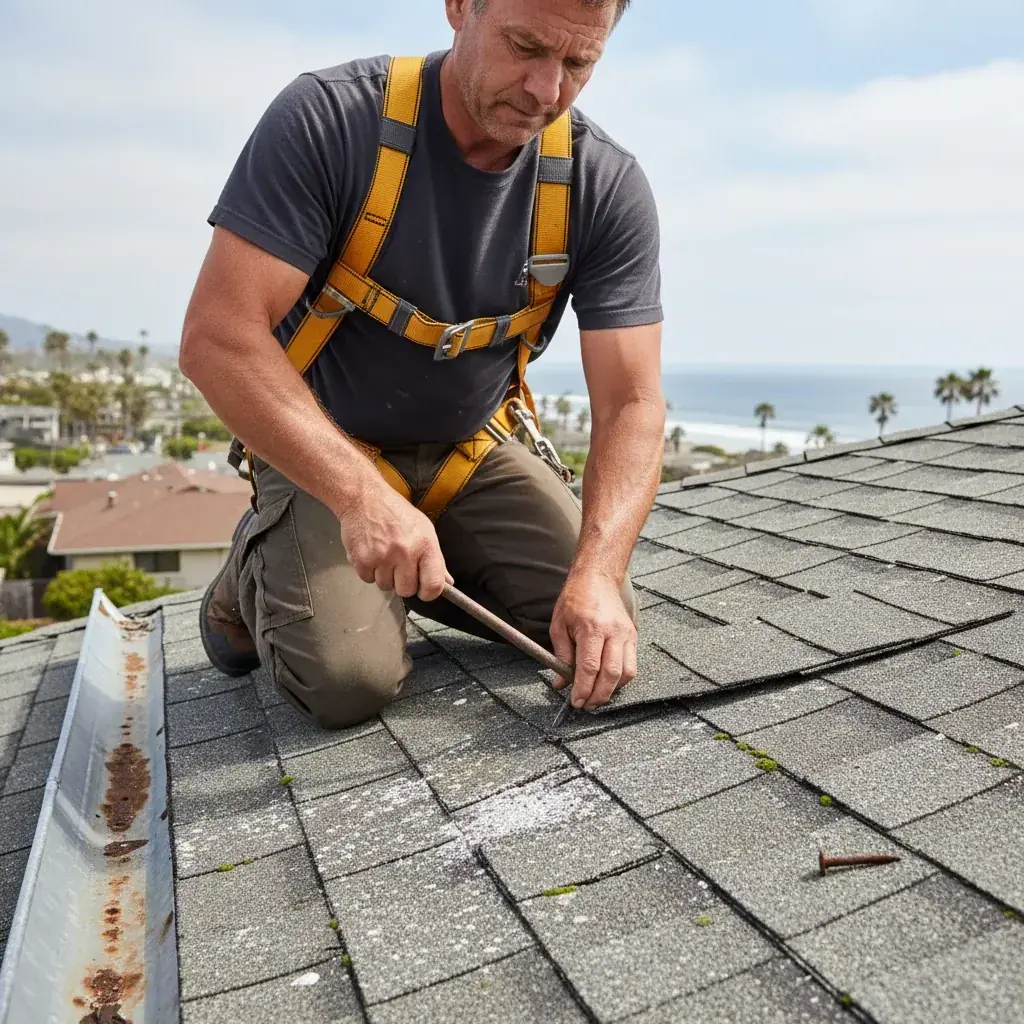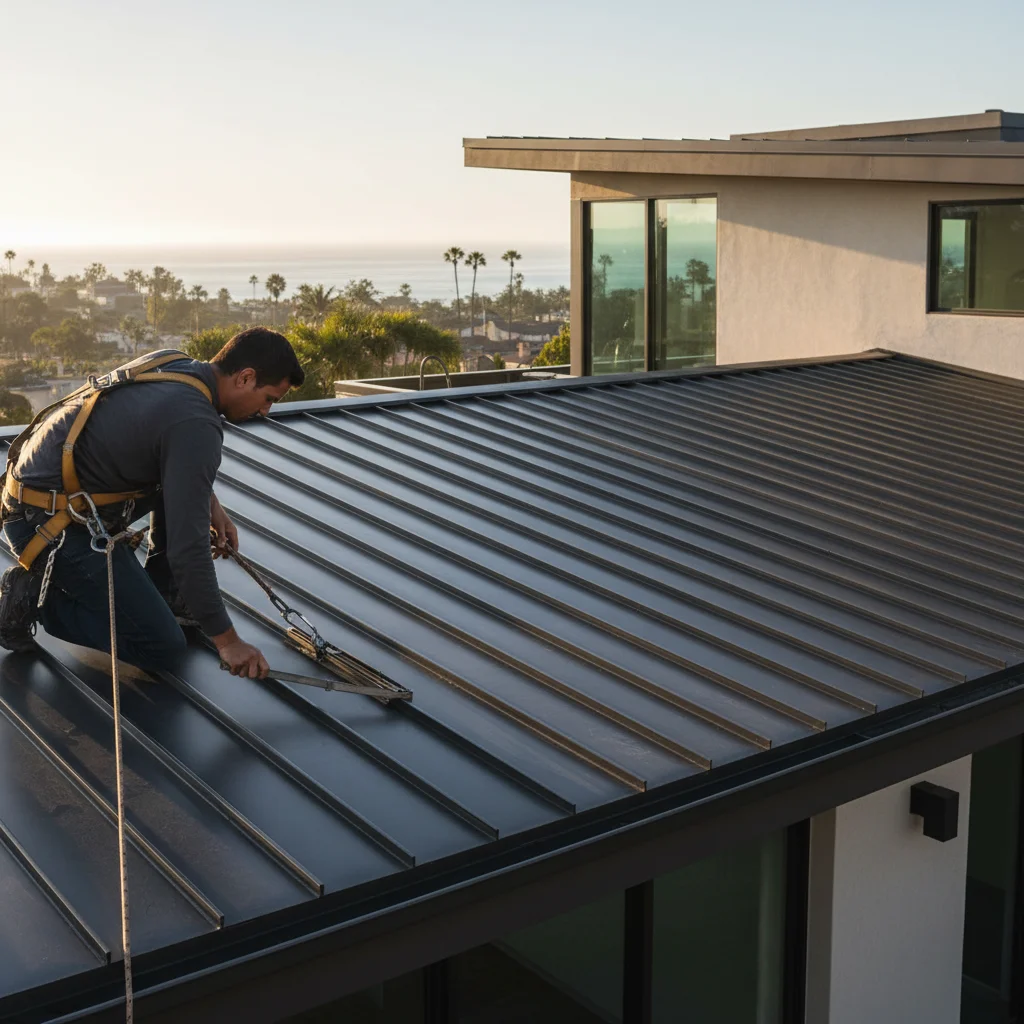
Short answer (60 seconds) Yes, salt damages metal roofs, but the rate depends entirely on the alloy. Within a mile of the San Diego coast, aluminum, copper, zinc, and 316 stainless are effectively bombproof and routinely outlive the building. Coated Galvalume and pre-painted steel hold up well when the factory finish is intact but fail fast at any cut edge, scratch, or fastener penetration. Plain galvanized and bare carbon steel corrode visibly within 5 to 10 years in coastal SD. Coating quality matters more than substrate brand. A PVDF-coated aluminum panel with stainless fasteners is the default coastal spec.

The honest answer most national roofing sites won’t give you: “metal roof” isn’t one product. It’s at least seven different substrates with corrosion behaviors that span 60 years apart at the coast. Below is which metals work in coastal San Diego, which fail, what the coating chemistry actually does, and the installer mistakes that turn a 60-year roof into a 15-year roof.

San Diego coastline at sunset showing the airborne salt aerosol that drives metal roof corrosion within the first mile inland.

For the underlying climate data, see our breakdown on coastal roof salt damage in San Diego.

How salt actually corrodes metal

Salt-spray corrosion isn’t about wet roofs. It’s about chloride ions.

Sodium chloride from the Pacific gets aerosolized at the surf line, carried inland by the prevailing onshore flow, and deposited on every horizontal and angled surface. When the salt absorbs humidity from the morning marine layer, it dissolves into a chloride-rich electrolyte film. That film does three things to metal:

  1. It strips protective oxide layers. Most metals naturally form a thin oxide skin that blocks further corrosion. Chloride ions disrupt that skin and let oxygen and water reach the bare metal underneath.
  2. It creates galvanic cells. When two dissimilar metals touch in the presence of an electrolyte, the more reactive metal corrodes preferentially. Salt-laden moisture turns every fastener-to-panel contact point into a tiny battery.
  3. It penetrates coatings. Paint and polymer coatings aren’t fully waterproof at the molecular level. Chloride ions migrate through pinholes and micro-cracks, reach the substrate, and start corrosion underneath an intact-looking finish.

The metals that survive on the coast are the ones that either form a chloride-resistant passive layer (aluminum, certain stainless grades), develop a self-protecting patina (copper, zinc), or are covered with a coating thick enough to keep chloride from ever reaching the substrate (PVDF over aluminum or steel).

Ranking metals by salt resistance

Here’s how the common roofing metals stack up under San Diego’s coastal exposure. The lifespan numbers assume properly installed panels with matching-metal fasteners, no cut-edge exposure left raw, and standard maintenance. Within 1 mile of the coast unless noted.

MetalCoastal lifespan (SD)Why it works (or doesn’t)Typical premium vs. galvalume
316 stainless steel75 to 100+ yearsMolybdenum content blocks chloride attack on the passive oxide layer. Marine-grade by design.+300 to 500%
Copper70 to 100+ yearsDevelops a green chloride-copper patina that seals against further attack. Self-healing.+250 to 400%
Zinc (natural or pre-weathered)60 to 80 yearsForms a stable zinc-hydroxycarbonate patina. Slow sacrificial corrosion is part of the design.+200 to 350%
Aluminum (PVDF-coated)50 to 70 yearsNaturally forms aluminum oxide passive layer. Doesn’t rust, full stop. PVDF coating protects color.+50 to 100%
304 stainless steel30 to 50 yearsWorks inland and in Zone C-D coastal, but pits in direct surf-zone exposure. Adequate, not ideal.+200 to 300%
Galvalume (55% Al-Zn coated steel)20 to 35 years if intact, 8 to 15 if scratchedAluminum-zinc coating protects the steel substrate. Excellent until the coating is breached.Baseline
G90 galvanized steel (pre-painted)15 to 25 yearsZinc coating sacrificially protects steel but depletes faster in salt environment. Paint helps.-5 to -15%
G60 galvanized or bare steel5 to 10 yearsInadequate zinc thickness for coastal exposure. Visible red rust within 3 to 5 years.-10 to -20%

The pattern: aluminum, copper, zinc, and 316 stainless don’t really care about salt. Galvanized and Galvalume care a lot, and the moment the coating is breached, they care immediately.

Why coating type matters more than metal type

For steel-substrate panels, the paint coating is what stands between the steel and the salt. Three coating chemistries dominate the market, and they’re not interchangeable.

CoatingGeneric nameCoastal performanceTypical warrantyCost premium
PVDF (Kynar 500 / Hylar 5000)Polyvinylidene fluorideExcellent. 30-40 yr coastal life on the finish itself.30-35 yr finish warrantyBaseline (premium spec)
SMPSilicone-modified polyesterModerate. 12-20 yr coastal life. Chalks and fades faster.25-40 yr structural / 10-20 yr finish-20 to -30% vs. PVDF
Polyester / standard paintPolyester baked enamelPoor. 5-10 yr coastal life. Avoid at the coast.10-25 yr structural / 5-10 yr finish-40 to -50% vs. PVDF

Two specifications worth knowing the difference between: a “40-year warranty” on a Galvalume panel with a polyester topcoat usually means 40 years against perforation of the substrate (if you maintain it perfectly) and 10 years against the paint chalking off. That’s not a 40-year coastal roof.

At the coast, the spec to ask for is PVDF-coated aluminum or PVDF-coated Galvalume with a finish warranty (not just substrate warranty) of 25 years or more. PVDF is what the Metal Construction Association and most major panel manufacturers recommend for coastal applications, and it’s the only coating the major chemistry brands (PPG, Sherwin-Williams, AkzoNobel) will warrant for direct salt-spray exposure.

The “1 mile from coast” rule (and why it understates inland exposure)

Most national roofing sources tell you to use coastal specs within 1 mile of the ocean. That’s a reasonable floor but it under-counts how far the prevailing onshore flow carries salt aerosol on San Diego’s specific topography.

Our distance-from-coast zones for metal-roof material selection:

ZoneDistance from coastSalt-aerosol loadRecommended substrate
A. Severe0 to 500 ftDirect salt spray, continuous chloride depositionAluminum, copper, zinc, or 316 stainless only. Steel substrates not recommended at any coating grade.
B. High500 ft to 3,000 ftRegular aerosol, heavy chloride depositionAluminum (PVDF preferred). Galvalume with PVDF acceptable with stainless fasteners and edge protection.
C. Moderate3,000 ft to 1 mileAerosol during onshore flow, moderate chloridePVDF Galvalume acceptable. Aluminum still preferred for long ownership horizons.
D. Standard1 to 3 milesEpisodic aerosol, mostly during Santa Ana reversalsStandard PVDF or SMP Galvalume fine. Coatings perform near published lifespans.
E. Inland3+ milesBackground levelsAny standard metal roof spec. Galvalume with SMP delivers nominal lifespan.

A note about prevailing wind. San Diego’s typical onshore flow runs out of the WSW at 8 to 15 knots in the afternoon. That carries salt aerosol 2 to 4 miles inland on flat terrain and as much as 5 to 7 miles up open valleys (Mission Valley, San Dieguito Valley, the San Luis Rey corridor). If your home is on a west-facing hillside with no obstruction between you and the water, treat your zone as one step more severe than distance alone would suggest.

San Diego coastal zip codes where this matters

Zone A and B exposure includes large parts of these neighborhoods. If your address is here, the metal-substrate decision really matters.

  • 92118 Coronado (all)
  • 92107 Ocean Beach
  • 92109 Pacific Beach, Mission Beach
  • 92037 La Jolla (western, especially Bird Rock and Windansea)
  • 92106 Point Loma
  • 92014 Del Mar
  • 92075 Solana Beach
  • 92024 Encinitas (western half)
  • 92007 Cardiff-by-the-Sea
  • 92054 Oceanside (western)
  • 92008 Carlsbad (western, Tamarack and south)
  • 92011 Carlsbad (Aviara, Poinsettia)
  • 92173 San Ysidro (coastal edge)
  • 91932 Imperial Beach (all)

Zone C extends through most of western Chula Vista (91910, 91911), western National City (91950), Mission Valley (92108), and parts of Mira Mesa and Clairemont that catch onshore flow off Mission Bay.

Common installer mistakes that accelerate coastal corrosion

A perfectly specified panel can still fail in 10 years if the installation is wrong. These are the four mistakes that show up most often on coastal SD re-roof inspections.

Mismatched-metal fasteners. Galvanized or zinc-plated carbon steel screws driven through aluminum panels create a galvanic cell every fastener head. The screw corrodes first; the corrosion product stains the panel; eventually the fastener head fails and the panel lifts in a wind event. Fix: stainless steel (305, 410, or 316) fasteners on every coastal install, no exceptions. The cost difference is roughly $0.15 per fastener. On a typical 25-square roof, that’s about $200 to $300 in fasteners that saves the roof.

Cut-edge exposure left raw. Field-cut panels expose the steel substrate (on Galvalume or galvanized) along the cut. If left untreated, that’s where rust starts and migrates back under the coating. Fix: edge-seal cut edges with a manufacturer-approved touch-up paint or specify “self-healing” coating systems (some PVDF formulations) on coastal jobs.

Mismatched flashings. A copper flashing detail on an aluminum roof is galvanic suicide. Aluminum is more anodic than copper, so the aluminum panel corrodes wherever runoff from the copper hits it. Same problem with galvanized step flashing on a copper roof. Fix: match all flashings, drip edges, and gutters to the panel metal. If a mismatch is unavoidable (existing copper plumbing vent through a new aluminum panel, for example), specify a dielectric separator or sleeve.

Direct ground or other-metal contact at the eave. Aluminum gutters bolted directly to galvanized fascia brackets, copper downspouts dumping onto galvanized splash blocks, panels resting on pressure-treated lumber (the copper-based preservatives are aggressively corrosive to aluminum). Fix: isolation washers, neoprene gaskets, or non-metallic spacers at every dissimilar-metal contact.

Maintenance that actually extends coastal metal-roof life

The single most useful maintenance item at the coast is also the cheapest: a freshwater rinse.

  • Annual freshwater rinse. Once a year, in late spring after the marine layer season but before the dry summer salt builds up, rinse the entire roof surface with potable water at moderate pressure (garden hose, not pressure washer). This dissolves and washes away accumulated chloride salts before they have a full year to attack the coating. Adds 10 to 20 years of life on PVDF coatings; doubles the life of SMP coatings.
  • Visual inspection at year 5, 10, 15, then every 3-5 years. Look specifically at fastener heads (rust streaks down-panel from a fastener are the leading indicator of corrosion), cut edges at the eaves and rake, valleys (where debris and salt accumulate), and any penetration flashings.
  • Touch-up paint on any chip or scratch within 30 days. Don’t wait. Once chloride starts working on bare steel, the corrosion progresses under the surrounding coating.
  • Clear leaf debris from valleys and gutters twice a year. Wet leaf litter holds salt against the panel for weeks at a time.
  • Don’t pressure-wash. It drives water and salt under panel seams and into the coating micro-cracks you don’t want them in.

A roofer who knows coastal SD will offer an annual “rinse and inspect” service for $300 to $600. On a $30,000 standing-seam aluminum roof, that’s the best lifetime insurance money you can spend.

When metal is still the right call coastal (vs. tile or premium shingle)

Within Zone A-C, the three serious coastal-roof options are metal (aluminum or coated steel), clay or concrete tile, and premium architectural asphalt with marine hardware. Metal is the right choice when:

  • The home has a moderate to steep pitch (3:12 or greater for most panel profiles, 1:12+ for some hidden-fastener systems). Tile typically needs 4:12+ for proper performance.
  • The structure was designed for or can carry only modest dead load. Clay tile weighs 900-1,100 lbs per square; concrete tile 950-1,200 lbs; metal panels 50-150 lbs. Older framing or post-and-beam designs often prefer metal.
  • The aesthetic target is modern, agricultural, or industrial. Standing seam reads contemporary; tile reads Spanish Revival or Mediterranean.
  • The buyer wants the longest service life with the lowest weight. Aluminum standing seam at 50-70 years on a coastal home matches clay tile life at a fraction of the structural load.
  • Solar is in the plan now or later. Standing seam metal accepts S-5 clamp-mounted solar without a single penetration, which is the best long-term solar attachment method available.

Tile wins on aesthetic match for older Spanish-style homes, on the longest absolute lifespan (clay can hit 100+ years), and on noise (tile is quieter under rain than metal, though modern underlayments narrow the gap). Premium asphalt wins on upfront cost and on complex roof geometries where metal panel runs would require too many seams.

For the side-by-side, see tile roof vs metal roof in San Diego and our overall best roof material for coastal climates guide.

When to upgrade to aluminum or copper from existing steel

If you have an older painted-steel or galvanized metal roof that’s showing surface rust at fasteners, edges, or valleys, the question is whether to spot-repair, recoat, or replace with a corrosion-immune substrate. Some rules of thumb for Zone A-B properties:

  • Age 0 to 10 years, isolated rust at fasteners only: replace fasteners with stainless, treat rust spots, touch-up paint. $800 to $2,500. Buys 5 to 10 more years.
  • Age 10 to 20 years, scattered rust at cut edges and fasteners, coating still mostly intact: consider a full re-coat with a coastal-rated elastomeric or PVDF re-coat system. $4 to $8 per square foot. Buys 10 to 15 more years if applied correctly.
  • Age 15 to 25 years, rust through the substrate at any location, coating chalked or faded: plan for replacement. The economics rarely favor major repair on a coated steel roof that’s already perforating. Replace with PVDF-coated aluminum or, if budget allows, a non-ferrous metal (copper, zinc).
  • Any age, perforations into attic space: immediate tarp and replacement planning. Continued moisture intrusion damages decking, insulation, and framing faster than the cost of replacement.

Total cost of ownership over 40 years (coastal SD home)

For a 2,500 sq ft Zone A-B home, here’s roughly what each metal-roof option costs over a 40-year ownership horizon, including the initial install, expected maintenance, and any mid-life recoat or repair.

SystemInitial install40-yr maintenanceMid-life recoat / repair40-yr totalCost per year
PVDF aluminum standing seam$35,000 - $48,000$8,000 (annual rinse + inspections)$0 (rated for 50+ yrs)$43,000 - $56,000$1,075 - $1,400
Copper standing seam$65,000 - $95,000$4,000 (minimal maintenance)$0 (rated for 70+ yrs)$69,000 - $99,000$1,725 - $2,475
PVDF Galvalume standing seam$25,000 - $35,000$10,000 (more frequent inspections)$8,000 - $15,000 recoat at yr 20-25$43,000 - $60,000$1,075 - $1,500
SMP Galvalume$20,000 - $28,000$12,000$12,000 - $20,000 recoat at yr 15-20, full replacement at yr 30$54,000 - $80,000+$1,350 - $2,000+
Painted G90 galvanized$18,000 - $26,000$14,000Full replacement at yr 18-22 + second roof$58,000 - $85,000+$1,450 - $2,125+

The pattern most coastal buyers miss: the cheapest-to-install system (painted galvanized) ends up among the most expensive over 40 years because you pay for it twice. PVDF aluminum looks like the most expensive upfront but is the cheapest per-year of any system for a long ownership horizon.

For a deeper price breakdown by panel type and profile, see our 2026 metal roof cost guide for San Diego and the comparison with stone-coated metal.

FAQ

Is galvanized steel ever okay for a coastal San Diego home?

Generally no within a mile of the coast. G90 galvanized with a high-quality PVDF topcoat and stainless fasteners can work in Zone C (3,000 ft to 1 mile inland) but performs poorly in Zone A-B. G60 galvanized and bare galvanized should not be installed at any distance inside the first three miles of coast. The lifespan penalty is too severe versus the modest savings.

Is pre-painted steel the same as PVDF-coated steel?

No. “Pre-painted” is a generic term that covers everything from cheap polyester baked enamel to premium PVDF. The coating chemistry is what determines coastal performance. Always ask for the specific resin system (PVDF, SMP, or polyester) and the specific finish warranty (not the substrate warranty). At the coast, you want PVDF with a finish warranty of 25 years or longer.

Aluminum is so much cheaper than copper. Is copper worth it on the coast?

Copper costs 2 to 3 times what aluminum does and lasts 20 to 40 years longer. The cost per year of life is roughly even between the two at the very top of the market. Copper makes the most sense when the design intent calls for the patina aesthetic, when ownership horizon is genuinely multi-generational, or when the roof has architectural prominence that justifies the upgrade. For most coastal SD homes, PVDF aluminum delivers 90% of the durability at 50% of the cost.

Is 316 stainless worth the premium over 304?

For the panel substrate, yes if you’re within 500 feet of surf-zone exposure (Zone A). For fasteners and flashings, 316 is the right call in Zone A and a defensible call in Zone B. Elsewhere, 304 stainless or even quality 305 fasteners perform adequately and save meaningful cost. The molybdenum content in 316 is what blocks chloride pitting in direct salt-spray exposure; you pay for it where you need it.

Do fastener type and flashing material really matter that much?

Yes, more than most homeowners realize. A perfectly specified aluminum panel with carbon-steel screws will rust at every fastener within 5 years at the coast, and the staining and eventual fastener failure shortens the effective roof life by decades. A perfectly specified Galvalume panel with copper flashing will galvanically corrode wherever runoff from the copper hits the panel. Match metals, use stainless or matching-metal fasteners, and isolate dissimilar-metal contacts. This is the single biggest controllable variable in coastal metal-roof longevity.

How often should I maintain a coastal metal roof?

Annual freshwater rinse, visual inspection every 3 to 5 years (more frequent in the first 15 years to catch installation issues), touch-up paint applied within 30 days of any scratch or chip, debris cleared from valleys and gutters twice a year. That schedule keeps a PVDF aluminum roof in original-condition shape for 50+ years.

My existing steel roof is 12 years old and showing rust. Should I switch to aluminum mid-life?

Depends on extent. If rust is limited to fasteners and isolated cut edges, replace fasteners with stainless and spot-treat the rust for $1,500-$3,000. If rust is into the substrate at multiple locations, the economics usually favor full replacement with PVDF aluminum rather than a major repair. Get a roofer to assess and quote both paths. The break-even is usually around 30% of panels showing substrate involvement.

What this means for you

If your home is in Zone A or B (within 3,000 feet of the coast), the substrate decision determines whether your metal roof lasts 20 years or 60+. Aluminum, copper, zinc, or 316 stainless are the durable picks; coated Galvalume works as a budget compromise if the coating is high quality and the install is meticulous; plain galvanized and bare steel are best avoided. Whichever substrate you choose, stainless fasteners and matched-metal flashings are non-negotiable.

If you’re in Zone C, you have more flexibility. PVDF Galvalume performs well, aluminum is still the long-term winner, and a careful install with marine hardware handles most of the coastal-specific failure modes.

If you’re three or more miles inland (Zone D-E), standard metal-roof specs perform near their published lifespans and the coastal premium isn’t worth paying.

For a walkthrough of your specific home (distance to coast, slope, structural capacity, existing roof condition, HOA constraints), we’ll connect you with a vetted San Diego roofer for a free estimate. Call (858) 925-5546 or use the contact form. Inspections are free; quotes are firm; no obligation.

Helpful related reading:


Sources and further reading: ASTM B117 salt-spray testing standard · Metal Construction Association technical resources · NRCA Roofing Manual coastal exposure classification · NOAA NWS San Diego marine layer and onshore-flow data · CSLB license check for your roofer

This post is grounded in ASTM B117 salt-spray methodology, MCA and NRCA coastal-application documentation, NOAA San Diego marine-layer observations, and current 2026 installed-cost ranges from active San Diego County roofing bids. Material specifications, coating warranties, and HOA rules vary; verify with your contractor and the panel manufacturer before final selection.