EPDM is a synthetic rubber single-ply used on low-slope commercial decks. In San Diego it is a UV-stable option when seams and flashings are done correctly. It is not automatically the cool-roof answer. We will not invent per-square-foot install prices, cooling-bill savings, or a guaranteed 30-year life.
Top Pro Roofing SD is a referral service. We connect owners and managers with licensed local commercial roofers. We do not install, we do not hold a C-39, and we do not register manufacturer warranties. Call (760) 750-5557.
Related: commercial roofing, flat and low-slope TPO, TPO vs modified bitumen, flat roof replacement cost, flat roof repair.
What EPDM is, and what actually lasts
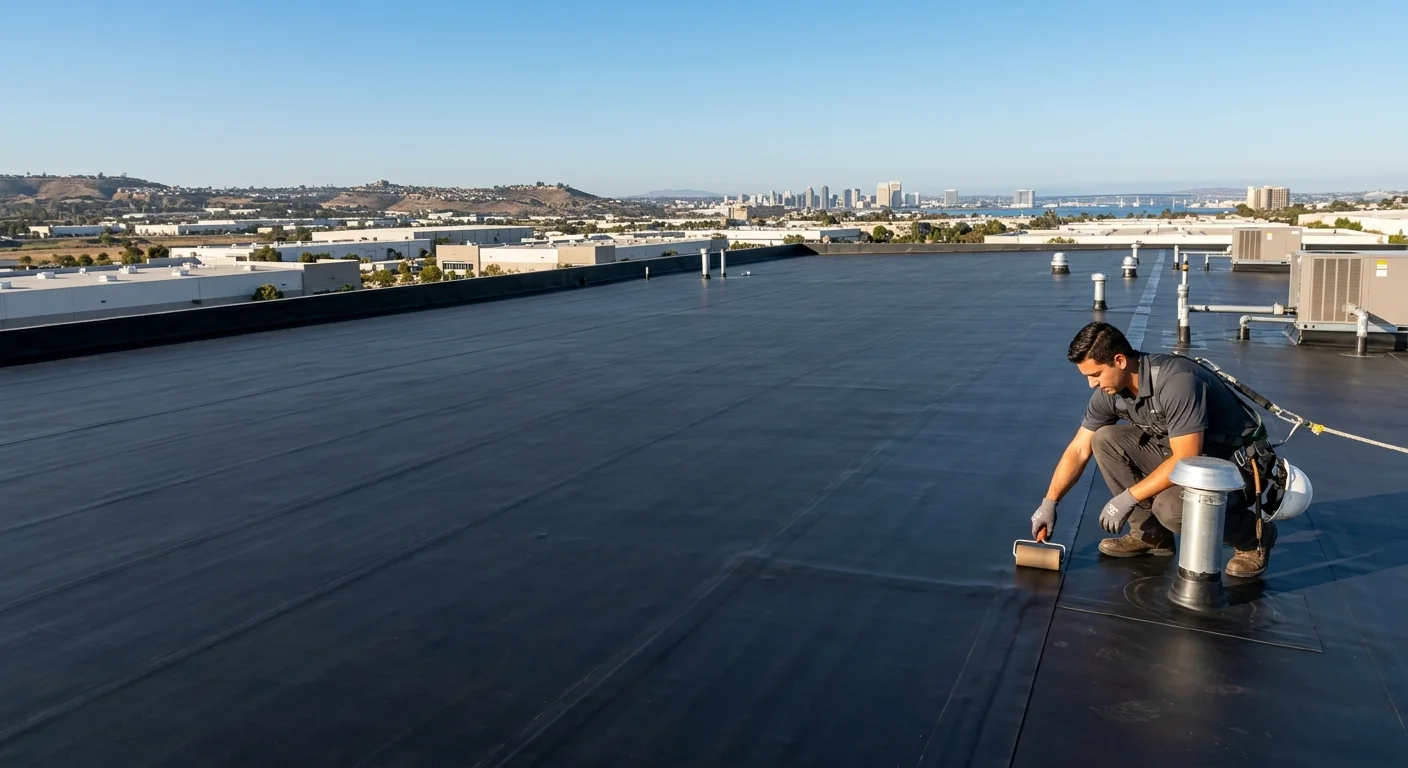
EPDM (ethylene propylene diene monomer) ships in large sheets, usually black. Crews fully adhere it, mechanically fasten it, or loose-lay it under ballast. Seams are typically taped or adhered, not hot-air welded like TPO or PVC.
The rubber stays flexible through heat and minor building movement. That helps on inland decks with big day-night swings and on seismic movement, if the flashing can move with it. UV resistance is the reason it still shows up on warehouses after decades of SoCal sun. Flexibility does not excuse skipped walk pads, clogged drains, or a taped lap that never got rolled.
Ask the manufacturer sheet for that EPDM product’s service-life language. Treat that as a product claim, not a promise for Kearny Mesa or Otay.
San Diego climate: UV is the plus, heat absorption is the catch
Inland commercial roofs (Mission Valley, Kearny Mesa, Escondido, El Cajon) take long, direct sun. Black EPDM shrugs off UV better than many older asphalts. It also absorbs heat. If tenant cooling or an energy-code path is the driver, ask about listed white EPDM, a listed coating over sound EPDM, or a white thermoplastic instead. The California Energy Commission publishes Title 24, Part 6. Read the current live text. Confirm the product ID with the AHJ. Do not treat Title 24 as a default. See cool roof Title 24 and the California Energy Commission.
Punctures and foot traffic are the usual knock. HVAC changeouts and sharp debris cut rubber faster than a thicker thermoplastic in some installs. Specify walk pads where techs walk. Coastal salt is harder on edge metal and fasteners than on the rubber itself.
EPDM vs TPO for this building
Both are single-ply systems for low-slope commercial work. They fail in different places.
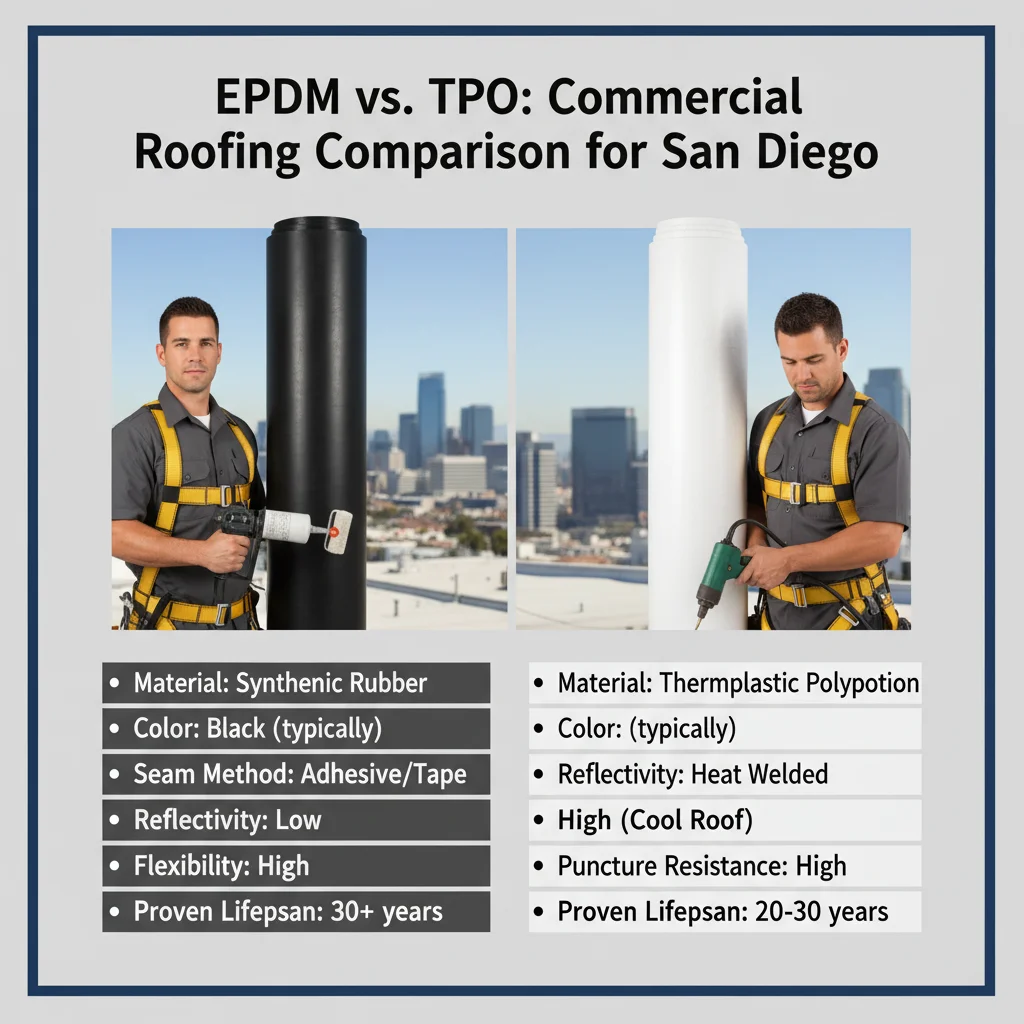
EPDM. Rubber. Tape or adhesive seams. Long field history. Usually dark unless you specify white. Heat load is the energy conversation.
TPO. Thermoplastic. Heat-welded laps when the crew actually welds. Commonly white, which is why it is the default cool-roof conversation in San Diego. Often specified where foot traffic and welded seams matter more than rubber flexibility.
Neither wins on a blog. A Kearny Mesa warehouse with few penetrations is a different job than a restaurant deck with grease exhaust (often a PVC conversation) or a recover over wet insulation (usually a bad idea on either membrane). The licensed independent roofer should say which lane this roof is in after they walk it.
What drives cost (without a fake per-foot table)
An exact installed rate without a measured roof is marketing. Cost moves with:
- Measured squares and how cut-up the field is
- Tear-off vs legal recover, and dump
- Deck repairs and wet insulation replacement
- Attachment: fully adhered vs mechanically fastened vs ballasted (ballast adds structural load; the engineer, not a blog, owns that)
- Insulation R-value and cover board
- Number of HVAC curbs, skylights, and drains
- Access, after-hours work, and tenant phasing
A small, busy roof with many units is not priced like an open warehouse field. Compare named scopes. We will not print a San Diego EPDM rate.
What a competent EPDM install looks like from the bid
- Inspect the deck. Probe wet insulation. Photograph.
- Tear-off or legal recover. Overlay over wet iso is a short roof. Confirm the AHJ’s layer limit.
- Vapor control and insulation as specified.
- Lay sheets. Adhere, fasten, or ballast as specified.
- Roll and detail every lap. Flash pipes, curbs, skylights, and walls.
- Final walkdown against the spec and permit.
Verify the contractor’s C-39 at cslb.ca.gov before you sign. Calling us is not a license check.
Maintenance that actually extends EPDM
- Inspect twice a year and after heavy rain. Look for punctures, open laps, and ponding.
- Keep drains and scuppers clear.
- Patch small cuts with compatible EPDM materials, not random roof cement.
- After the sheet has aged, a listed reflective coating is a separate scope. It is not a substitute for failed flashings. See flat roof ponding.
A written log is what manufacturers and insurers ask for later. We do not keep that log. The contractor or building engineer does.
When to call us
If you are comparing EPDM to TPO or PVC on a San Diego commercial deck, you need a written commercial scope, not a blog total.
Call (760) 750-5557 and we will connect you with a licensed independent local roofer. We do not dispatch 24/7 crews. Availability is the contractor’s calendar.