Top Pro Roofing SD is a referral marketplace. We connect San Diego County homeowners with CSLB-licensed roofers. We do not hang gutter guards and we do not publish a 2026 per-linear-foot rate card. Call (760) 750-5557.
San Diego debris is not Midwest maple leaves. Palm fiber, eucalyptus bark, and Torrey pine needles clog troughs on a year-round schedule. The right guard is the one that matches this canopy, sound gutters, and coastal fasteners. Cheap plastic inserts often trap wet fines against the metal.
We will not invent installed dollars per foot, a 175-foot whole-house total, a cleaning-visit fee, or a payback year.

Why San Diego’s debris profile matters more than the brand name
Most guard guides assume autumn leaves. That is not this county.
Palm trees drop fibrous fronds, seed pods, and a fine hairy fiber. That fiber does not flush with rain. It packs the trough and wraps downspout screens.
Eucalyptus sheds bark strips, narrow leaves, and seed pods through the year. The leaves are oily and slow to break down. They stay wet in the trough.
Torrey pines drop needles continuously. Needles bridge wide mesh and mat on the surface so water cannot get in.
Asphalt shingle granules still pass most mesh and settle in the trough. No guard makes cleaning zero. Granule loss is also a shingle-wear signal. See what deteriorates asphalt shingles fastest in San Diego.
San Diego needs a product rated for fine, fibrous, and oily debris, not only large leaves.
The five main guard types and how they perform here
Construction, not the logo on the box, decides how a guard handles local debris and salt.
Micro-mesh guards
Micro-mesh uses a frame with a fine stainless-steel mesh over it. Pore openings are often in the tens to low hundreds of microns. Fine mesh is the usual conversation for eucalyptus leaves, palm fiber, and pine needles.
Ask the bid to name: opening size, stainless vs aluminum mesh, how the panel attaches, and fastener metal.
Watch out for: granules and pollen still sit on top. Plan an occasional brush or rinse.
Stainless mesh matters near the coast, where salt air oxidizes cheaper metals. Named systems (LeafFilter, HomeCraft, and similar) are product families, not a county invoice. Read the warranty PDF.
Screen and expanded-metal guards
These sit in the middle: an aluminum or steel frame with openings around 1/8 inch to 1/4 inch. They stop large pods and full fronds. Needles, granules, and small seeds go through.
Best for: moderate tree cover without conifers.
Watch out for: needle mats on the surface that dam water.
Reverse-curve guards
Reverse-curve (surface-tension) covers send water around a curve into the gutter. Debris is supposed to fall off the nose. Oily eucalyptus and sticky palm fiber often stick instead. The clog forms at the entry, not in the trough.
Best for: light canopy and little overhang.
Watch out for: heavy San Diego canopy defeating the design. Some profiles show from the street.
Foam inserts
Foam cylinders sit in the trough. Water is supposed to pass through. In practice the foam compresses, traps seed, and grows moss. Coastal UV and salt shorten that life further.
We do not treat foam as a permanent San Diego install. Temporary use during construction is a different job.
Brush guards
Bristle inserts sit in the trough like a bottle brush. Debris works into the bristles and is hard to pull out. After a couple of cycles they can hold more material than an open gutter. Skip them here.
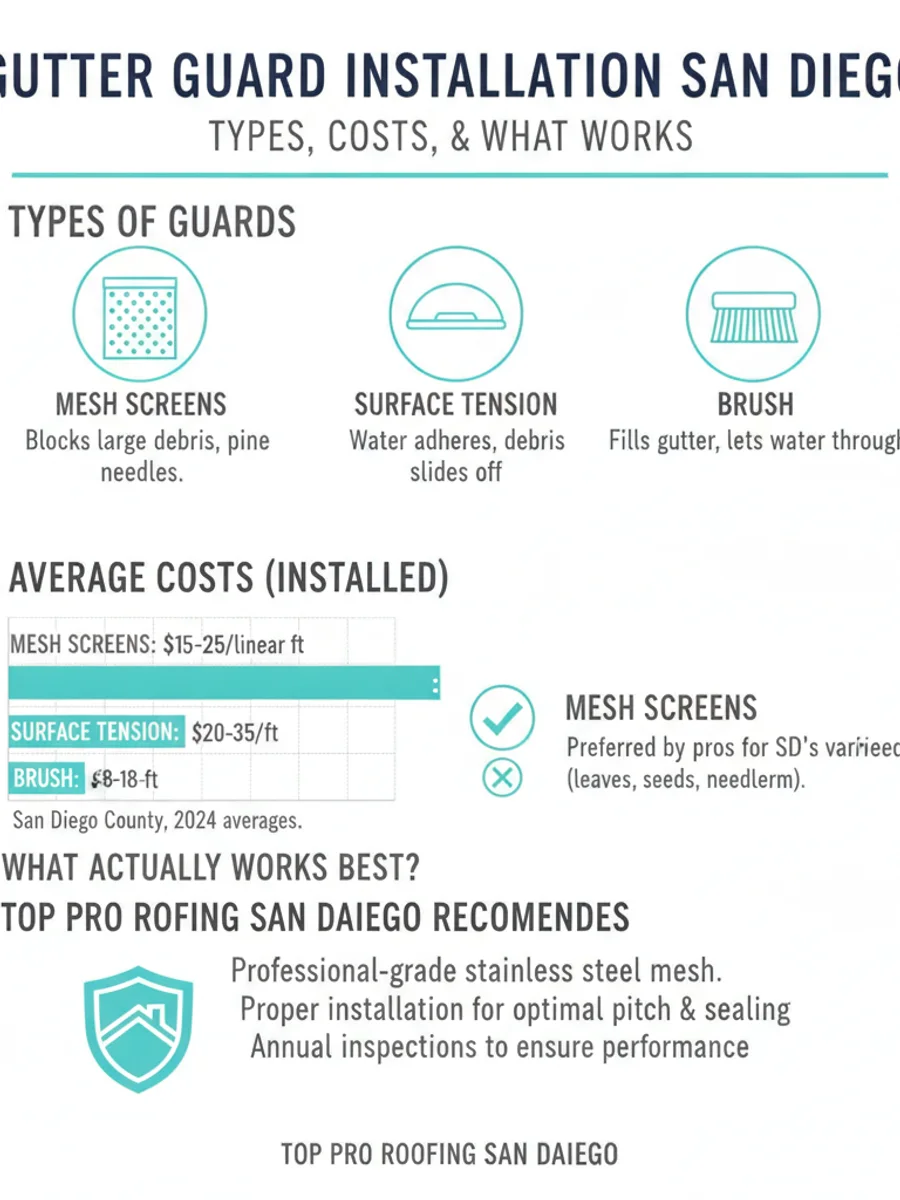
Guard type comparison (no dollar column)
| Guard type | SD debris performance | Coastal durability | Typical role |
|---|---|---|---|
| Micro-mesh (stainless) | Strong on fines and needles | High if mesh and fasteners are stainless | High-debris yards |
| Screen / expanded metal | Good on large debris | Moderate | Light to moderate canopy |
| Reverse-curve | Fair; oily leaves stick | Moderate | Open lots |
| Foam insert | Poor | Low | Not a long-term coastal spec |
| Brush insert | Poor | Low | Not recommended here |
How to read an installed bid (no rate card)
A typical single-story house is often discussed as a 150 to 200 linear foot trough run plus downspouts. Measure. Do not use living-area square footage.
Ask every written bid to show:
- Product family and opening size, not a slogan
- Linear feet measured on this house
- Existing gutter condition: hangers, pitch, seams, end caps
- Fastener and bracket metal for salt air
- Corners, valleys, and downspout details
- Whether the trough is cleaned before the cover goes on
- Who owns annual maintenance
National cost pages print wide per-foot bands. Use them as a reminder that mesh, screen, reverse-curve, and foam are different products. Do not treat them as a San Diego invoice.
If you are replacing gutters anyway, sequence matters: sound troughs and fascia first, covers last. See gutter replacement cost. Recurring cleaning is a separate visit. See gutter cleaning cost. Run your cleaning frequency against this guard bid. We will not invent that visit fee or a payback year.
Retrofit vs new install: what changes
Retrofit. The matched roofer should inspect and clean first, then snap, slide, or screw sections. Many micro-mesh systems catch the front lip and slide under the first shingle course on K-style. Half-round needs a profile made for it.
Before a retrofit, the installer should check:
- Gutter pitch (a cover does not fix a trough that does not drain)
- Fascia (a cover on rotting wood fails)
- Joints (a cover over leaky seams hides the leak)
With new gutters. Pitch, hangers, and the cover can be set together. That is usually cleaner than covering a trough you already planned to replace.
When gutter guards are not the job
Almost no trees. Granules and wind-blown grit often do not justify a whole-house kit. Open troughs cleaned on a real schedule can be enough.
Tile with no shingles. Tile does not shed granules. Guards still help with leaves and needles if the canopy is heavy. Frequency is often lower than on aging shingles.
Failed gutters. Pitch, seams, or soft fascia first. A cover on a bad trough is wasted metal.
Cheap foam vs nothing. If the only offer is foam, open gutters you can see are often the better call.
La Jolla canopy and salt are a tighter version of this same choice. Gutter guards in La Jolla.
Coastal corrosion: why cheap plastic inserts fail
Marine-layer salt and hard UV punish low-grade vinyl inserts. They go brittle, crack, and hold wet debris against the trough. That speeds gutter corrosion.
For homes near the water (Pacific Beach, La Jolla, Encinitas, Oceanside, Coronado), stainless micro-mesh and named coastal fasteners are the spec conversation. That is the same salt issue that hits flashing and hangers. Gutter repair cost is how to read a repair bid when corrosion is already ahead of you.
Frequently asked questions
How much does gutter guard installation cost in San Diego?
We will not publish a per-foot rate or a whole-house total. Compare measured linear-foot bids that name the product, fasteners, and gutter condition. Micro-mesh usually sits above screen. Foam is cheaper and is usually the wrong coastal product.
Do gutter guards work on homes with palm trees?
Fine-mesh systems are the usual match for palm fiber. Wide screen and reverse-curve often let fiber through or let it pile on the surface. Heavy palm cover is a micro-mesh conversation, not a foam insert.
Are gutter guards worth it in San Diego?
They can be, when canopy is heavy and the troughs are sound. They cut how often someone climbs a ladder. They do not make cleaning zero. On an open lot, annual cleaning of open gutters can be the honest job.
Do gutter guards eliminate cleaning entirely?
No. Granules, pollen, salt, and fines still land. A company that promises never to clean is overselling. Plan at least an annual look.
Can I install gutter guards myself?
Snap-in screen and foam are sold at big-box stores. Permanent micro-mesh usually needs the first shingle course lifted and a confirmed pitch. A wrong install sends water over the front during a hard rain. Gutter work on a house is contractor-licensed work in California. Check CSLB.
What’s the best gutter guard for eucalyptus debris?
Stainless micro-mesh with a named small opening is the usual spec for narrow oily leaves. Reverse-curve is the conversation for larger bark if the lot is otherwise open. Oily film still wants a rinse. Ask the installer to walk your trees.
When to call
If you are not sure the troughs can take a cover, you want a C-39 who hangs gutters and covers, not a cover-only kit. They should check fascia and pitch and say when a guard is not worth buying.
Call (760) 750-5557. We will connect you for a written estimate on guards or gutter installation. We do not hang the metal.