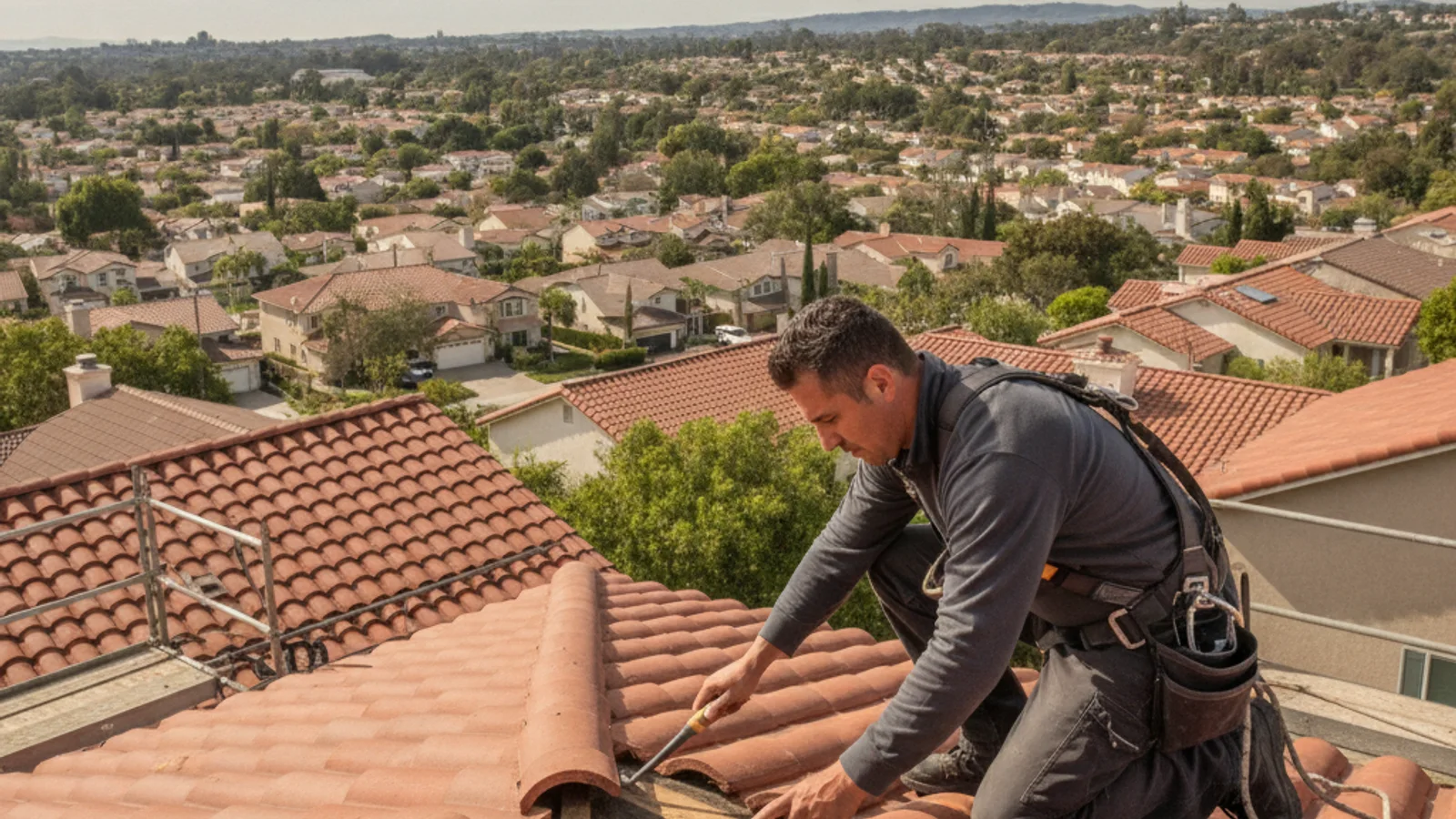
Most roof leaks in Scripps Ranch don’t come from the tile. They come from the underlayment underneath it, and on the neighborhood’s original 1980s and 90s homes that felt layer is now 30 to 40 years old and past the point where it keeps water out. The concrete tile on top still looks solid, which is exactly why the leak feels like a mystery. It isn’t one. It’s a predictable end-of-life problem showing up across a whole community that was built out in the same two decades.
Scripps Ranch sits on a canyon-rimmed mesa, wears a tile mandate through its HOAs, and lives under a heavy eucalyptus canopy. All three of those shape how these roofs leak and how the repair gets done. Here’s what’s actually happening on the roof and what the fix looks like.
Why Scripps Ranch tile roofs leak when the tile looks fine
Concrete tile is a 50 to 80 year material. The felt or synthetic underlayment beneath it, the layer that actually stops water, is a 25 to 35 year material. That gap is the whole story.
Scripps Ranch built out mostly during the 1980s and 90s, and the developers spec’d concrete tile across nearly every tract. Those original roofs are now hitting the underlayment-failure window all at once. The tile sheds most of the water, but tile isn’t waterproof on its own. Wind-driven rain, capillary action, and the small gaps around every penetration all send water down onto the felt. When that felt is four decades old and brittle, it cracks, tears at the fasteners, and stops doing its job. The water finds the deck, then the ceiling.
That’s why so many homeowners here describe the same thing: a roof that looks perfect from the street but stains a bedroom ceiling every winter. The tile is fine. The layer you can’t see is done.
The eucalyptus factor
Scripps Ranch is the eucalyptus neighborhood, and those trees are hard on tile roofs in ways newer tracts never deal with.
Eucalyptus drops heavy, oily debris all year: leaves, bark strips, seed pods, and branches. It piles up in the valleys and against the ridge, where it holds moisture directly against the underlayment and speeds up the rot. Larger limbs snap off during Santa Ana wind events and crack tiles on impact, and a cracked tile is an open door for water. The debris also dams up valleys and clogs gutters, so rain that should run off instead backs up under the tile.
Two practical points come out of this. First, valleys and gutters here need clearing at least twice a year, not once. Second, if branches overhang the roof, it’s worth asking about ember-resistant valley metal during any repair, because Scripps Ranch sits in a wildland-urban interface zone where wind-blown embers are a real fire-season concern.
Where the water actually gets in
On a 30-plus-year Scripps Ranch tile roof, leaks cluster at a handful of predictable spots. A good repair starts by finding which one, not by patching the ceiling stain.
| Leak point | Why it fails here | Typical fix |
|---|---|---|
| Aged underlayment | 30 to 40 years old, brittle, cracked | Lift and relay the affected section, or the full roof |
| Valley metal | Eucalyptus debris traps moisture, metal corrodes | Replace valley metal, upgrade to closed or ember-resistant valley |
| Headwall and sidewall flashing | Decades of sun and movement open the seal | Re-flash the wall junction, replace mortar or metal |
| Pipe and vent boots | Rubber and lead cracks after 20-plus years of UV | Replace the boot, reseal the penetration |
| Cracked field tiles | Wind-thrown branches, foot traffic, freeze cycles | Swap the broken tiles, matched to the HOA color |
| Ridge and hip | Old mortar-set ridge lifts and cracks | Rebed or convert to a mechanical ridge system |
The tell that points at underlayment rather than a single detail is timing. A roof that only leaks in heavy, wind-driven rain and stays dry in light rain is usually a wind and underlayment problem, not one bad boot. We walk through that pattern in our guide on why some San Diego roofs only leak in heavy rain, and it fits a lot of mesa-top homes.
Roof leak repair in Scripps Ranch: your three real options
Because the HOAs here mandate tile, switching to shingle to save money isn’t on the table. The choice is about how much of the tile system to touch. There are three honest paths.
| Option | When it’s the right call | What to expect |
|---|---|---|
| Spot repair | One clear entry point, sound underlayment elsewhere | Replace the boot, tile, or flashing; lowest cost |
| Section lift and relay | Leaks concentrated in one plane or valley | Lift the tile, replace underlayment in that area, reset the tile |
| Full lift and relay | Underlayment failing roof-wide, tile still good | Reuse existing tile, all-new underlayment, best long-term value |
Most single-point Scripps Ranch leak repairs land between $350 and $1,500, depending on whether it’s a boot, a flashing junction, or a valley. Our roof leak repair cost breakdown for San Diego covers those ranges in detail. When the underlayment is the real problem, though, the honest answer is a lift and relay, not a fourth patch on a roof that’s going to leak somewhere new next winter. A tile lift and relay reuses your existing HOA-approved tile, replaces the felt that’s actually failing, and usually doesn’t trigger a fresh design review since the look doesn’t change.
If your tile is more than 30 percent broken or the color is discontinued and can’t be matched, a full re-roof with new tile starts to make more sense. That’s a bigger project with an HOA approval layer, and we cover it in the Scripps Ranch HOA roof requirements guide.
How the repair gets scoped
A leak repair is only as good as the diagnosis. Chasing the stain on the ceiling rarely finds the actual entry point, because water travels along the deck and rafters before it drips. The roofers in our Scripps Ranch network start on the roof, trace the water path back to its source, and check the underlayment condition around it before quoting a fix. That’s the difference between a repair that holds and one that moves the leak two feet over.
If you want the full method, our guide on how to find a roof leak in San Diego shows what a thorough trace looks like. For the repair itself, our roof leak repair service and roof inspection service cover what the network handles across the county, and the tile roofing service page walks through the tile-specific work Scripps Ranch homes need. You can also see what typically shows up in the area on our Scripps Ranch roofing page.
Frequently asked questions
Why does my Scripps Ranch roof leak when the tile isn’t broken?
Because the tile isn’t what keeps water out. The underlayment beneath it does, and on original 1980s and 90s homes that felt is 30 to 40 years old and cracked. The tile can look perfect while the layer under it has failed, which is the most common leak cause in the neighborhood.
Can I just replace the underlayment without buying new tile?
Yes, and it’s usually the smart move here. It’s called a lift and relay. The roofer lifts your existing concrete tile, installs new underlayment, replaces any cracked tiles, and resets the original tile. You keep the HOA-approved look and only pay to replace the part that’s actually worn out.
How much does a roof leak repair cost in Scripps Ranch?
Most single-point repairs run $350 to $1,500, depending on whether it’s a cracked boot, a flashing junction, or a valley. If the underlayment is failing across a plane or the whole roof, a section or full lift and relay costs more but fixes the real problem instead of patching around it.
Do the eucalyptus trees really cause leaks?
They contribute to them. The oily debris piles up in valleys and against the ridge, holds moisture against the underlayment, and dams up gutters so water backs under the tile. Falling branches also crack tiles during Santa Ana winds. Clearing valleys and gutters twice a year cuts the risk.
Does a leak repair need HOA approval in Scripps Ranch?
A like-for-like repair or a lift and relay that reuses your existing tile usually doesn’t, since the roof’s appearance doesn’t change. Some sub-associations still want a courtesy notice. A full re-roof with new tile does go through design review. Check your specific sub-association before the work starts.
If a ceiling stain keeps coming back every rainy season, the roof needs a real look before the underlayment failure spreads across the deck. We connect you with a vetted local roofer who traces the leak to its source, checks the underlayment, and fixes it the right way for a tile-mandate community. Call (760) 750-5557 for a same-day match in Scripps Ranch.