Short answer: a 2,000 sq ft San Diego house often needs a very different material count than 20 squares. Living area is not roof area. A two-story footprint is smaller than a ranch with the same listed size. Pitch stretches the surface. Waste covers hips, valleys, and cuts.
Top Pro Roofing SD refers. We do not install. We do not publish per-square install prices on this page. Call (760) 750-5557 to get matched for a real takeoff.
House square footage is not roof square footage
The 2,000 number on a listing is usually heated floor area on every level. The roof covers the footprint, the outline from above.
A single-story 2,000 sq ft ranch in Clairemont starts near 2,000 sq ft of plan before pitch. A two-story 2,000 sq ft house in Mission Hills often has a footprint closer to 1,000 to 1,200 sq ft because the second floor sits on the first. Same listing size. Very different roof.
Pitch adds surface. A dead-flat roof matches the footprint. A steeper roof uses more covering for the same plan. Roofers order and bid in squares (100 sq ft of roof surface).
Working formula:
Roof area = footprint (sq ft) × pitch multiplier × waste factor
Divide by 100 for squares. Round up for ordering after the takeoff, not after a blog example.
The pitch multiplier table
Pitch is rise over run. A 6:12 rises 6 inches in 12 inches of horizontal run. The multiplier is the secant of that angle. NRCA measurement practice uses the same geometry.
| Roof pitch | Slope angle | Pitch multiplier |
|---|---|---|
| 2:12 | 9.5° | 1.014 |
| 3:12 | 14.0° | 1.031 |
| 4:12 | 18.4° | 1.054 |
| 5:12 | 22.6° | 1.083 |
| 6:12 | 26.6° | 1.118 |
| 7:12 | 30.3° | 1.158 |
| 8:12 | 33.7° | 1.202 |
| 9:12 | 36.9° | 1.250 |
| 10:12 | 39.8° | 1.302 |
| 11:12 | 42.5° | 1.357 |
| 12:12 | 45.0° | 1.414 |
Many San Diego tract roofs sit around 4:12 to 6:12. Mission-tile houses in Mission Hills, Kensington, and parts of La Jolla often run a bit steeper. Hillside custom in Del Mar or Rancho Santa Fe can go steeper still. Coastal infill low-slope work may sit near 2:12.
How to measure without guessing: roof pitch in San Diego explained.
Waste factor
Every covering is cut at rakes, hips, valleys, chimneys, and skylights. A simple gable often uses about 10 percent extra. More intersections need more:
- Simple gable, two planes: about 10%
- Hip roof, four planes: about 12%
- Multiple hips and valleys: about 15%
- Cut-up roof with dormers, turrets, or wings: about 17 to 20%
If the roof has more than three valleys or dormers cutting the main plane, ask the matched roofer to show the waste line. Understated waste is a mid-job shortage. Overstated waste is padding. The takeoff should defend the number.
Two worked examples
Example A: 2,000 sq ft single-story ranch in Clairemont
- Footprint: 2,000 sq ft
- Pitch: 5:12 (multiplier 1.083)
- Waste: 10% (simple gable)
2,000 × 1.083 × 1.10 = 2,383 sq ft, about 23.8 squares. Order after rounding on the actual takeoff, often 24 squares for this sketch.
Example B: 2,000 sq ft two-story in Mission Hills
- Footprint: 1,100 sq ft
- Pitch: 6:12 (multiplier 1.118)
- Waste: 12% (hip, four planes)
1,100 × 1.118 × 1.12 = 1,377 sq ft, about 13.8 squares, often 14 squares on a sketch.
Same listed house size. Almost double the material on the ranch. That is why a “cost per living square foot” from a national calculator is not a San Diego bid.
Accessory quantities once you know squares
ARMA application specs size shingles by coverage, not by house listing size. Typical architectural shingles are three bundles per square. Some thick designer lines need more. Read the wrapper.
| Roof size | Shingle bundles (3 per square) | Underlayment rolls (about 4 squares per roll) | Notes |
|---|---|---|---|
| 15 squares | 45 | 4 | Drip edge and ridge are linear, not square-driven |
| 18 squares | 54 | 5 | Add ice-and-water in valleys as specified |
| 20 squares | 60 | 5 | |
| 22 squares | 66 | 6 | |
| 25 squares | 75 | 7 | |
| 30 squares | 90 | 8 |
- Underlayment coverage assumes a listed roll yield plus overlaps. California residential code requires underlayment on steep-slope reroofs. Ice-and-water in valleys is extra sheet, not the field roll count.
- Drip edge follows eaves and rakes. A rectangular ranch is not a cut-up hillside.
- Ridge cap is linear feet of ridge and hip, not squares. Bundle coverage varies by brand (often roughly 20 to 35 linear feet). Most simple ranches need one or two bundles. Confirm on the takeoff.
- Nails follow manufacturer pattern and wind listing. Do not order from a blog pound chart.
Do not use this page as a price
Install price per square is labor, tear-off, disposal, access, pitch, and discoveries. Independent roofers set it. We will not publish a 2026 shingle, metal, or tile dollar table here. Compare written bids in squares and in scope. For cost structure without a number from this article: new roof cost San Diego 2026.
Steeper roofs also cost more per square in labor (harnesses, slower handoffs). Quantity and labor both move. Ask the matched roofer to say which.
Ballpark squares by era (not a takeoff)
| Home era / style | Typical footprint | Typical pitch | Typical roof squares |
|---|---|---|---|
| Older ranch (Clairemont, Linda Vista) | 1,200 to 1,800 sq ft | 4:12 | 14 to 21 |
| 1960s split-level (College Area, San Carlos) | 1,400 to 2,000 sq ft | 4:12 to 5:12 | 16 to 24 |
| Older tract single-story (Mira Mesa) | 1,400 to 2,200 sq ft | 5:12 to 6:12 | 17 to 27 |
| Older tract two-story (Rancho Penasquitos) | 900 to 1,400 sq ft footprint | 5:12 to 6:12 | 11 to 17 |
| 1990s production two-story (Carmel Mountain, 4S Ranch) | 1,000 to 1,600 sq ft footprint | 6:12 to 8:12 | 13 to 21 |
| Mission/Craftsman two-story (Mission Hills, Kensington) | 1,000 to 1,400 sq ft footprint | 6:12 to 7:12 | 13 to 18 |
| Modern stacked-flat infill (North Park, Hillcrest) | 800 to 1,200 sq ft footprint | 1:12 to 2:12 | 9 to 14 |
| Custom hillside (Del Mar, La Jolla, Rancho Santa Fe) | 2,000 to 4,000 sq ft footprint | 6:12 to 10:12 | 24 to 60+ |
Starting points only. Models vary on the same street. HOA color and material rules: Carmel Valley HOA roof requirements.
Where the sketch goes wrong
Skylights. Extra flashing and cut shingles. Waste, not a mystery.
Dormers. New valleys and walls. A shed dormer adds a little. A pair of gable dormers adds more.
Many valleys. Long 45-degree cuts. Waste climbs.
Two pitches. Main house vs garage vs porch. Calculate each plane.
Re-decking. Rotted plywood, OSB, or skip sheathing is a sheet count (4x8 covers 32 sq ft), priced by the contractor after they see it. Coastal salt: coastal roof salt damage. We will not invent a per-sheet install dollar.
Title 24 product swaps. A required cool-roof covering can change the SKU mid-planning. Cool roof Title 24.
How to read three takeoffs
A takeoff is the roofer’s measurement: wheel, satellite (EagleView, HOVER, or similar), or tape on the roof. Compare squares, not only the bottom line.
Trust the set when quotes land within about 1 to 2 squares, someone shows a labeled report, and waste is a visible line.
Ask questions when one bid is more than about 15 percent away on squares, when re-decking allowance is zero on an old roof, or when the square count is “approximately” with no method.
Satellite sketch plus this formula is a sanity check. It will not beat a walked roof on dormers and odd hips.
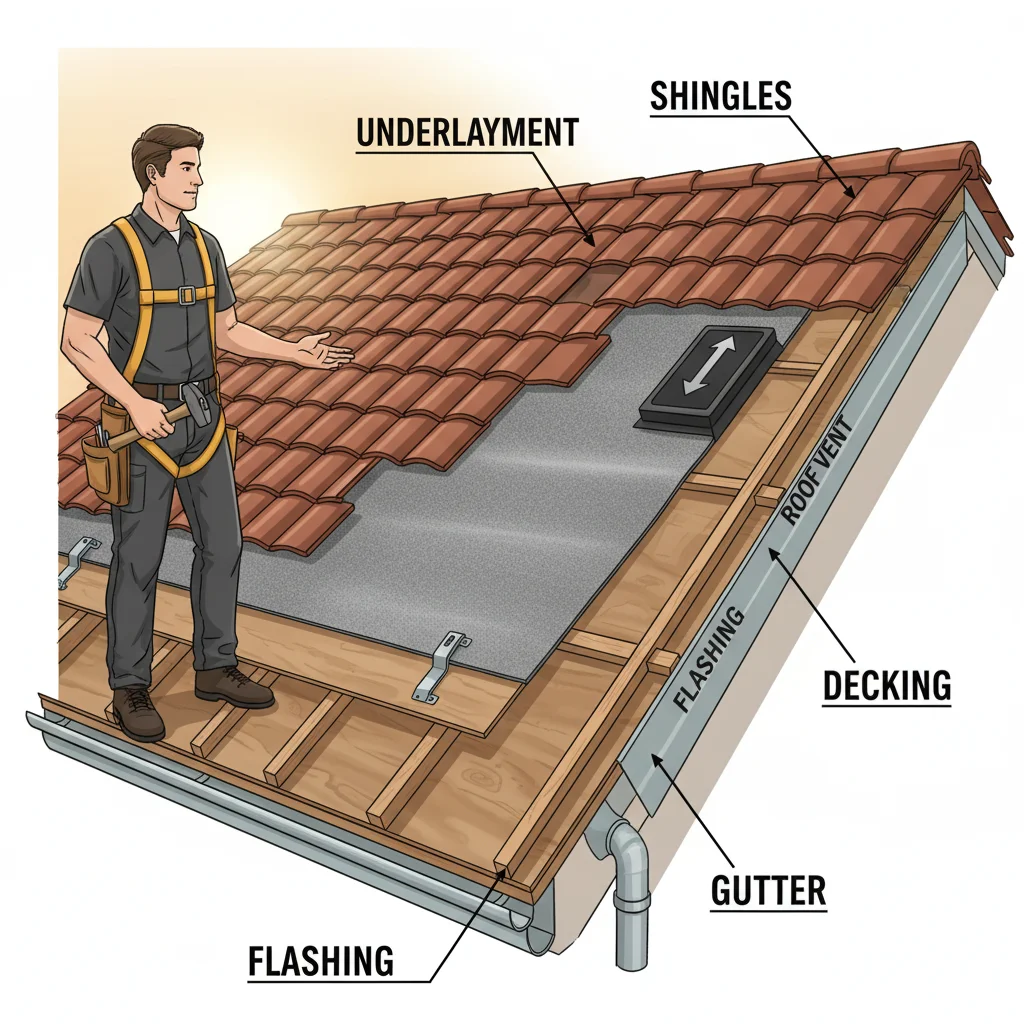
Process after you hire: asphalt shingle roof replacement. Anatomy: parts of a roof. Verify the C-39 at CSLB.
FAQ
Quick formula?
Footprint × pitch multiplier × waste. Divide by 100. Single-story 2,000 sq ft at 5:12 with 10% waste: 2,000 × 1.083 × 1.10 = 2,383 sq ft, about 24 squares.
Bundles per square?
Three for many architectural shingles. Designer laminates can be 4 or 5. Read the manufacturer coverage.
Underlayment rolls?
A common listed yield is about 4 squares per roll before overlaps. A 20-square roof is not “exactly 5 rolls” until the overlap and valley membrane are counted.
Ridge cap vs squares?
Ridge is linear. Count ridge and hip feet. Then divide by the bundle coverage on the wrapper.
Why does the roofer differ from my math?
Dormers, two pitches, valleys, skylights, and odd wings. A 1 to 2 square gap is often geometry. More than about 3 squares is worth a method conversation.
Should I buy extra bundles myself?
If the takeoff includes 10 to 15 percent waste, do not freelance a pallet. Color lots shift. Leftovers age. The contractor who warrants the install should control the material. Many leave a small attic stash for later repairs. Ask. Do not store a garage full of mixed lots.
Get a measured quote
We connect San Diego County homeowners with licensed independent roofers who show squares, pitch, and waste on the page. Top Pro Roofing SD does not measure from this article. Call (760) 750-5557 or request an estimate. Related: roof replacement, roof repair.