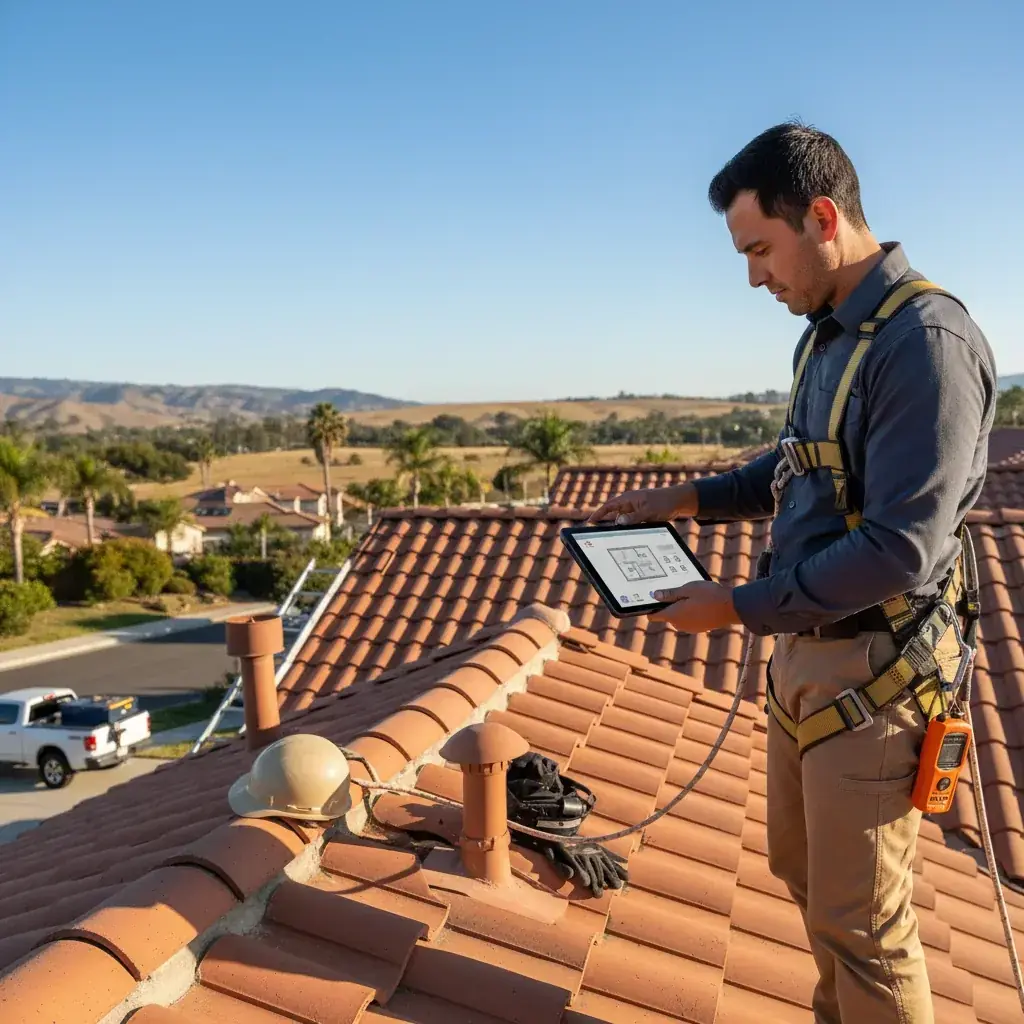
Adjusters sort a roof claim from physical evidence and from what you volunteer. A San Diego roof with clear wind-lift after a named storm can still land as wear if you say you have been meaning to get it looked at for years. This page is phrasing and documentation, not legal advice. Top Pro Roofing SD is a referral service. We do not hold a C-39, we do not file claims, and we do not speak for your carrier. Call (760) 750-5557 if you want a licensed local roofer to write an independent takeoff you can attach.
Related: California roof insurance claim guide, does insurance cover roof leaks, public adjusters.
How adjusters classify the file
Most homeowner roof files get sorted into one of three buckets before the first line of the estimate:
- Covered peril, replacement cost (RCV) if your policy pays that way: recoverable depreciation after the work is invoiced.
- Covered peril, actual cash value (ACV): payout minus depreciation. Confirm which you bought on the declarations page.
- Wear, tear, or maintenance exclusion: denied, or limited to incidental interior damage.
California Insurance Code Section 2071 is the standard fire form. The California Department of Insurance publishes consumer guidance. Read the current live text and your policy. This page does not restate neglect, notice, proof-of-loss, or payment holdings. Your job on inspection day is to stay specific to the loss event and not invent a maintenance history you do not actually know.
We will not invent a dollar swing between those buckets. Compare the written scope to a licensed roofer’s line-item estimate on the same roof.
Phrases that hurt, and what to say instead
The pattern: the bad phrase volunteers a fact the carrier can use, often a fact you do not know. The replacement stays dated, specific, and inside what you can prove.
| Don’t say | Why it hurts | Say instead |
|---|---|---|
| ”The leak has been there a while.” | Can be written as wear or a long-running condition. | ”I noticed water staining after [storm date]." |
| "I noticed it last year.” | Prior knowledge and late notice arguments. | ”I am reporting this within the notice period in my policy." |
| "The whole roof needs replacing.” | The file can treat that as your claim of scope. | ”Please document all damage you find, including what I have not seen." |
| "I’ll take whatever you offer.” | Sounds like you will not supplement or invoke appraisal. | ”I want to review the written scope before I respond." |
| "I don’t have any receipts or photos.” | Leaves depreciation and pre-loss condition unchallenged. | ”I will check records and send what I find by [date]." |
| "My roofer said the whole roof is shot.” | Contractor slang is not policy language. The carrier can treat it as pre-existing. | ”I have an independent estimate from a licensed C-39 if you want a copy." |
| "I think it’s old, maybe 20 years.” | Age guesses get written as fact. | ”I will confirm age from permits, invoices, or the seller disclosure." |
| "It only leaks when it rains hard.” | Sounds like a maintenance leak, not a storm event. | ”The leak appeared after [storm date]. I had no interior signs before that." |
| "I tried to patch it myself.” | DIY work can be used as unworkmanlike repair. | ”I tarped to stop further damage. I will follow the mitigation language in my policy." |
| "I just want this over with.” | Adjusters quote this. | ”I want the scope to capture all damage before we settle.” |
That second column is a posture, not a script. Cooperative, dated, and quiet about what you have not verified.
What to assemble before they arrive
The report is built from what they see, what they measure, and what you hand them.
- Date-stamped photos. Every elevation, every interior stain, soffits. Phone metadata is a timestamp. Pull pre-loss photos if you have them: listing photos, family shots with the roof in frame, drone shots.
- Weather for the loss date. NOAA Storm Events for San Diego County, plus a local weather archive or SDG&E outage map if it matches the date.
- Roof age proof. City or County permit lookup, prior invoice, purchase inspection, seller disclosure. San Diego city portal: Development Services. Other cities have their own portals.
- Declarations page. RCV vs ACV, deductibles (including a separate wind/hail deductible if you have one), roof endorsements.
- An independent C-39 estimate. Not required. It is a second takeoff in the same units the carrier uses if the roofer writes Xactimate or equivalent. Matching is a referral, not a guarantee of format.
- A dated timeline. Loss date, when you noticed it, when you tarped, when you called the carrier. Facts only.
Full claim sequence: roof insurance claim in California.
During the inspection
Carriers send field adjusters on their own schedule. The California Department of Insurance and Insurance Code Section 790.03(h), plus the Fair Claims Settlement Practices regulations (Title 10, Chapter 5, Subchapter 7.5), are the authorities for unfair-practices rules. Read the current live text, your policy, and the CDI guide. This page does not restate communication, investigation, or written-explanation holdings.
Recorded statements. California recording rules live in the Penal Code, including Section 632. Read the current live text at the California Legislative Information site before anyone records a conversation. This page does not restate consent rules. Off-the-cuff answers stay in the file. A written statement after you have checked dates is often cleaner. That is a common policyholder-attorney recommendation, not a requirement from this brand.
Have a licensed roofer there if you can. A C-39 on the ladder can point at drip edge, valley metal, flashing, and code items the field file might skip. The adjuster does not have to agree. The conversation still goes in notes. We cannot promise a free site visit. Ask the matched roofer what they charge to attend.
Walk with them if you can. Anything seen and not written is hard to appeal. Same roof, same hour.
Stay off fault, blame, and “the roof was already bad.” Answer the loss event. Do not volunteer other properties’ claims or a general opinion of the roof.
Photograph what they measure. Test squares, peeled flashing, elevations they skip. If the report later says no damage on the west slope and your photos show otherwise, you have a supplement argument.
Ask for the inspection file in writing. Request the report, photos, and measurements. Keep a copy of the request.
How to read the scope
The estimate is usually an Xactimate or Symbility printout. Check it as a takeoff, not as a feeling.
- Squares. One square is 100 square feet of roof surface, including slope, not living area. Compare to the roofer’s measurement.
- Tear-off. Replacement should name removal, disposal, and a new assembly. “Overlay only” may not match current code. Confirm with the AHJ, not with this page.
- Underlayment. Ask whether the line item matches what the AHJ and the current residential code require for this climate and this covering. If you see a cheap felt where the bid should name a listed product, ask why.
- Ordinance or Law. Many California policies include a Coverage A share for code upgrades. Drip edge, valley membrane, and ventilation changes often live here. If those lines are missing, ask in writing. Read the endorsement, not this page.
- Drip edge, flashing, valley metal, ridge cap. Real work. Thin scopes omit them.
- Tax and overhead/profit. Ask the carrier how they treat sales tax and O&P on this file. We will not invent a bulletin number.
- Depreciation. ACV uses age and remaining life. Confirm they used your documented age, not a guess. Recoverable depreciation typically returns after invoiced work if the policy pays RCV.
If a line is wrong, request a supplement or re-inspection in writing. Attach the independent estimate. Verbal arguments do not start the carrier’s documented-response clock under 790.03.
When to escalate
| Situation | First move | Next |
|---|---|---|
| Scope is materially below the independent C-39 estimate | Written supplement with that estimate attached | Re-inspection with the roofer present |
| Denied as wear with a documented storm event | Written demand for the exclusion language and the roof evidence | CDI complaint; then a public adjuster or coverage attorney if it stays vague |
| Delay | Written demand citing 790.03 and the Fair Claims regulations | CDI, then counsel |
| Amount dispute, coverage already accepted | Appraisal clause in the policy | Appraisal decides price and scope, not coverage |
| Coverage denied outright | Coverage counsel | Appraisal does not reopen a coverage denial |
Public insurance adjusters in California are licensed under Insurance Code Sections 15007 and following. Read current Section 15027 and the contract for any fee limits. We do not restate caps, emergency rules, or waiting periods. Guide: public adjuster for California roof claims.
The CDI appraisal overview is the consumer starting point. Appraisal is not a lawsuit and it is not a coverage appeal.
Statutes worth citing in writing
You do not need to be a lawyer to put a section number in an email.
Insurance Code 790.03(h). Unfair claims settlement practices. Use it for delay, unexplained denials, and unexplained low offers.
Insurance Code 2071. Standard fire form. Read the current live text and your policy for notice, protection, proof of loss, and any other duties. This page does not restate those holdings.
Insurance Code 15007 to 15029. Public adjuster licensing and contracts. Read current Section 15027 for any fee limits instead of a blog paraphrase.
10 CCR, Chapter 5, Subchapter 7.5. The regulations that implement 790.03. CDI uses them for enforcement.
A short line (“Please treat this as a formal request under Insurance Code 790.03(h)”) changes who reads the file. It is not a threat. It is a citation.
San Diego notes out-of-state desks get wrong
- Santa Ana winds. NOAA records gusts well above everyday wind in East County foothills (Alpine, Ramona, Julian). Wind-lift below the shingle’s listed rating is a peril conversation, not “California weather.”
- Atmospheric rivers. Tie first interior staining to a documented storm date, not to “it rains here.”
- Coastal salt. La Jolla, Pacific Beach, Carlsbad: corroded fasteners can still fail in a wind event. Ask them to separate age of the fastener from the event that lifted the shingle.
- Inland heat cycling. Santee, El Cajon, Lakeside, Poway, San Marcos. Generalized granule loss over years is not the same as cracking from a single storm. Make them pick one and cite the exclusion.
If the denial is “age” or “California weather,” ask for the policy exclusion and the roof evidence. Read current Insurance Code 790.03(h) for what a written explanation must include. Do not treat this page as the statute.
How a licensed roofer fits
The useful move is a licensed local C-39 at the inspection with a written estimate. They do not overrule the adjuster. They put drip edge, squares, and code items on the record.
Top Pro Roofing SD connects San Diego County homeowners with independent roofers. We do not write Xactimate. We do not attend inspections. You verify CSLB, insurance, and whether they will produce a claim-format estimate.
Related: storm damage claims, insurance non-renewal and roof age, roof repair, roof replacement, county service area.
FAQ
Should I record the meeting? Only with consent after you have read current Penal Code Section 632. Recording rules are the statute’s, not this FAQ. Photos and video of the roof are not a conversation recording. Notes still matter.
Can I refuse a recorded statement? Usually yes. Filing a claim does not automatically require a recorded interview. Offer a written statement. If they insist, get the request in writing and read the cooperation clause. A coverage attorney can read that clause with you. We do not.
Should I let them on the roof alone? You can decline to leave them unsupervised. Liability and documentation both favor you or your roofer being present. If you cannot attend, photograph the roof immediately before and after.
What if the offer looks thin? Written re-inspection request, independent estimate attached, ask for the basis of each omitted line. If coverage is accepted and only the amount is in dispute, appraisal may fit. If the file is a denial, that is a coverage problem, not an appraisal problem.
When does a public adjuster make sense? When the file is large enough that a licensed PA’s fee (read current Section 15027) is worth the documentation fight, or when you cannot run the supplement yourself. Read the statute and the contract. See the public adjuster guide.
Can my roofer attend? Yes. Ask them before the appointment. A reputable C-39 will tell you whether attendance is included in the estimate fee.
Can they deny only because the roof is old? Age alone is not a sentence this page can certify. Wear and tear is a policy exclusion if the carrier can show the loss was caused by wear, not by a covered peril. Read current Insurance Code Section 2071 and your policy. Demand the written denial with the policy language. Vague “old roof” language is a CDI complaint candidate. Non-renewal after a claim is a different problem: insurance non-renewal.
Bottom line
Stay dated. Do not volunteer a wear story. Read the scope like a takeoff. Escalate in writing.
If you are in San Diego County and need an independent estimate for a live claim, call (760) 750-5557 or request a match. We introduce a licensed roofer. You still verify the license.