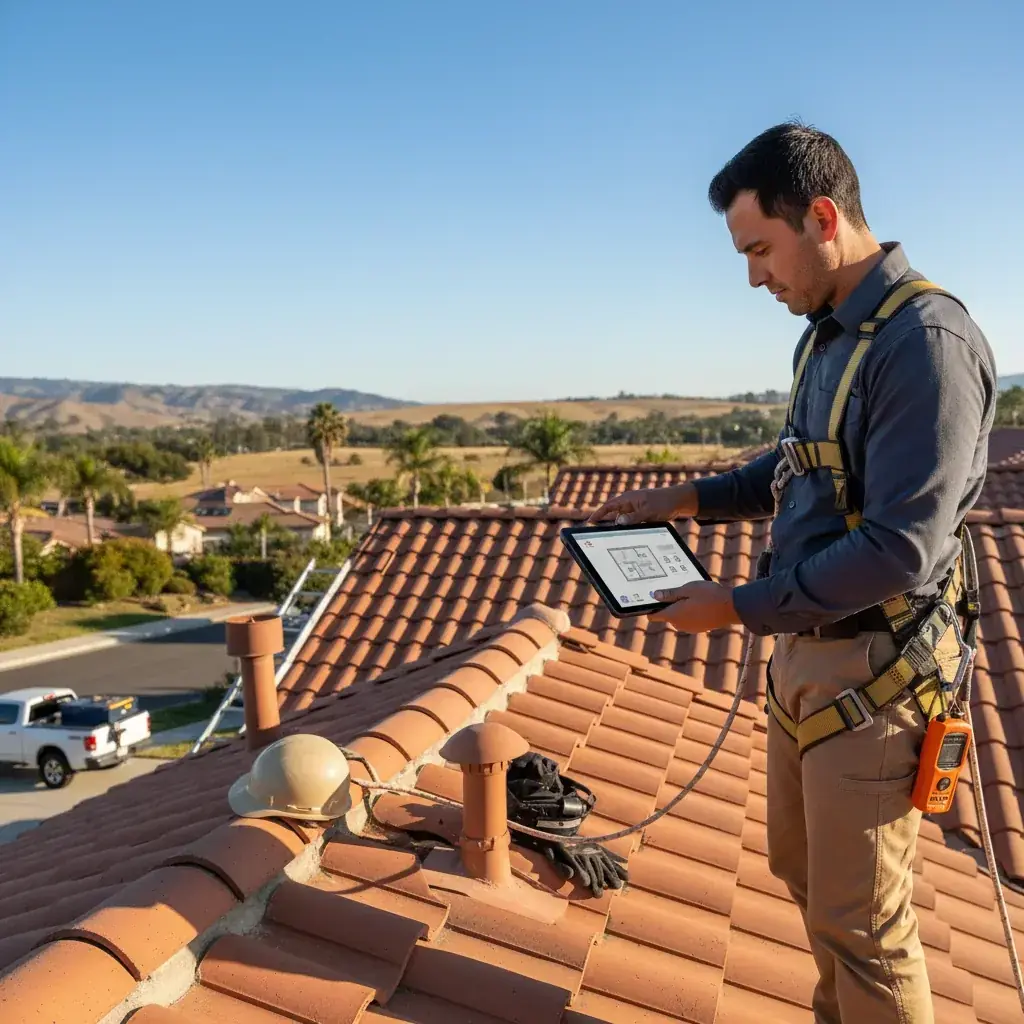
A public adjuster (PA) is a California-licensed claims professional you hire to prepare, present, and settle your claim against the carrier. They work for you. Staff and independent adjusters work for the insurer. The fee is whatever the approved written contract says, often a percentage of the settlement. We will not invent a “typical” percent or a dollar threshold where hiring one “always pays.” Read the percentage and the base before you initial. Verify the license at the California Department of Insurance. Top Pro Roofing SD refers licensed roofers for inspection and repair. We do not adjust claims. Call (760) 750-5557.
If a San Diego roof took Santa Ana wind, an atmospheric river, or hail, and the first offer feels thin, start with documentation. Then decide whether you need a PA. Related: what not to say to a roof insurance adjuster.
What a public adjuster actually does
A PA handles the claim file on your behalf. Typical work:
- Inspect the damage and write a scope of loss
- Build an estimate in the same software the carrier uses (often Xactimate)
- Document measurements, photos, code items, and later-found damage
- Submit the claim, talk to the carrier’s adjuster, and push back on a thin number
- Negotiate supplements when concealed damage shows up during repairs
- Take you through appraisal or a lawyer referral if negotiation stalls
The point is bargaining power. The carrier has a trained adjuster and a pricing database. Most homeowners have a phone and a few photos. A PA can even the table. That does not guarantee a larger check.
Carrier adjuster vs independent adjuster vs public adjuster
California’s required PA disclosure names three roles. They are not interchangeable.
| Role | Who pays them | Who they work for |
|---|---|---|
| Company (staff) adjuster | The insurer, as an employee | The insurance company |
| Independent adjuster | The insurer, on a contract | The insurance company |
| Public adjuster | You, per the written contract | You |
A staff adjuster and an independent adjuster look the same on inspection day. Both write the scope. Both hand the file back to the carrier. Neither represents you. That is the job, not a personal failing.
A public adjuster is the only one of the three licensed to advocate for the policyholder under the Public Insurance Adjusters Act (Insurance Code sections 15000 and following). The contract must say, in substance, that they represent the insured only.
How California licensing works
To practice legally, a PA must hold a current Public Insurance Adjuster license from CDI, pass the exam, and post a surety bond. Confirm the current bond amount on the live California Department of Insurance pages and the current Insurance Code text on leginfo. Do not treat a blog’s dollar figure or section number as the statute.
Verify any name in the CDI license search. Confirm the license is active and check discipline history. If they are not in that database, walk away. There is no gray area.
Insurance Code section 15027 requires a written contract on a commissioner-approved form before they act. The contract must show license number, the full fee, the percentage and the base it applies to, and your cancellation rights. You initial the compensation line. A handshake is not a contract.
What they cost (what the code actually says)
We will not publish a “standard 10 to 15 percent” or a 20 percent statewide cap. Current section 15027 does not set that percentage. It requires the fee in writing. It also says the PA’s fee must not leave you with less than amounts the insurer already paid you before the PA contract. The PA cannot take the entire fee from the first insurer check. They cannot require the carrier to pay only in the PA’s name.
Ask, in writing:
- Percent (or other method) and what it applies to (whole settlement vs additional recovery after they were hired)
- Whether supplements later in the job are included
- What happens if you already have a partial payment
- Who pays if you cancel inside the statutory window
A reputable PA answers those before you ask twice. If they will “figure it out later,” that is information about them.
When a PA can be worth considering
Hiring a PA is a math and process decision on this claim, not a blog’s invented uplift table. It can make sense when:
- The first offer is far below a competent C-39 bid for the same visible scope
- Code upgrades, matching, or underlayment are in play and the carrier scoped a patch
- The file is a FAIR Plan or split policy and documentation is getting lost between covers
- Negotiation has stalled and you are looking at appraisal
It often does not make sense when:
- The damage is small, isolated, and the offer already covers a real repair bid
- The cause is excluded (wear, deferred maintenance) and no advocate can rewrite the policy
- The carrier is already paying a full slope or full roof at the right code level
A PA’s job is to find money the carrier is not offering. If there is no room, you are paying a percentage for paperwork. Get a roofer’s independent assessment first so you know what “room” even is. Roof inspection is that starting point.
California rules after a disaster
Insurance Code section 15027.1: in an area subject to a catastrophic disaster, a PA must not solicit a residential engagement until seven calendar days have elapsed from the end of the loss-producing occurrence, unless you contact them. Door-knocking the morning after a named event can be illegal even if they are licensed.
They also must not solicit during a loss-producing occurrence (conditions still present, emergency responders on scene, or an evacuation order still in effect), and they must not initiate contact between 6 p.m. and 8 a.m. unless you asked.
Cancellation: three business days after you sign and receive the signed contract, in ordinary cases. If the loss is in a catastrophic disaster as defined in section 15001, you have five calendar days. Use the notice of cancellation in the contract, or any writing that clearly cancels, sent with proof of mailing.
A door-knocker inside those windows is a red flag. Take the card. Do not sign. Verify the license. If they are real, they will still be licensed in a week.
Red flags in PA solicitations
After Santa Ana wind and atmospheric-river weeks, door-knockers show up. Some are roofers. Some are PAs. Watch for:
- Uninvited solicitation inside the seven-day disaster window (section 15027.1)
- “No recovery, no fee” with no approved written contract
- Pressure to sign on the spot (you have a statutory cancel window)
- No license number on the card or contract (required)
- Steering you to fire your roofer or to “their” contractor. A PA’s job is the claim, not picking your C-39. Kickbacks from a contractor conflict with your interest
- Vague fee answers
- No principal place of business on file with CDI
How a roofer fits with a PA
The two roles do not overlap.
| Job | Roofer | Public adjuster |
|---|---|---|
| Climb the roof and identify damage | Yes | Yes (claims inspection) |
| Document with photos and measurements | Yes | Yes |
| Write a repair or replacement bid | Yes | No |
| Build an Xactimate-style scope | Sometimes | Yes, as part of the claim |
| Negotiate scope and price with the carrier | No (negotiating the claim as a PA without a PA license is not allowed) | Yes |
| Pull permits and do the work | Yes | No |
| Handle supplements mid-job | Coordinate on the roof | Negotiate the paper |
A clean path: roofer inspects and documents, you decide whether to hire a PA, the PA uses that documentation, settlement comes in, the roofer does the work to the agreed scope, the PA handles supplements if the contract still covers them.
Asking a roofer to “handle the insurance side” can mean they are acting as an unlicensed PA (Insurance Code section 15007 territory) or they are accepting the carrier’s number to get the job. Neither is a substitute for a licensed PA when you actually need one.
California Insurance Code section 15007 defines who may act as a public adjuster. Confirm current text on leginfo.
What to hand a PA on day one
- Full policy: declarations, endorsements, exclusions
- Prior claims on the property
- Dated photos (phone metadata helps)
- Claim number and adjuster contact if the claim is already open
- Emails, letters, and notes of calls with the carrier
- Any roofer report or bid
- Date and cause of loss as you can reconstruct it
- Receipts for emergency tarping or water mitigation
FAQ
How long does a PA-handled claim take?
Negotiation adds time. We will not invent a day count. Ask the PA for a typical file length at your carrier and claim type.
Can I fire my PA mid-claim?
Yes inside the statutory cancel window, without penalty except documented out-of-pocket emergency expenses they advanced. After that, the contract controls. Read it.
Does hiring a PA hurt me with my carrier?
They cannot legally punish you for using a licensed PA. The file often becomes more formal. That is usually the point.
What if the carrier denied the claim?
A PA can review whether the denial is a coverage fight they can work, or wear-and-tear they will not take. Coverage disputes can also go to a policyholder attorney. PAs negotiate claims. Lawyers litigate. Do not treat those fees as interchangeable.
Do I need a PA for a small storm repair?
Often no. If the offer covers a real bid and there is no code-upgrade fight, use the California roof insurance claim guide.
Can a PA help with a non-renewal?
No. That is a policy and broker/CDI issue, not a claim.
Bottom line
A public adjuster in California is a paid advocate with a license, a posted surety bond, and a written fee. Whether they are worth it depends on the gap between the carrier’s number and a documented roof scope, not on a blog’s invented recovery stories. We will not invent those stories.
If you are already in a claim and the numbers feel low, get an independent roof assessment before you sign a PA contract. You may need better photos, not a percentage. Top Pro Roofing SD connects you with a licensed local roofer. We do not adjust the claim, take a cut of the settlement, or pick a PA for you.
More: does insurance cover roof replacement in California, does homeowners insurance cover roof leaks, Santa Ana wind roof damage.
Sources:
- California Insurance Code section 15027
- California Insurance Code section 15027.1
- California Department of Insurance
- NAPIA (membership is not a license)