A leaking corner does not mean every gutter has to come down. Repair fits a named joint, hanger, or short run. Replacement fits when several edges fail, the profile is wrong, or the fascia behind the trough is gone.
Top Pro Roofing SD refers licensed independent contractors. We do not inspect, repair, or install gutters, and we do not set prices. Call (760) 750-5557. You contract with the matched pro. Confirm the license on the CSLB lookup.
Width choice is a different page: 5-inch vs 6-inch gutters. Cost categories without invented totals: gutter repair cost and gutter replacement cost.
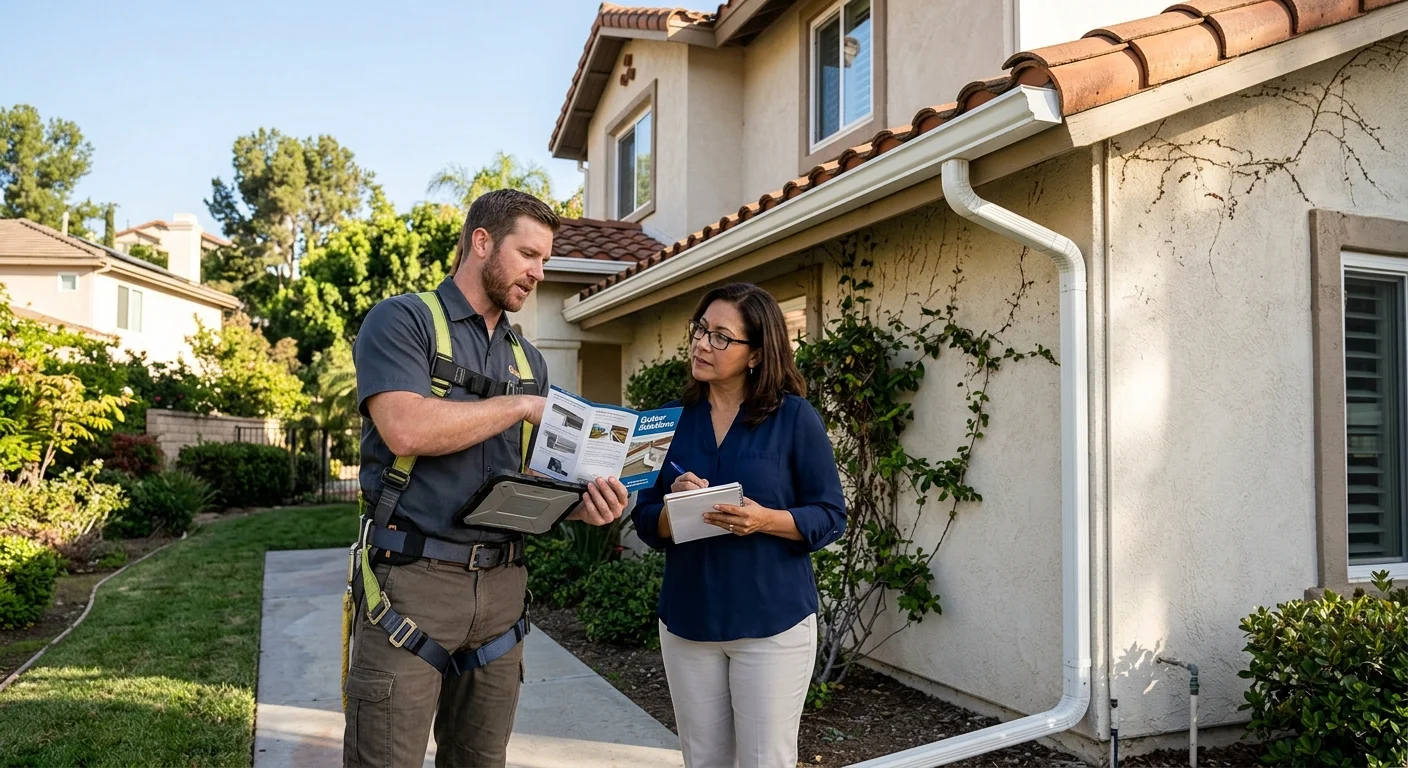
What repair can fix, and what it cannot
Repair makes sense when the defect has a boundary you can photograph. One open miter. One pulled hanger. One crushed downspout elbow. The proposal should name that location and say what stays.
Ask the evaluator to show where water left the trough. A stain on stucco is not a diagnosis. Water can travel along fascia, then drip far from the failed joint.
Reject vague lines. “Seal gutters” does not name joints. “Fix drainage” does not name outlets. Ask for run names, outlet locations, downspout connections, and marked photos.
Replacement is the clearer scope when leaks show up on more than one elevation, the trough is undersized for the roof area, hangers have pulled in a pattern, or the metal is split along the back. Replacement still does not have to mean every building on the lot. A proposal can split the house, garage, and patio.
Ask why each retained section can stay. Ask why each proposed replacement section cannot be repaired. That is the decision, not a sales label.
Service match: gutter installation and repair. How to read competing bids: comparing gutter contractors.
Fascia, slope, and where the water goes
The trough is only the visible part. The wood behind it and the ground below the downspout change the job.
Ask for close photos at the back of the gutter. Gaps, staining, soft wood, and loose nails belong in writing. Separate gutter work from fascia carpentry. State who handles hidden rot after the trough comes off.
Trace each path: roof edge, outlet, downspout, splash block or drain. Driveways, patios, retaining walls, and the neighbor’s lot can block a discharge you assumed was fine. Encinitas and La Jolla lots often dump toward a side yard. El Cajon and Santee lots often dump toward a slab. Neither layout is a county rule. It is that address.
Permit and drainage rules sit with the city or county that owns the address. City of San Diego, Chula Vista, Oceanside, and unincorporated county desks are not interchangeable. Ask the authority having jurisdiction before you approve work. The independent pro should name the jurisdiction on the proposal.
Do not accept repair from one wet mark. Do not accept full replacement from curb appeal alone.
What a written proposal should include
Compare work, not slogans such as “complete gutter service.”
The document should identify:
- Which runs will be repaired, removed, replaced, or left alone
- Which joints, corners, outlets, and downspouts are in scope
- Whether fascia observations are included, excluded, or unknown until removal
- How concealed rot or fastener failure will be priced after opening
- Materials, profile, color, and finish
- Debris handling
- Whether a permit or drainage review applies. Ask the building department that owns the address. Read the current counter text. Do not treat this page as the permit rule.
- How scope changes get written approval
- Whether any warranty is offered, and who issues it
- Which completion photos and product labels you will receive
Ask for a simple edge diagram. “Front” and “left” fail on a house with a courtyard. Labels should match the photos.
If replacement is recommended, ask why repair was rejected. If repair is recommended, ask which later finding would flip the job. Those answers belong in the same PDF as the price.
Guards are a separate product. They do not fix a sagging run or a rotten fascia. See gutter guard installation.
How to compare two bids without inventing a market price
We will not publish a county average. Line items have to describe the same edges.
Make one row for every roof edge, outlet, and downspout. Mark each bid as repair, replace, retain, exclude, or silent. Then compare the photos and the reasoning.
A cheaper total can omit fascia, two-story access, or the garage. A higher total can include hangers, outlets, and paint. Neither number is a verdict until the rows match.
Ask each pro to split base work from optional items. If a condition cannot be confirmed until the trough is off, the proposal should say how that change is approved.
Also compare who owns each task. Gutter-only with fascia “as needed” is not the same job as gutter plus carpentry on named elevations.
Records to keep after the work
Keep the signed proposal, change orders, invoices, license lookup printout, and completion notice. Top Pro Roofing SD does not warrant work performed by referred contractors.
Save before and after photos with elevation names. Keep color chips, care sheets, and any manufacturer card. Keep permit cards when the city required them.
If the work follows storm damage and may become an insurance claim, keep photos and emails before permanent repairs. The California Department of Insurance tells homeowners to document damage and keep temporary-repair records.
Note which joints were repaired, which runs were replaced, and which areas were out of scope. That list is the starting point for the next inspection. It is not a claim about current condition years later.
When to call
Call when several sections leak, the fascia looks soft, or two proposals describe different houses. A matched licensed pro can inspect and write both options. Call (760) 750-5557.