Fairbanks Ranch estate roofs are mostly clay or concrete tile, with some slate, many valleys, and often a casita or barn. Leaks here often start under intact tile, in a debris-packed valley, or at custom flashing, not as a missing shingle tab. Diagnosis takes a careful lift-and-look, not a walk across the field. Repair cost is whatever the independent C-39 writes for this measured area. Top Pro Roofing SD does not publish a Fairbanks Ranch price list.
We refer. We do not install or warrant. Call (760) 750-5557.
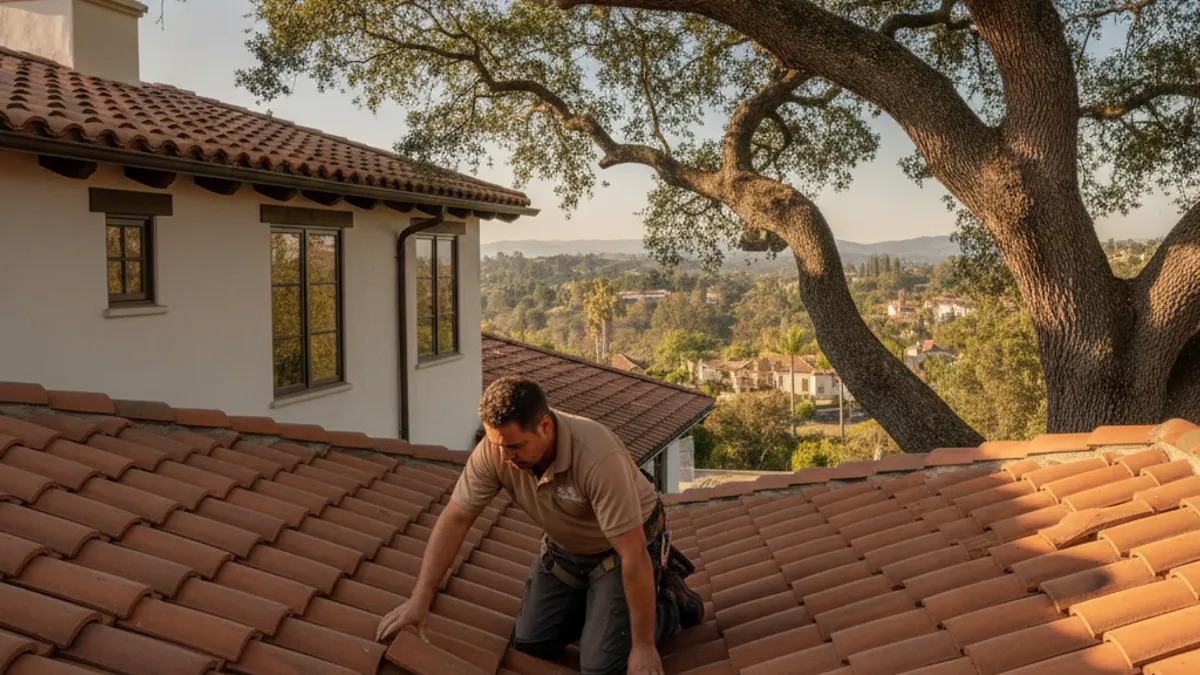
The most common leak patterns here
Failed underlayment under sound tile. Tile can look fine while felt or an aged synthetic sheet underneath has split or shrunk. That layer is what actually sheds water. Mechanism: common causes of tile roof leaks.
Oak and canyon debris in valleys and gutters. Tree-lined lots and trail easements drop heavy litter into valleys. A blocked valley backs water under tile laps in a storm. It reads as a “new” leak when the drainage path was clogged.
Dust and organic load on low-slope outbuildings. Casitas, barns, and arena-adjacent roofs collect paddock dust faster than a suburban garage. Clogged drains pond water on TPO or other low-slope covering.
Flashing at complex rooflines. Multiple wings, dormers, and chimneys mean more joints. One failed cricket or sidewall can wet a room far from the joint. Chimney-specific: chimney flashing repair.
What to do first
Contain indoor water. Move belongings. If a ceiling bulge is heavy with water, a small puncture at the low point can relieve it before a larger collapse. If water is at a light or outlet, shut that circuit at the breaker.
Do not walk the tile yourself. Untrained foot traffic cracks units and can open new entry points. That is why the first paid visit should be a C-39 who knows how to lift and reset tile.
How diagnosis works on tile or slate
The interior stain is often downhill from the entry. On a multi-wing estate the search can cross several planes. Tile is lifted and reset to see the sheet, not stomped. We will not invent a half-day clock or a fixed travel distance from stain to entry. Ask the roofer how they will trace this layout and what remains uncertain after the first visit.
Fairbanks Ranch is unincorporated San Diego County for building permits, with a separate HOA architectural track. A leak patch and a lift-and-relay are different permit conversations. Read the current live text from County PDS. This page will not restate fee caps or which patches skip a permit. The contractor should name the County counter and the association if the scope grows.
What repair typically costs (and what we will not invent)
We will not invent localized underlayment patches, flashing totals, gutter-guard packages, or section lift-and-relay ranges. Those numbers belong on the C-39’s written bid for this roof.
Ask every quote to split:
| Line | Why it matters here |
|---|---|
| Exact plane, valley, or chimney | Estate roofs have many of each |
| Confirmed vs suspected source | Stain is not proof |
| Tile salvage and reset method | Cracked units from walking |
| Named underlayment or flashing metal | The waterproofing, not mastic |
| Low-slope outbuilding as its own job | Easy to omit |
| How extra rotten deck would be priced | Found after lift |
| Who files County permit / HOA if scope grows | Two offices |
| Workmanship vs manufacturer papers | Separate |
When underlayment has failed across a large share of the field, repeated valley patches are a short-term plan. The honest fork is a tile roof lift-and-relay on the affected section versus another localized repair. That threshold is a condition survey, not a fraction we invent.
Preventing the next leak
Estate roofs have more linear valley and more canopy than a tract lot. A C-39 check before winter rain, focused on valley debris, gutter capacity, and chimney and skylight flashing, is the useful habit. Waiting for a ceiling stain usually means water has already traveled.
Give equestrian or casita low-slope roofs their own drain check. Paddock dust clogs a scupper on a different calendar than oak litter on the main house.
Local routing: roofing in Fairbanks Ranch. Insurance cause vs wear: does homeowners insurance cover roof leaks in California.
FAQ
Why did the roof leak with no broken tile showing? Underlayment under intact tile is the usual hidden path. It is not visible from the driveway.
Is it safe to walk my own tile roof? No, unless you are trained on that covering. Concrete and clay crack under the wrong step.
How urgent is a chimney or flashing leak? Treat it as active. Gaps at metal joints tend to open further with each rain.
Does homeowners insurance cover this? Sometimes. Sudden storm damage and gradual underlayment wear are different conversations. Read the policy and the linked California guide. Coverage is the insurer’s call.
When to call us
Estate tile and slate need a C-39 who has worked this kind of layout, not only tract shingle. We connect Fairbanks Ranch homeowners with licensed independent local roofers. You contract and pay them directly. Call (760) 750-5557.