TL;DR

Chimney flashing isn’t one piece of metal. It’s three: step flashing (woven into shingles up the sides), counter flashing (mortared into the chimney face), and on wider chimneys, a saddle or cricket on the uphill side. In San Diego, these systems fail in predictable windows. Coastal homes from Coronado up through Cardiff see galvanized step flashing corrode through in 18 to 25 years. Inland chimneys get 25 to 30. Sealant joints fail sooner, usually 7 to 12 years, regardless of zip code. The full breakdown on the best roof material for coastal climates goes deeper.

Real repair pricing in San Diego sits between $450 for a counter-flashing reglet re-bed and $2,400 for a full strip-and-replace including a new cricket. The “caulk-and-pray” patch a handyman quotes at $180 will fail within 18 months and almost always makes the real repair more expensive. If your chimney has been leaking after rain for two seasons running, the metal underneath your shingles is already gone.

How chimney flashing actually works

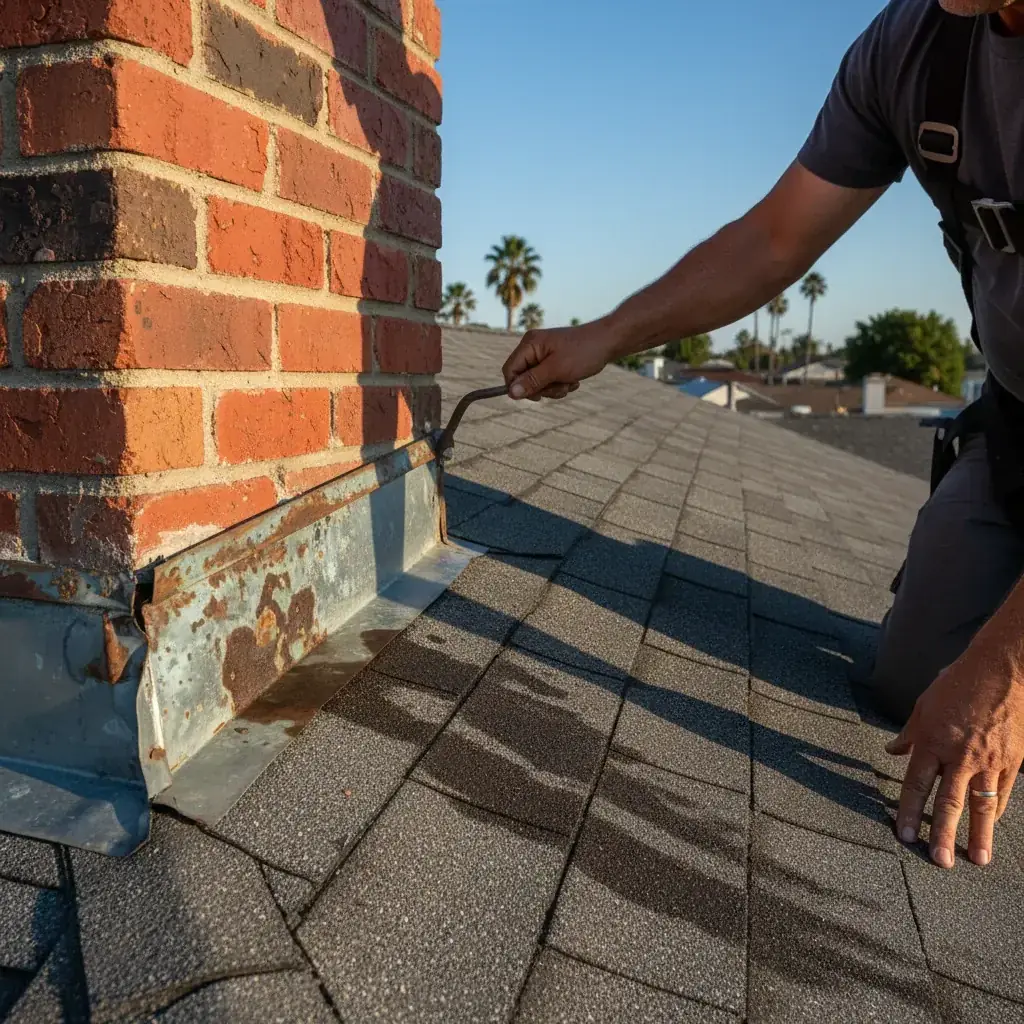
Most homeowners think of chimney flashing as “that strip of metal where the brick meets the roof.” That’s only the visible part. A correctly built chimney flashing system has three layered components.

Step flashing is a series of small L-shaped metal pieces, usually 5x7 inches, woven between each course of shingles running up both sides of the chimney. Each piece overlaps the one below it like fish scales. Water hits the chimney face, runs down, gets caught by a step, and is shed back onto the shingle below.

Counter flashing sits on top of the step flashing. It’s either bent over a 90-degree return and mortared into a saw-cut groove in the brick (called a reglet), or surface-mounted with sealant and screws. Its only job is to cover the top edge of the step flashing so water can’t get behind it.

Saddle or cricket flashing goes on the uphill side of any chimney wider than 30 inches. It’s a small peaked structure that diverts water around the chimney instead of letting it pool against the back wall. Code (IRC R903.2.2) requires it. Older San Diego homes in Mission Hills, North Park, and Kensington often don’t have one because they predate the code.

When any one of those three components fails, water gets in. When two fail at once, common at 20-plus years coastal, the leak gets ugly fast.

Why San Diego chimneys leak

The leak causes here aren’t generic. Our climate creates a specific failure pattern that you won’t see in Phoenix or Seattle.

Salt-air corrosion of galvanized step flashing. Most San Diego homes built between 1985 and 2005 used G90 galvanized steel. Within five miles of the coast, salt aerosol cuts the lifespan in half. Step flashing in Coronado, Imperial Beach, Ocean Beach, La Jolla, Cardiff, and Encinitas commonly shows perforation by year 18 to 22. The zinc coating sacrifices itself to protect the steel, and once it’s gone, the steel rusts through in a few seasons. You can’t see this from the ground. It only shows up when you lift the shingles.

For more on how salt air degrades roofing metal, see our coastal salt damage data analysis. For more on this, see whether salt will damage a metal roof.

Sealant aging at counter flashing. If your counter flashing was surface-mounted (screwed to the brick with sealant instead of mortared into a reglet), that sealant has a service life. Polyurethane in San Diego sun lasts 7 to 10 years before it cracks. Silicone fails the same way around year 5 to 8.

Mortar cracks at the reglet. On older homes with proper reglet-mounted counter flashing, the leak point shifts to the mortar joint itself. Brick chimneys flex slightly in heat and during seismic events. Over 30-plus years, that flex opens hairline cracks. Water seeps behind the flashing and down the chimney exterior, bypassing the entire system.

Missing cricket. The silent killer on wide chimneys. A 36-inch chimney with no cricket lets every gallon of rain that hits the uphill slope pool against the back wall. Even perfect step flashing can’t handle standing water indefinitely. The shingles upstream rot, the underlayment saturates, and the leak shows up four feet inside the attic instead of next to the chimney.

If you’re seeing water stains but can’t trace them back to the chimney, our guide on how to find a roof leak walks through the diagnostic process.

5 signs of chimney flashing failure

You don’t need to climb on the roof to catch most of these.

  1. Rust streaks on the brick. Brown vertical staining below the metal flashing line means the galvanizing is gone and the steel underneath is rusting. The flashing has months left, not years.

  2. Water stains on the ceiling near the chimney chase. If the stain is within three feet of where the chimney passes through the ceiling, it’s almost always flashing. Farther than that, it could be a missing cricket dumping water upstream.

  3. Visible separation between flashing and brick. Walk around the base of the chimney from the ground with binoculars. If you can see a gap, a curl, or sealant pulling away from the brick, the system has already failed.

  4. White efflorescence on interior chimney brick. Powdery white deposits on the firebox or smoke chamber mean water is migrating through the masonry. Often a reglet or cap issue, sometimes both.

  5. Musty smell in the attic after rain. Sustained moisture from a chronic chimney leak shows up as smell before it shows up as a visible stain. By the time the drywall is wet, the framing has been wet for months.

Cost breakdown by repair scope

The price range on chimney flashing repair in San Diego is wider than almost any other roof repair because the scope varies so much. Here’s what real work actually costs, not internet averages.

Failure mode × repair × cost

Failure modeRepair scopeTypical cost (San Diego, 2026)
Sealant joint failure on surface-mounted counter flashingClean, prime, re-bed in polyurethane$450 to $650
Cracked reglet mortar, flashing still goodCut out old mortar, re-bed metal, repoint$550 to $850
Step flashing corroded, counter flashing reusableLift shingles, replace step flashing, reset counter$950 to $1,500
Full system replacement, no cricket neededStrip everything, new step + counter + reglet$1,400 to $2,000
Full system replacement with new cricketAbove plus framed cricket, decking, flashing, shingles$1,900 to $2,400
Chimney chase rebuild required (rotted framing)Rebuild + reflash$3,500 and up

Pricing assumes a single-story home with good roof access, a chimney under 48 inches wide, and asphalt shingle roofing. Tile and slate roofs add 25 to 60 percent because the surrounding roofing material has to come off and go back on without breaking. For more on flashing repair pricing across all flashing types, see our roof flashing repair cost guide.

Why “caulk-and-pray” repairs always fail in 18 months

There’s a repair you’ll get quoted at $180 to $250. A handyman or a roofer who doesn’t want the job will climb up, smear a bead of black roofing cement across the top edge of your flashing, and call it done. It looks fixed for about a year.

Here’s why it fails. The leak isn’t at the top edge of the flashing. It’s behind the flashing, where the step pieces have rusted through, or under the counter flashing, where the sealant has cracked. Smearing cement on top traps water against the failing metal and accelerates the corrosion. The next hard rain, water finds a new path around your patch, and the leak is worse than when you started.

We see this on roughly one in three chimney repair callouts. The previous “repair” is a black smear of asphalt cement two years old, the metal underneath is paper-thin, and the homeowner spent $200 to make the real repair cost $400 more in labor because we have to chisel the cement off first.

The only honest temporary fix is a self-adhered flashing membrane wrapped over the failure point. It buys you a season, not a decade.

Stainless and aluminum upgrade options

When step flashing has to be replaced, the question is what to replace it with.

Material × lifespan × cost premium

MaterialCoastal lifespanInland lifespanCost vs. galvanized
G90 galvanized steel18 to 22 years30 to 40 yearsBaseline
Aluminum (.024 or .032)30 to 40 years40 to 50 years+15 to 25%
Type 304 stainless steel50+ years60+ years+80 to 120%
Copper (16 oz)60+ years75+ years+200 to 300%

For most San Diego homes, aluminum is the right answer. It costs slightly more than galvanized, doesn’t rust, and salt air doesn’t eat it the way it eats steel. Stainless is worth it on coastal homes where you want a 50-year solution. Copper is mostly aesthetic, often spec’d on Mission Hills or La Jolla restorations.

One caveat: aluminum can’t touch wet concrete or fresh mortar. A correct install isolates it with butyl tape or a self-adhered membrane. Skipping that step is a common shortcut failure on cheap re-flash jobs.

Masonry reglet repair

If your counter flashing is reglet-mounted and the leak is at the mortar, the repair stays in masonry. Grind out the old mortar at full depth (about 1 inch), inspect the back of the counter flashing, re-bed in fresh Type N or Type S mortar, tool flush, apply a sealant cap.

Half-day job, $550 to $850. The most common mistake is a roofer who skips the masonry step and just runs caulk along the visible joint. Lasts a season because the underlying mortar is still cracked.

Cricket installation (when your chimney is wide enough to need one)

Code requires a cricket on any chimney where the side parallel to the ridge is wider than 30 inches. Most San Diego chimneys built before 1995 don’t have one. Adding one while the area is already open adds $400 to $700 and solves the upstream water pooling problem for the life of the roof.

A proper cricket is framed (not just bent metal), decked with plywood, underlaid with ice-and-water shield, flashed with woven step flashing, and shingled to match. Pre-formed metal saddles are fine on chimneys under 36 inches, but anything wider should be framed.

When the whole chimney needs to come down vs. repair only

Sometimes the flashing isn’t the real problem. The chimney itself is. Signs that flashing repair won’t solve your leak:

  • Crown is cracked or missing. The top cap of the chimney is its own waterproofing system. If the crown is shot, water enters from above and runs down the inside of the chimney regardless of how good the flashing is.
  • Brick face is spalling. Flaking, crumbling brick means water has been migrating through the masonry for years. Repointing or partial rebuild may be needed.
  • Chimney is leaning or pulling away from the house. Foundation or framing issue. Don’t reflash a chimney that’s structurally compromised.
  • No active venting (decorative-only chimney). Many San Diego homes have chimneys that were sealed off when fireplaces were converted or removed. If you’re never going to use it, the most cost-effective fix is sometimes to take the chimney down to the roofline and patch the roof over. We’ve done this for $2,800 to $4,500 on homes where the alternative was an $8,000 rebuild.

For broader context on what’s actually causing your leak, our overview of common San Diego roof leak sources covers the full diagnostic landscape.

Components × who repairs which

Chimney flashing repair sits in a weird gap between trades. Knowing who does what saves you from paying the wrong person to do the wrong job.

ComponentTrade responsibleNotes
Step flashingRooferRequires lifting shingles, not a mason’s job
Counter flashing (surface-mounted)RooferSealant work, screw mounting
Counter flashing (reglet-mounted)Roofer or masonMortar work, either trade qualified
Reglet cut into existing brickMasonDiamond blade in brick, roofer usually subs this out
Cricket framingCarpenter / rooferMost roofing crews do this in-house
Crown repair / rebuildMason or chimney specialistNot a roofer’s scope
Brick repointingMasonNot a roofer’s scope
Cap and spark arrestorChimney sweep or rooferEither qualified

If you call a roofer and they tell you the chimney itself needs work (crown, brick, repointing), that’s not them dodging the job. That’s an honest assessment. Bringing in a mason for masonry and a roofer for flashing is the right way to handle a chimney that’s failed across multiple systems.

For the specific case of flashing repair across pipe boots, walls, and chimneys, see our flashing and vent repair service page and our overview of roof flashing leak repair.

FAQ

How long should chimney flashing last in San Diego?

Coastal homes (within 5 miles of the ocean) with galvanized step flashing get 18 to 22 years. Inland homes get 25 to 35. Aluminum or stainless lasts 40 to 60-plus years anywhere. Sealant joints on counter flashing are the weak link regardless of metal, usually failing at 7 to 12 years.

Can I repair chimney flashing myself?

Surface-level sealant touch-ups, yes, if you’re comfortable on a roof and the underlying metal is sound. Anything that involves lifting shingles, re-bedding mortar, or replacing step flashing requires a roofer. The two most common DIY mistakes are smearing roofing cement on top (traps water, accelerates corrosion) and replacing step flashing without the right shingle technique (guarantees a leak in the first storm).

Is chimney flashing covered by homeowners insurance?

Generally no. Insurance covers sudden damage (a tree limb tears the flashing off, hail dents it). It doesn’t cover wear, corrosion, or sealant failure, which is what causes 95 percent of chimney leaks here.

Why does my chimney only leak in heavy rain?

Almost always a missing or undersized cricket. Light rain runs off without pooling. Heavy rain volume overwhelms the uphill area, water backs up against the back wall, and finds the weakest point. Adding a cricket fixes this.

How much should a real chimney flashing repair cost?

Sealant or reglet re-bed: $450 to $850. Step flashing replacement: $950 to $1,500. Full system with cricket: $1,900 to $2,400. Under $300 is a temporary patch. Over $3,500 should include either a cricket, a chase rebuild, or masonry work.

Does my roofer need to be CSLB-licensed?

Yes, for any job over $500. California requires a C-39 (Roofing) license for roofing and C-29 (Masonry) for masonry. Verify any contractor at the California Contractors State License Board. The National Roofing Contractors Association publishes the flashing detail standards most reputable roofers work from.

What’s the difference between a cricket and a saddle?

Same thing. “Cricket” is more common in code language. “Saddle” is more common in West Coast usage and on pre-formed metal versions.

How long the right repair lasts

A correct chimney flashing repair (aluminum or stainless step flashing, reglet-mounted counter flashing, fresh mortar, cricket where required) should hold 30 to 40 years on a coastal home and 40 to 50-plus inland. The system outlasts most roof replacements, so a properly flashed chimney usually only needs to be re-flashed once during a re-roof, then never touched again.

The trap most homeowners fall into is paying for the wrong repair three times before paying for the right one once. The $200 caulk patch becomes a $400 mid-grade fix becomes a $1,400 real repair becomes a $2,200 strip-and-replace with a cricket, because by then the deck is wet and the shingles around the chimney are gone. The cheapest path is almost always to do the correct repair the first time.

If your chimney is leaking and you’re not sure what scope you’re looking at, get up there with a flashlight first. Look at the metal, the sealant, the brick. If you can see rust, gaps, or pulling sealant, you’re past the patch stage. If everything looks sound from the outside, the problem is the part you can’t see (the step flashing under the shingles), and that’s the call to make.