Top Pro Roofing SD is a referral marketplace. We connect San Diego County homeowners with CSLB-licensed C-39 roofers. We do not repair roofs, we do not tear them off, and we do not publish a 2026 price list for either path. Call (760) 750-5557. You pay the contractor.
The useful question is remaining life versus how wide the failure is. A single pipe boot on a young roof is a repair. Three separate leaks on worn underlayment is a system problem. A carrier that will not renew because of roof age will not be satisfied by a patch.
We will not invent repair bands, replacement totals, permit fees, plywood sheet prices, or a 10-year spend table.
The 20 percent rule, and when it does not settle it
A common field rule: if the repair is a small share of a full replacement and the roof still has years of honest life left, repair. If either half fails, replacement is the conversation.
The ratio is a guideline. Two facts override it often:
- Insurance status. If the carrier is citing roof age for non-renewal, a localized repair does not change underwriting. Replacement is the document they want. Does homeowners insurance cover roof leaks in California.
- Sale timeline. If you are listing inside a year, buyers’ inspectors routinely treat a mid-life or older roof as a price conversation. Repair can still be right if the failure is one component and the field is sound. Put the remaining-life call in writing.
A related California discussion is the 25 percent rule. Treat that nickname as a prompt to confirm with the building department and the insurer. We will not certify a percent on this page. Age context: the roof-age guide.
Area, age, and remaining life
Cost share is one axis. Area and age are the other.
If storm or wear damage is a small part of the roof area, repair is usually the honest job. If damage covers a large share of the field, you are paying to refresh a system that is already failing. If the roof is late in its rated life, even a small-looking leak can be the first of several. Ask the AHJ and the carrier whether they use an area-share test. Do not copy a percent from a blog.
| Where the roof sits | Localized damage | Wide-field damage |
|---|---|---|
| Early in rated life | Repair | Repair unless the deck or structure failed |
| Mid life | Repair if one source | Replacement is often the cleaner bid |
| Late in rated life | Repair only if truly isolated | Replace |
A second opinion is worth it when one bid is a patch and another is a tear-off for the same house. Ask both to photograph the same bays.
Repair vs replace checklist
Repair is usually the right first bid when:
- The roof is still in the first half of its rated life
- The damage is one spot: one boot, one flashing run, a few tiles
- This is the first leak on this roof
- Damage is a small share of the area
- The carrier is not citing the roof for non-renewal
Replacement belongs on the table when:
- The roof is late in rated life
- Leaks showed up in two or more different places
- A large share of the field is worn, bald, or brittle
- The ridge sags or you see daylight through the deck in several spots
- You have a non-renewal notice that names the roof
- You are selling soon and the inspector will write the age anyway
If you land in the middle, remaining life in writing and insurance status usually decide it. A C-39 inspection with photos is the input. Service path: roof inspection.
Signs that point to full replacement
Age relative to the climate, not a calendar slogan
San Diego County is not one climate. Coastal salt and fog, inland UV, and East County heat and wind change how long a given covering lasts. Tile itself can outlive the felt or synthetic under it. Shingles inland often wear faster on south and west slopes. Flat membranes fail at seams and penetrations before the field looks “old.”
If the covering is beyond the high end of what that product usually lasts in your microclimate, replacement usually wins even when the surface still looks acceptable from the street. How long does a roof last in San Diego.
Heavy granule loss (shingles)
Granules protect the asphalt from UV. Gutters full of grit, or bald patches on the field, mean the remaining life is short. Inland south and west slopes in Poway, Escondido, and Ramona show this first.
Multiple leaks in different places
One leak is a repair until proven otherwise. Two might still be two repairs. Three different entries on a mid-life or older roof usually means the system is done, not that you need three patches. What causes roof leaks in San Diego.
Sagging ridge or deck
A dip in the ridge, or slopes that look uneven because the deck is moving, is not a flashing job. Opening that roof is already most of a replacement. Older light framing in Mission Hills, Kensington, Hillcrest, North Park, and Old Town shows this more often after decades of moisture.
Daylight in the attic
Lights off, daytime. Daylight through the deck in several spots (not a designed ridge vent) means the deck has gaps. A patch on the covering will not hold that.
Insurance or a sale inspection already flagged it
Carriers have tightened roof-age underwriting in California. A spot repair will not satisfy a non-renewal that names the roof. Some policies want a certification from a licensed C-39. Check the CSLB listing of whoever writes that letter: CSLB license lookup. Roof replacement is the path when insurability is the actual problem.
When repair is the honest call
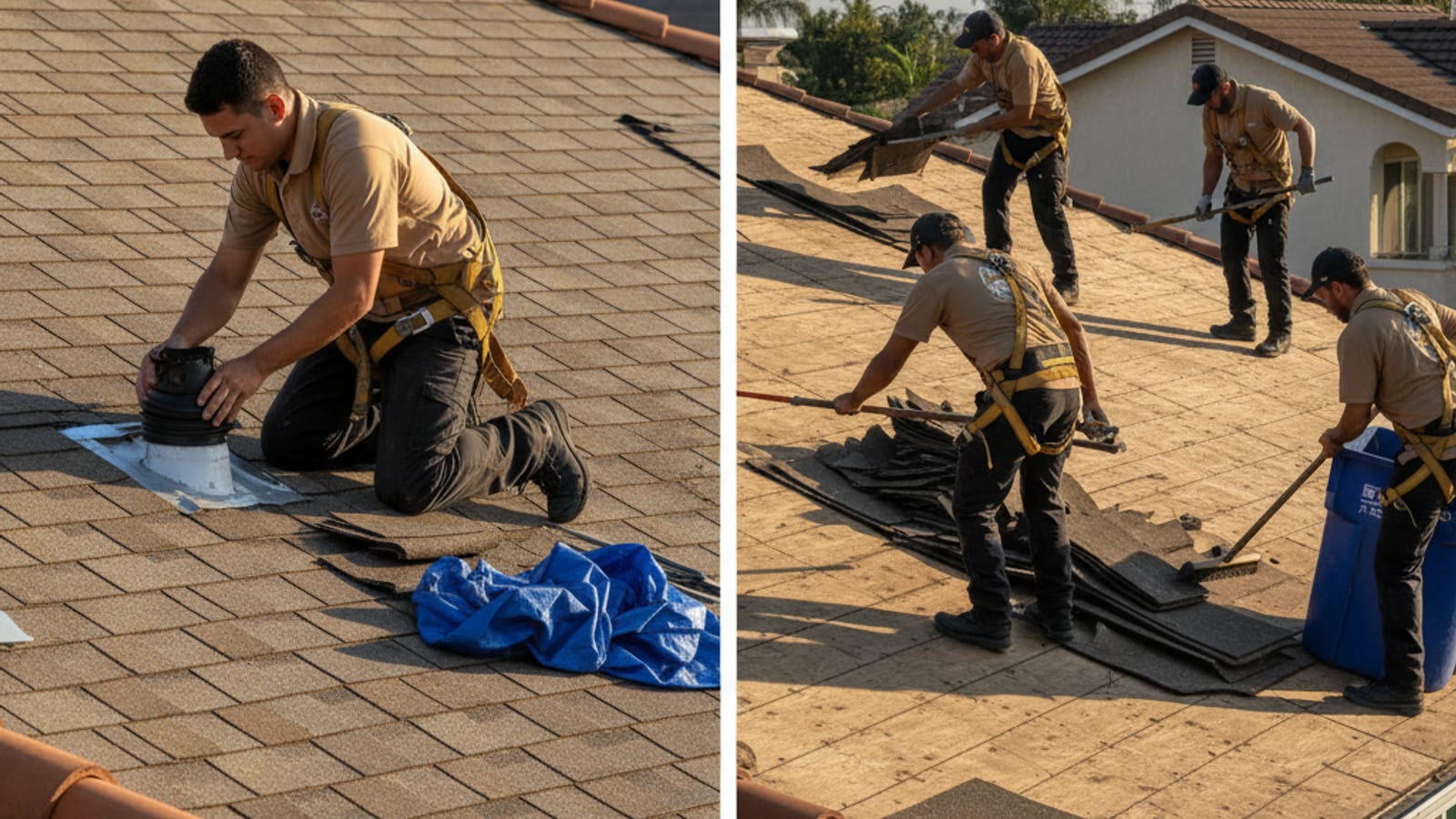
A leak traced to a pipe boot, chimney flashing, or a few broken tiles on a roof with remaining life is a repair. Do not accept a full tear-off as the only option because you called about one stain.
A young shingle roof should be repairable for almost any single-point failure. The exceptions are a documented storm event (often an insurance question) or a defective install. Tile jobs are often lift, underlayment in the wet bay, and reset of the original tiles, not a new tile roof.
Name the component on the bid: boot, step flashing, valley metal, skylight curb, a handful of tiles, a short shingle run, a solar foot. Flashing and vent repair. Roof leak repair.
Partial replacement
Replacing one slope can be honest when that slope took the UV or wind and the others are still sound, or when budget cannot do the whole house now, and you are not voiding a manufacturer warranty that requires a full roof.
Tradeoffs: color mismatch on shingles for a long while, a shorter warranty on the new section, and you will likely replace the rest later. Coordinate solar feet, a fan, or a mast move while the deck is open if those changes are already planned.
San Diego scenarios (decision, not a quote)
Poway, mid-life shingles, one chimney leak. Localized flashing, rest of the field sound, years of life left. Repair, then a regular inspection cycle.
Carlsbad, older tile, three leaks. Tile can still be good while felt underlayment is done. Three entries in different bays is system failure. Lift-and-relay with new underlayment is the usual honest bid, not three patches.
Ramona, older shingles after Santa Ana winds. Lifted tabs and granule loss on the windward slope. If the carrier treats it as a storm peril, replacement under that claim can matter more than a cheap patch that the next claim calls wear. Documentation and photos first. Storm damage and insurance.
Why bids disagree
If three replacement bids are far apart, the usual causes are different scope (permit, flashing, warranty enrollment), different material grade, or different assumptions about how much deck will come out. Compare line items:
- Permit through the city or county that actually governs the house
- Tear-off versus lift-and-relay
- Deck inspection and a plywood replacement allowance (a method, not a made-up sheet price here)
- Ice-and-water or equivalent at valleys, eaves, and penetrations
- Field underlayment type
- Drip edge, step and counter flashing, valley metal
- New pipe and vent boots
- Product name and code for the covering
- Hip and ridge
- Inspection and haul-away
- Manufacturer enrollment and a written labor warranty
Material and size still drive replacement cost. Coastal fasteners and flashing, inland UV-rated underlayment, tile versus shingle versus metal versus low-slope membrane are different jobs. Read new roof cost in San Diego and roof replacement cost for the cost conversation without treating this page as a rate card.
Questions that get an honest remaining-life call
- Can you show me the damage on the roof, with photos?
- What remaining life do you put in writing if I repair instead?
- What is in this scope that another bid might skip?
- Who pulls the permit, and who calls for final?
- What is the CSLB number, and is it C-39?
- Will you write the remaining-life estimate for the carrier?
Walk away from pressure, a refusal to write remaining life, or a license you cannot verify.
Frequently asked questions
How do I know if my roof needs repair or full replacement?
Use remaining life plus how wide the failure is. One localized leak on a roof with years left is a repair. Several leaks, late age, a soft deck, or a carrier non-renewal points to replacement. Insurance and a sale can override a cheap-looking patch.
Is it worth repairing an aged shingle roof in San Diego?
One boot or flashing repair on an otherwise sound field can still be worth it. Multiple leaks, heavy granule loss, or a carrier that will not renew at that age usually means replacement. Coastal and inland life expectancies are not the same. How long roofs last here.
Why do roofing quotes vary so much?
Different scope more often than different “quality.” Permit, flashing, deck allowance, and warranty enrollment change the paper. Compare lines, not only totals.
Can I replace just part of my roof?
Yes when one slope is clearly worse, and you accept color mismatch and warranty limits. Even aging across the whole roof usually favors a full replacement when you can fund it.
Will insurance pay for repair vs replacement?
Sudden covered perils are the usual path. Wear is not. Some carriers prefer a repair payout when the damage is wider than a patch. An independent C-39 estimate is the document that argument uses. California leak coverage.
Does my HOA care about repair vs replacement?
Most care about color and profile, not whether you patched a boot. Tile-mandated tracts (Scripps Ranch, Carmel Valley, Rancho Santa Fe, Fairbanks Ranch) will care if the visible tile changes.
How long does a roof replacement take in San Diego?
Shingle is usually a short stretch of dry days. Tile lift-and-relay and new tile take longer. Metal is its own schedule. Weather, permit, and HOA can stretch any of them. How long replacement takes.
The bottom line
Age, leak count, deck condition, and insurance status answer most San Diego houses. A competent local C-39 can read the rest in an inspection with photos.
Cost ranges by material: 2026 new roof cost. Lifespan: how long roofs last in San Diego. If the leak might be one of several: what causes roof leaks.
Service area
Inspections and written remaining-life calls through licensed independent roofers in La Mesa, El Cajon, Encinitas, Escondido, Chula Vista, Carlsbad, Oceanside, Poway, Ramona, and the rest of the county service area.
Call (760) 750-5557. We connect you with a licensed independent local roofer. Whether an inspection fee is credited to later work is that contractor’s written policy, not ours.