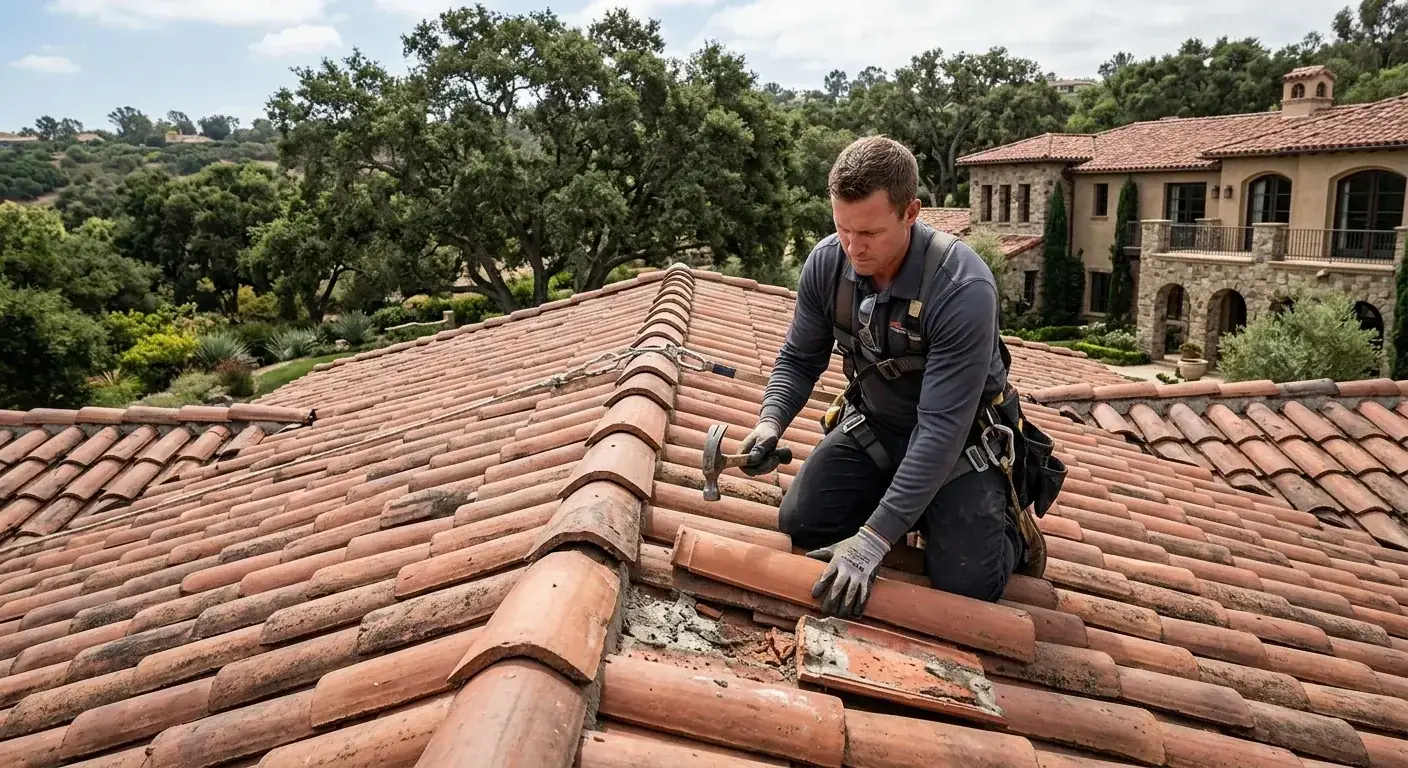
Rancho Peñasquitos (PQ, ZIP 92129) sits between I-15 on the east and open-space canyons to the west and north. Tract streets, larger lots than Mira Mesa, a lot of concrete tile, and a wildland edge along the preserves. Those four facts drive most roof conversations here. Top Pro Roofing SD is a referral service. We do not price lift-and-relay jobs or send a crew. Call (760) 750-5557 for a match with a licensed independent C-39.
This guide is for cause, WUI mapping, and HOA process. It is not a price list.
What PQ roofs look like
Much of Rancho Peñasquitos proper, Park Village, the shared Carmel Mountain Ranch edge, and older Sabre Springs blocks went up in the 1970s-1990s boom. Concrete tile is the usual covering. Eagle, Monier, U.S. Tile, and Boral profiles show up often because those were the production tiles of that era.
The tile field is rarely the first failure. Felt or later underlayment under the tile ages in heat cycling. Symptoms: water in the attic after the first hard rain, a new ceiling stain, drip marks on a wall. From the street the tile still looks fine.
The usual repair path on that pattern is tile lift-and-relay: stack and inspect existing tile, tear off failed underlayment, install a high-temp synthetic the bid names, reset flashing at every penetration, relay sound tile. Some pieces break in handling. The bid should say how matching profiles or salvage will be sourced, not a guessed breakage percent from this page.
A smaller set of lots toward the Black Mountain Ranch edge carry clay barrel tile. Same underlayment aging. Clay is more brittle, and matching salvage is harder. Ask the bidder to show the match plan before you sign.
Leak patterns county-wide: what causes roof leaks in San Diego. PQ-specific leak notes: roof leak repair in Rancho Peñasquitos.
The WUI fire-zone question
Several edges of the community sit against open space: west of Park Village Road, Black Mountain Open Space Park, Los Peñasquitos Canyon Preserve to the north, and the eastern unincorporated backcountry. That is real wildland-urban interface, not a slogan.
Check the parcel on the CAL FIRE Fire Hazard Severity Zone map. Interior master-plan blocks can sit outside a Very High overlay while a canyon-backing lot on the next street sits inside it. Do not copy a neighbor’s permit notes.
In mapped zones, ask the AHJ whether California Building Code Chapter 7A applies to this reroof. Read the current chapter. Expect a listed-assembly conversation if they say it does. Do not treat Class A as automatic on every 92129 street. Concrete tile is noncombustible at the surface. The vents, eaves, bird-stop, and underlayment still have to meet the stamped details if the permit set names them. Asphalt, if the HOA even allows it, needs whatever listed assembly the AHJ and the manufacturer pairing require, not a color name.
Ask the independent roofer to walk:
- Class A covering plus the listed underlayment
- Ember-resistant vents per the current Chapter 7A section and product listing (mesh size from the code sheet, not a blog)
- Eave and edge metal where the lot meets vegetation
- Gutters and valley debris, which matter on canyon lots even when the overlay is Moderate
Insurance letters can ask for roof class photos even off the overlay. That is underwriting. We will not invent a premium credit. Ember and Class A context: wildfire ember facts and wildfire-resistant roofing materials.
HOA architectural review in PQ
Most of Rancho Peñasquitos runs through architectural review for visible roof work. Color, profile, and material are in play. There is a master association plus sub-associations in Park Village, Carmel Mountain Ranch, and parts of Sabre Springs. Read the CC&Rs for your tract. Do not assume Park Village rules apply on a PQ proper cul-de-sac.
A typical like-for-like tile package the committee wants:
- Manufacturer, product line, color, and profile
- Physical samples
- Photos of completed nearby work, if you have them
- Underlayment, flashing, and fastening notes
- A schedule
Ask whether the independent roofer prepares the submittal or you do. Like-for-like tile is usually simpler than a material change. Tile to shingle, or a sharp color change, can be a longer argument. Some associations allow it. Some do not. Get that in writing before you pay a deposit.
We will not invent a two-to-four-week average. Ask the current committee calendar.
What a PQ bid should separate (no invented prices)
PQ roofs are often larger and more cut-up than a Mira Mesa rectangle. Valleys, hips, and penetrations drive labor more than ZIP code. We will not publish repair, boot, lift-and-relay, new-tile, shingle, or WUI add-on dollar ranges.
Ask the quote to line-item:
- Isolated tile and flashing versus a broader lift-and-relay
- Each penetration: plumbing vents, skylights, chimneys, solar feet
- HOA submittal work, if they handle it
- WUI or Chapter 7A details that apply to this address only
- Matching tile source, including discontinued profiles
- Hidden deck repair as a stop-and-approve extra
Process context, not a copied number: San Diego new roof cost guide and tile lift-and-relay.
Common PQ repair calls
Underlayment leaks on original tile. Covered above. The covering can outlast the felt.
Ridge and hip mortar. Mortar-set caps crack and loosen. Many crews now use dry-ridge systems with closures. Ask the bid which system, and whether it is a local reset or a full ridge run.
Pipe boots. Rubber collars split in sun. Lead or a listed long-life boot is the usual upgrade during a lift-and-relay. A standalone boot is still a flashing job, not a reroof.
Skylight curbs. Many tract homes still have original acrylic domes. The plastic yellows. The flashing at the curb leaks. Skylight work in Rancho Peñasquitos should name flashing and surrounding tile, not only the unit.
Repair-versus-replace: roof repair vs replace.
How to vet a PQ roofer
C-39 license. Check CSLB. The license name should match the contract.
Tile handling, not only shingle tear-offs. Lift-and-relay is its own crew skill. Ask for recent 92129 or nearby tile addresses you can drive by.
HOA packet. Who fills it out.
Mapped fire-hazard lots. Ask them to pull the FHSZ designation and write the assembly they will stamp, for this street, not a generic “Class A” line.
Red flags: roofing contractor red flags in San Diego.
Get connected
We match homeowners with licensed, independent roofers who bid Rancho Peñasquitos work. We do not employ those crews. Emergency tarp is the leak-during-storm path. No arrival-time promise from this brand.
Call (760) 750-5557 or request a quote. City hub: Rancho Peñasquitos roofing.