Tile is the default roof across much of San Diego County. Concrete S-tile in Scripps Ranch, clay barrel on Spanish Revival streets, two-piece mission in Mission Hills and Kensington. “Tile roof cost” is still not one number. A Clairemont concrete job and a two-piece clay job in Rancho Santa Fe are different products.
This page is how to read a tile bid in 2026: by tile type, by new tile vs lift-and-relay, and by the line items that surprise people. We do not invent installed totals. Ask the matched independent roofer to measure your roof and write the spec. Call (760) 750-5557.
For a 2026 replacement walkthrough, see tile roof replacement cost in San Diego. For per-foot math as a separate task, see tile roof cost per square foot.
TL;DR
- Concrete S-tile is the common tract product. Clay barrel is the classic Spanish look. Two-piece mission is slower and more specialized.
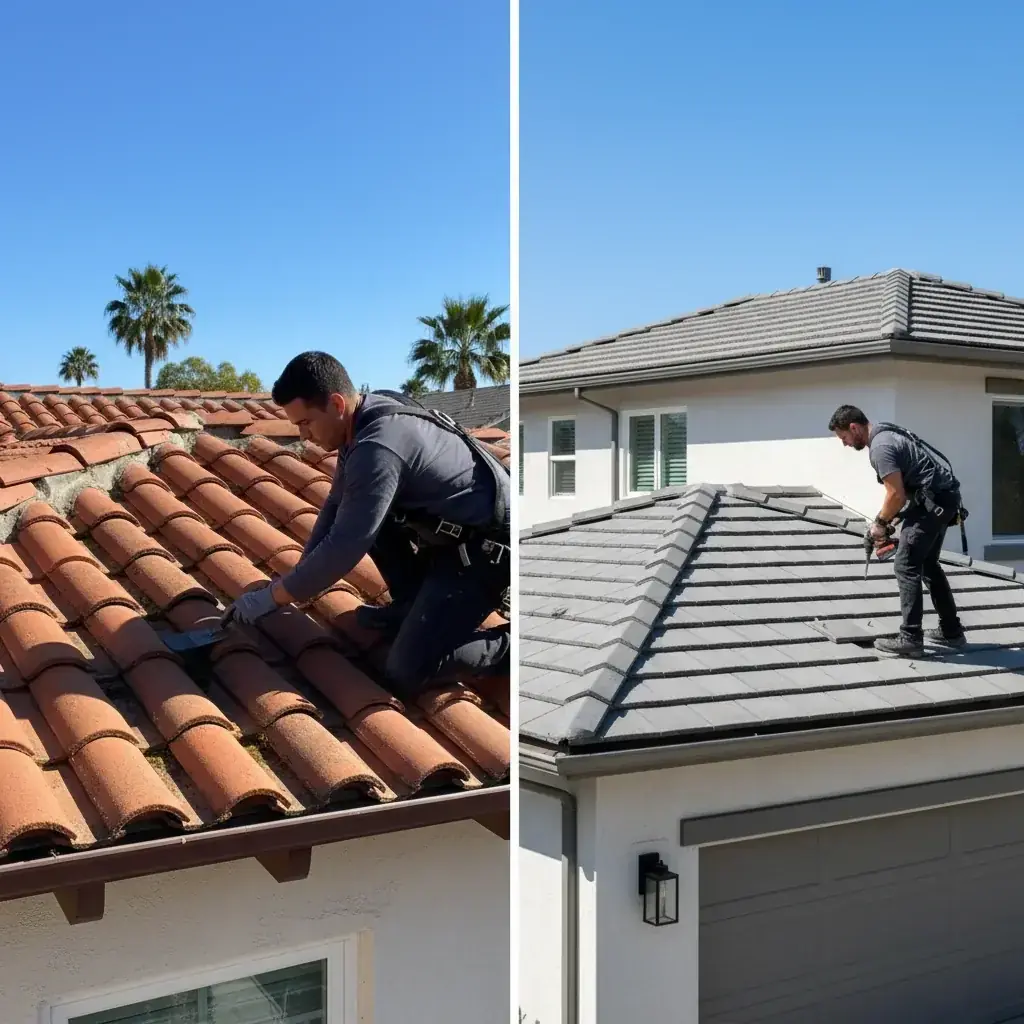
- If the tile is still sound and the felt underneath is failing, lift-and-relay is often the real job, not a full new tile roof.
- Underlayment, flashing metal, deck repairs, and solar reset usually move the bid more than the tile color.
- Older homes may need a structural look before anyone adds weight. Ask before you sign.
- Compare line items. A single round number is not a tile quote.
The decision that actually sets the bid
For a typical single-family house, the first fork is not “cheap vs expensive tile.” It is:
- New tile, full tear-off and new units.
- Lift-and-relay: existing tile comes off, new underlayment and flashings go on, original tile goes back, with a breakage allowance.
| Scope | When it is the honest job | What the bid must name |
|---|---|---|
| New concrete S-tile or flat tile | Tile is spalling, you want a new profile, or the deck is coming off anyway | Manufacturer, profile, underlayment, battens, flashing metal |
| New clay barrel | You want baked-in color and a clay look the house was designed around | Clay source, installer experience, matching, two-piece vs one-piece |
| Two-piece mission | Historic Spanish Revival where pan-and-cap is the original language | Labor time, weather blocking, salvage vs new |
| Lift-and-relay | Tile is intact, leaks are from felt, flashings, or isolated breakage | Breakage percent, salvage plan, underlayment grade, flashing replacement |
Those numbers in national blogs are not your house. Pitch, valleys, chimneys, two-story access, and skip-sheathing change labor. Ask for roof area, not heated square footage.
Cost by tile type: what you are buying
Concrete S-tile
The workhorse on tract streets from Mira Mesa through much of North County. It mimics a barrel from the curb. Concrete is heavy. Most later San Diego houses were framed with that in mind. Color coating can fade while the tile body is still fine, which is why a tired-looking roof is not automatically a new-tile job. Ask the matched roofer to separate cosmetic fade from broken, spalled, or unfastened tile.
Concrete flat tile
Common on newer contemporary work in Pacific Highlands Ranch and newer Carmel Valley. Cuts and flashing lines show. A sloppy flat-tile job is obvious from the sidewalk. Ask about layout, closures, and how valleys are detailed.
Clay barrel
Terracotta look, color in the body rather than a surface coat. Lighter than many concrete profiles, slower to install well. Not every crew that sets concrete is good with clay. Ask how many clay jobs they have closed in your city, and whether they will name the tile maker.
Mission tile (two-piece)
Pan and cap, alternating courses. Historic Mission Hills, Kensington, Old Town, older Mission Beach cottages. Slow labor, tight weather-blocking at eaves and ridges. If the bid treats this like S-tile, it is the wrong spec.
Lift-and-relay
The tile roofing version of “save the good material.” Crews stack tile, replace underlayment and flashings, reset. Plan on some breakage. Salvage matching matters on discontinued clay. This is the usual conversation on many San Diego tile roofs when the felt is done and the tile is not. See tile roof lift and relay.
What drives the price up or down
Two houses on the same street can bid far apart. Ask about these before you pick a total.
Deck. Tear-off exposes plywood or skip-sheathing (1x6 boards with gaps, common on older shake-era decks). Modern tile assemblies usually want a solid deck. Ask for a per-sheet rate and how skip-sheathing will be handled if they find it.
Underlayment. This is where thin bids hide. Felt, synthetic, and self-adhered membranes are not the same product. On a roof you expect to keep for decades, the membrane under the tile is what keeps water out. Ask for the product name, not “felt.”
Weight and profile. High-barrel profiles need more weather-blocking. Heavier tile needs fasteners and battens that match the load. Ask the matched roofer whether the existing framing was built for this tile.
Older framing. Mission Hills, Kensington, North Park, Old Town, and Mission Beach houses sometimes picked up heavier roofs over time. A structural review is a real line item when you are going from shake or composition to tile, or stacking history on old rafters. Ask whether the city will want engineering before permit.
Permit. Fees differ by city. We will not invent a fee. The contractor should pull the permit. Confirm the department: City of San Diego Development Services, or your city’s building counter. Skipping a reroof permit is a red flag. Verify the C-39 at the CSLB lookup. Top Pro Roofing SD refers work. We are not the installer.
Hidden lines that belong on the first quote
Tile matching. Partial work on old clay often needs salvage. Ask where matching units come from and how long that takes.
HOA. Scripps Ranch, Carmel Valley, 4S Ranch, Rancho Santa Fe, Fairbanks Ranch, and similar tracts often control color and profile. Ask when the architectural review has to happen relative to the contract.
Solar disconnect and reset. Panels come off. Some solar companies will only let their own people touch the array. Get that in writing.
Disposal. Old tile is heavy. Ask whether dump fees are in the bid.
Fire assembly. Eastern unincorporated areas, Poway, parts of Escondido, and canyon edges may need a listed Class A assembly. Tile over the wrong underlayment can fail inspection. Ask for the ICC-ES assembly they will use.
Lift-and-relay vs new tile
Look at tile condition, underlayment condition, and how long you will keep the house.
Lift-and-relay is the usual path when most tiles are intact, leaks track to felt or flashing, matching new clay would be painful, and you want more waterproofing without throwing away good tile.
New tile is the path when tiles are spalling or breaking in quantity, you want a different look, the deck is failing, or you are rebuilding the whole assembly anyway.
Ask the matched roofer to put both options on paper when the tile still looks serviceable. If they will only sell new tile, ask why lift-and-relay is off the table.
FAQ
Is tile more expensive than shingles over the long run? Up front, tile is usually the heavier check. Shingles typically return for another cycle sooner in this climate. Tile with sound underlayment is a different ownership pattern: one membrane refresh (lift-and-relay) rather than repeated shingle tear-offs. Ask for both ownership stories on your roof, not a blog year-count. Shingle context: asphalt shingle replacement. Broader material spread: new roof cost.
Can my house carry tile? Many post-1980 San Diego homes were framed for tile. Many pre-1940 Spanish houses were too. The awkward middle is mid-century composition or shake houses that never carried this load. A structural look is the only honest answer. A careful roofer will not set concrete on a maybe.
How long does a tile roof last here? The tile body and the underlayment do not age together. Flashings and felt often fail first. Ask the matched roofer what they see on your underlayment and metal, not what a wrapper printed. More on that split: how long roofs last in San Diego.
Why is skip sheathing an extra? It was standard under wood shake so the wood could dry. Tile assemblies usually want solid decking. If they find it at tear-off, re-decking is a change order unless it was already in the bid. Ask for the unit price now.
Do I have to match the neighbors? Inside an HOA, usually yes. Outside one, you still have resale and street context. Ask the association in writing before you lock a color.
Does tile handle coastal salt? Tile itself does not rust. Flashings and fasteners do. Within a mile of the water, ask for stainless or copper at the metals, not galvanized. See best roof material for coastal climates.
Clay or concrete? Clay if you want that body color and you have budget and a crew that knows it. Concrete if you are matching a typical tract roof and want a widely stocked profile. Detail: concrete vs clay tile.
How to read a tile quote
If the bid is one number, ask for this list:
- Tear-off: area, layers, disposal
- Deck: inspection, per-sheet rate, skip-sheathing plan
- Underlayment: product name
- Flashings: metal named, valleys, drip edge
- Tile: maker, model, color, profile
- Battens and fasteners, including corrosion rating
- Permit and inspections
- Workmanship vs manufacturer coverage, named separately
- Payment schedule that follows California contract rules (do not overpay up front)
If a contractor will not itemize, that is information.
For most 25-to-35-year San Diego tile roofs with intact units, start the conversation on lift-and-relay plus a named underlayment. For failed tile or a style change, concrete S-tile or flat tile is the practical new product. For historic Spanish streets, mission barrel is the language of the house if the structure can take it. Slate is a different product: slate roof cost.
Get three written bids. Verify each C-39. Insist on a permit. Read the underlayment line twice.
Need a walk on your roof? Contact us or call (760) 750-5557. We match you with an independent roofer. We do not install tile.