Short answer For San Diego houses within about a mile of the ocean, standing seam aluminum and clay tile are the long-stay answers. PVDF-coated steel can work farther back if the coating, edges, and fasteners are marine-honest. What fails fast: galvanized fasteners, raw or cheap-coated steel panels, 3-tab shingles, and galvanized flashing. We will not invent a cost-per-year spreadsheet. Top Pro Roofing SD refers. We do not install. Call (760) 750-5557.
National lists treat Phoenix, Portland, and Ocean Beach as the same five materials. Salt aerosol is not a footnote here. Rank by corrosion and UV, then check slope, structure, HOA, and budget.
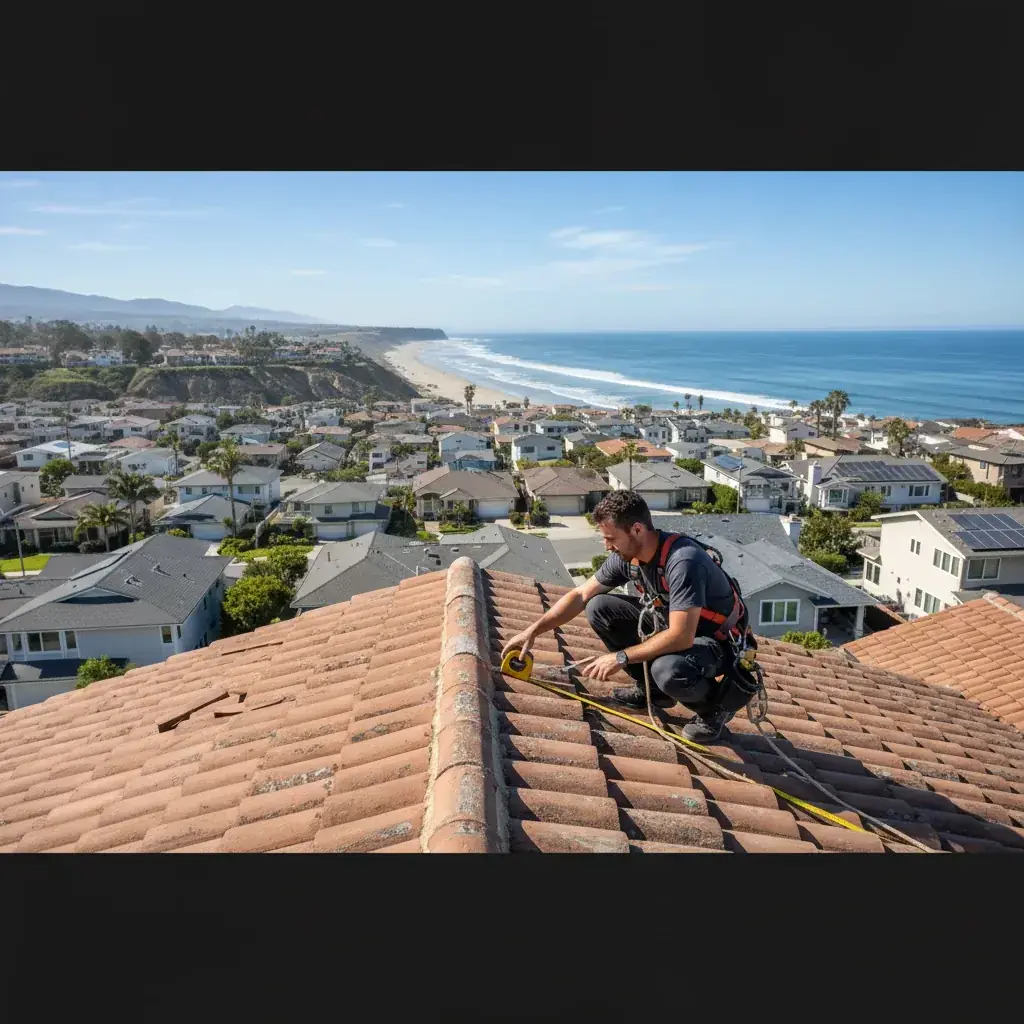
The exposure data sits on coastal San Diego roofs and salt. Metal chemistry sits on will salt damage a metal roof. This page is the covering choice.
Why coastal climates kill roofs faster
Salt aerosol. Onshore flow dumps microscopic salt on the roof. NOAA/NWS San Diego marine-layer and onshore-flow patterns are the weather side of that. Salt plus wet film accelerates electrochemical corrosion of iron-containing metal. On asphalt, the galvanized nail is often the first failure, not the shingle face.
Marine-layer humidity. The coast stays damp. Asphalt mats absorb, granule binder breaks down, and lime mortar on tile ridges erodes. Products that like dry inland heat can underperform in a June gloom belt.
UV, including bounce off water. South and west slopes with a water view take more UV than the same slope in El Cajon. Polymers, sealant strips, and plastic accessories age faster.
The combination is the point. One stressor is manageable. Salt plus humidity plus UV is why a “25-year” shingle on Mission Beach is not an inland shingle.
Coastal durability ranking (no sticker column)
Zone language here is a rule of thumb for houses with a real shot of marine air (roughly inside a mile, tighter if you can see the water). It is not a lab map.
| Rank | Material | Coastal role |
|---|---|---|
| 1 | Standing seam aluminum | Does not rust. Concealed clips. Finish is for color. |
| 1 | Clay tile (S-tile or flat) | Inert ceramic. Salt does not eat the tile. Underlayment and fasteners are the wear parts. |
| 3 | Copper | Patina, long stay, architectural. Match flashings. |
| 4 | Concrete tile | More porous than clay. Bedding and re-seal are the maintenance. |
| 5 | Stone-coated steel | Steel core under stone. Spec AZ coating, sealed cuts, stainless fasteners. |
| 6 | PVDF-coated Galvalume standing seam | Coating and edges decide it. SMP paint is the wrong finish. |
| 7 | Premium architectural asphalt + stainless fasteners + non-ferrous flashing | Honest mid stay if metal or tile is off the table |
| 8 | Standard architectural asphalt + galvanized nails | Fastener corrosion often beats the shingle |
| 9 | 3-tab asphalt | Skip at the coast |
| 10 | Galvanized steel panel / wood shake | Steel rusts. Shake rots in constant damp and is the wrong fire conversation in many WUI zones. |
Two things national lists miss: split asphalt by fastener metal, and do not let “metal roofing” hide galvanized ag panel.
More on assemblies: metal roof cost San Diego and tile roof cost San Diego. Those pages discuss cost drivers. They are not a quote.
What actually fails in coastal salt air
Galvanized fasteners. Zinc depletes. The head weakens. The next Santa Ana or 40-mph onshore gust lifts the shingle. Stainless ring-shank (304 inland-leaning, 316 at the surf) or copper nails are the coastal ask. We will not invent a nail surcharge.
Exposed steel flashings. Drip edge, valleys, and step flashing stocked as galvanized will perforate. Then you have a slow leak and deck damage before anyone sees a stain. Spec aluminum, copper, or stainless, matched to the roof metal.
Granule loss. Granules are the UV shield. Bald south and west faces in the teens are a coastal tell. Shingle granule loss in San Diego.
Mortar on tile ridges. Humidity attacks standard mortar. The tile is fine. The bedding is not. Foam-set ridges or polymer-modified mortar are the modern ask. Older pre-2005 mortar jobs often need a lift and relay.
Salt-corrosion ranking (iron vs not)
| Rank | Material | Why |
|---|---|---|
| 1 | Copper, clay tile, aluminum | No rust path in the covering itself |
| 4 | Zinc panel | Sacrificial patina. Needs a dry, ventilated underside |
| 5 | Concrete tile | Inert, porous |
| 6 | Stone-coated steel | Good while the coating and edges stay sealed |
| 7 | PVDF on Galvalume | High iron, coating-dependent |
| 8 | Galvanized / thin Galvalume, poorly detailed | Sacrificial coating, then steel |
| 9 | Asphalt of any grade | Shingle is not iron; the nails often are |
Never mix metals. Copper on aluminum, or galvanized through copper, is galvanic corrosion. Metal roofing is the service page for that install conversation.
Specs to request by name
| Material | Ask for |
|---|---|
| Aluminum standing seam | Named alloy and gauge the manufacturer lists for wind, PVDF finish, concealed clips |
| Copper | Weight the manufacturer and designer specify for the wind zone |
| Stone-coated steel | AZ aluminum-zinc base, factory edge sealing, stainless fasteners |
| PVDF steel | AZ Galvalume, full PVDF (not SMP), hemmed or sealed edges |
| Clay / concrete tile | Foam-set or polymer-modified ridges, marine-grade screws |
| Fasteners (all) | 304 or 316 stainless, or copper. Not galvanized within a mile of the water |
| Flashing (all) | Aluminum, copper, or stainless, matched to the roof |
Slope still governs. Standing seam needs the manufacturer’s minimum pitch. Tile needs the structure. Asphalt needs the pitch the underlayment and shingle allow.
San Diego coastal bands, by neighborhood (qualitative)
Surf and first blocks. Coronado, Imperial Beach west, Mission Beach, Ocean Beach west of Sunset Cliffs, Bird Rock, western La Jolla, Del Mar west of Camino Del Mar, beachfront Cardiff, Carlsbad, Oceanside. Default to aluminum standing seam, clay tile, or another non-ferrous covering with marine hardware.
Still in regular salt air. Solana Beach, the rest of Del Mar, Point Loma, Pacific Beach, eastern La Jolla, downtown Encinitas, Carlsbad, Oceanside. Same material list. Stainless fasteners are not optional.
About a mile inland. Hills above the coastal strip, western Chula Vista, National City slope, western Mission Valley, central Encinitas/Carlsbad/Oceanside. Premium asphalt with stainless and aluminum flashing can be a defensible mid stay. Metal and tile still win if you are staying.
Well inland. El Cajon, Santee, Poway, inland Escondido, San Marcos, Ramona. Corrosion is no longer the first constraint. Heat, fire maps, and HOA are.
Open valleys (Mission Valley, San Dieguito, San Luis Rey) can carry salt farther than a GPS mile. A west-facing hill with a water view is harsher than a sheltered inland lot at the same distance. Measure, then spec.
When asphalt is still the right call
Capital is capped. Premium architectural shingle, stainless fasteners, and non-ferrous flashing is a real upgrade over 3-tab and galvanized. It is still a shorter stay than aluminum or clay. Asphalt shingle replacement.
Short ownership. If you are selling in a few years and the roof is failing, marine-hardware asphalt can get you to closing. The next owner can upgrade.
Chopped geometry or low slope. Short panel runs make standing seam expensive and leak-sensitive. Some older framing cannot take tile. Then premium asphalt with marine hardware is the practical covering.
HOA and design review still veto materials. Check CC&Rs and the architectural committee before you fall in love with a charcoal standing-seam photo. Tile vs metal in San Diego.
Title 24 cool-roof rules depend on climate zone and slope. Confirm the listed product for this address with the AHJ and the current code cycle. Do not assume a beach house has the same prescription as an inland reroof.
Insurance discounts and coastal surcharges are carrier-specific. Ask your carrier what they actually credit for Class 4, tile, or metal. Do not use a blog percentage.
FAQ
Does coastal San Diego really need different material than inland?
Yes. Salt and marine-layer humidity change fastener, flashing, and coating choices. Inland East County is a heat and fire conversation first. See coastal leaks vs inland.
How close to the ocean does it matter?
Treat anything with a regular salt film as coastal. First blocks are severe. A mile is still worth marine hardware. Beyond that, topography matters more than a round number.
Aluminum vs steel for coastal metal?
Aluminum is the default near the water. Steel, even Galvalume, is coating-and-edge dependent. Distributors often warn against cheap steel substrates on the coast. PVDF is the finish to name.
Is premium asphalt with marine fasteners enough?
It is a real upgrade. It is not a 50-year aluminum or clay conversation. Use it when budget, slope, or HOA blocks the premium covering.
What this means for you
On the surf strip, if a reroof is in the next few years, start with standing seam aluminum or clay tile, then check structure, slope, and HOA. Stainless fasteners and non-ferrous flashings are the two upgrades that still pay on an asphalt job.
Top Pro Roofing SD matches you with an independent local roofer. Call (760) 750-5557 or use the contact form. Verify the C-39 at CSLB.
Related:
- Coastal salt damage: the data
- Best roof types for Southern California
- Best roofing shingles for San Diego climate
- Standing seam metal
- Stone-coated metal
- Tile vs metal
- Metal roofing · Tile roofing · Roof replacement
Sources: NRCA coastal exposure practice · NOAA NWS San Diego · ASTM B117 (lab salt spray, not a San Diego year table) · Title 24, Part 6 · CRC R908 reroofing if recover vs replacement is in play
Material, HOA, and code details vary. Confirm with the matched roofer and the property’s building department before you buy.