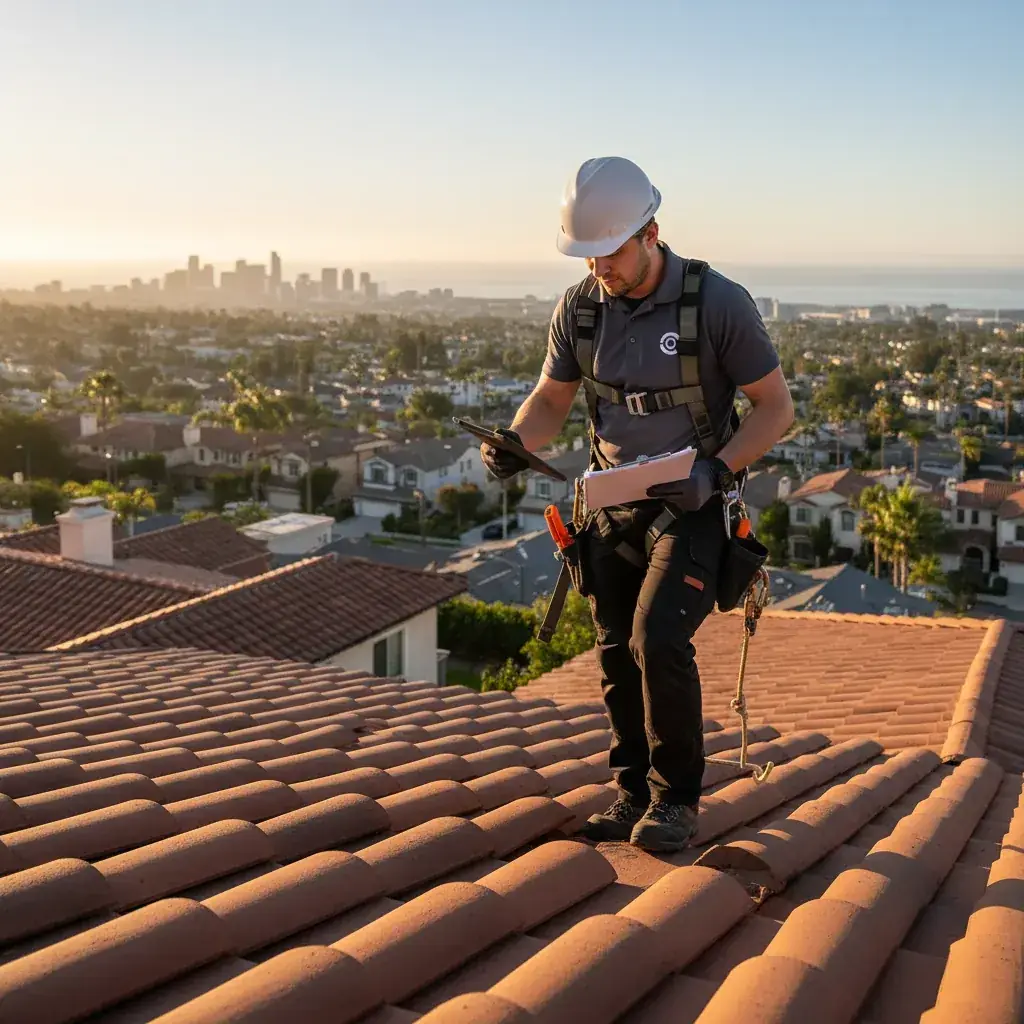
A drone is the right first look on tile, two-story, steep, or storm-damaged roofs in San Diego County. It is a camera with a licensed pilot, not a moisture meter and not an attic. Most honest jobs are a flyover plus targeted hands-on and an attic check, not “drone only” sold as a complete inspection.
Top Pro Roofing SD is a referral marketplace. We connect homeowners with independent CSLB C-39 roofers. We do not fly aircraft, we do not hold an FAA certificate, and we do not publish inspection prices. Call (760) 750-5557. You pay the contractor. Ask that contractor whether they (or their current FAA commercial UAS authorization pilot) will also open the attic.
Tile replacement context: 2026 tile roof replacement. Inspection scope: roof inspection checklist and the inspection service.
What a drone inspection actually is
A commercial operator authorized under current FAA UAS rules flies a small UAS, photographs every plane, ridge, valley, eave, and penetration, and often records video. Confirm current FAA rules rather than this page. Some payloads add optical zoom or thermal. The product should be geotagged stills, a defect map, and written findings, not a 90-second flyaround in a text thread.
Flight time on a typical single-family house is short. You are paying for the eye that knows kick-out flashing from a shadow. A hobby drone in a neighbor’s hands is not that.
When the drone should go first
Tile. Concrete and clay in Mission Hills, Rancho Santa Fe, Kensington, and older Coronado crack under a 200-pound walk. Looking for broken hips by walking them creates more broken hips. The camera sees ridge and valley courses without a boot on the barrel.
Two stories and up. Long ladders, tie-off, and fall risk make a “quick look” expensive. The aircraft does not care about eave height.
Steep pitches (about 8:12 and up). Harness work. Many companies will not walk that for a complimentary sales visit. The drone will.
Storm-damaged roofs. After East County Santa Ana winds, walking lifted composition or shifted tile makes the loss worse. Capture as-is, then decide where a person needs to stand.
Claim photos. Date-stamped, geotagged images from a commercial operator are easier for an adjuster to use than a phone shot from the driveway. They still do not replace an attic or a moisture reading.
When walking still wins
Flashing by hand. Pushing step flashing or a pipe boot tells you if the seal failed under a surface that photographs clean.
Attic. Stains on the deck underside, daylight at penetrations, compressed insulation, rusted nail tips. None of that is visible from 40 feet up.
Lifting a tile or shingle. Underlayment failure is a common leak with a pretty top surface. Someone has to lift material in a sample area when that is the question.
Single-story composition at 4:12 to 6:12. Granule loss, nail pops, and seal-strip failure are faster by hand. A drone-only fee on that roof is often theater.
Low-slope membranes. Seam wrinkles, open laps, and ponding depth read poorly from an oblique air angle. Walk the TPO or mod-bit, or you will miss the leak.
| Roof type | First tool | Why |
|---|---|---|
| Single-story composition, moderate pitch | Walk | Hands-on flashing, cheap and safe |
| Single-story tile | Drone | Walking breaks tile |
| Two-story composition | Drone, then walk if you can tie off | Ladder risk |
| Two-story tile | Drone | Height plus brittle covering |
| Above about 8:12 | Drone | Harness territory |
| After wind or hail | Drone first | Do not add footprints to the loss |
| TPO / modified bitumen | Walk | Seam-level detail |
| Solar on the roof | Drone | Paths between arrays are slow and easy to slip |
FAA current FAA commercial UAS authorization and San Diego airspace
Anyone charging for the flight should confirm current FAA commercial UAS authorization on the FAA commercial operators page. This page will not restate certificate names as a legal holding.
Much of the metro sits under controlled airspace around San Diego International (KSAN), Montgomery-Gibbs (KMYF), Brown Field (KSDM), Gillespie (KSEE), Palomar (KCRQ), and Navy or Marine fields. Low-altitude commercial flights in that airspace typically need LAANC authorization. If the person on the phone cannot say what class your house sits in and whether they will file LAANC, hire someone else.
The current FAA commercial UAS authorization card and a CSLB C-39 are different licenses. An independent inspector may only fly. A roofer selling repairs should have the C-39 (or you hire a second company for the work). Do not let a drone video become an unlicensed repair contract.
Cost: we will not invent a 2026 rate card
Free contractor walk-arounds exist. They are sales visits. Paid independent inspections cost more and should include a written report. Drone-only, drone plus attic, and claim-grade packages (drone, walk, attic, EXIF-backed files) are different scopes. Commercial buildings cost more than a ranch house.
Compare written scopes, not a blog column of dollar ranges. We do not collect a county survey and we do not set those fees. Related reading: roof inspection cost in San Diego and free roof inspections.
What belongs in the report
- Site overview with directions marked
- Every slope
- Close-ups of vents, skylights, chimneys, solar attachments
- Ridges, hips, valleys, eaves, rakes
- Gutters at more than one point
- Numbered defects on a diagram
- Severity and a next step (monitor, repair, replace)
- For insurance: date, weather, aircraft, current FAA commercial UAS authorization certificate number, original files with metadata
A single video and “looks fine” is not a report.
What drones cannot do
They cannot lift tile, press flashing, read moisture in a deck, or walk an attic. Wind and rain ground them. Thermal cameras see temperature difference, not water. A hot patch needs a meter or a stain in the attic before it is a leak.
An aged shingle roof can look intact from the air and still have been nailed wrong. Sample lifts answer that.
A sane workflow
- Airspace and weather, LAANC if required
- Ground: gutters, fascia, soffits
- Flight: orbit, then detail on penetrations
- Attic: every reachable bay
- Hands-on only where the photos or attic flagged a spot
- Written report on the promised calendar
San Diego patterns
Mission Hills, Kensington, older Coronado: brittle tile, some profiles no longer made. Walking is how you lose matching pieces.
Encinitas, Cardiff, La Jolla coast: salt on flashings and jacks. Year-over-year photos help you see fasteners going orange before they fail.
Ramona, Alpine, Jamul after Santa Ana winds: fly soon, then call the carrier with dated files. Waiting weeks lets the file turn into “age.” Sequence: Santa Ana wind damage and what California policies cover on leaks.
How to vet the person flying
| Ask | Solid answer | Walk away |
|---|---|---|
| current FAA commercial UAS authorization number? | Number and expiration | ”My buddy has a drone” |
| Airspace over this ZIP? | Class and LAANC yes/no | Blank |
| C-39 if they will repair? | License number you can look up | Selling repairs with no C-39 |
| Report contents? | Stills, map, writing | ”I’ll AirDrop the video” |
| Attic? | Included or priced as a line | Drone only, forever |
| Aviation liability? | They can name the policy | General liability only, shrugged |
Owned aircraft, in-house current FAA commercial UAS authorization, and an in-house C-39 is a clean setup for repair follow-through. An independent inspector with no repair incentive is a clean setup for a purchase. Both are valid. Mixing them without saying so is not.
FAQ
Will a drone inspection void a shingle warranty? Non-contact photos do not disturb the roof. Manufacturer warranties still have their own inspection and maintenance rules. Read that booklet.
Can I send my own hobby footage to the carrier? Maybe as extra. Many files want a commercial operator. If the claim is real, hire the licensed pilot.
Lindbergh, Miramar, North Island? current FAA commercial UAS authorization plus LAANC covers a lot of controlled airspace quickly. Some restricted military volumes take longer. Point Loma, Coronado, and the Miramar edge can mean a wait. That is airspace, not a roofing myth.
Does thermal find leaks? It finds temperature oddities. Verify on the deck or in the attic. Do not buy thermal as a standalone leak detector.
How often? Tile and two-story: after major wind, and on a regular calendar your C-39 recommends. Single-story shingle: less often unless you are coastal or you already have a leak history. We do not invent an “annual drone” product.
Can it replace a buyer’s roof inspection? No. Pre-purchase work still needs attic access and, when the question is underlayment, a sample lift.
HOA vs drones. CC&Rs can restrict launch and landing on common area. Flight in the National Airspace System is an FAA issue. California recording and privacy rules are a Legislature and Attorney General topic. If the operator records audio, read the current Penal Code text they cite. We will not restate that section. Tell neighbors anyway. Do not pick a fight with the board from a blog paragraph. If common-area launch is banned, the operator can often take off from your private driveway if that is lawful on that lot.
Bottom line
Use a drone when walking is stupid or destructive. Use feet and an attic when that is how you find the leak. Hire aviation skill and roofing skill as two checkboxes.
Call (760) 750-5557. We will connect you with a licensed independent C-39. Ask them on that call whether your roof is a drone job, a walk job, or both. See roof inspection.