Manufacturer “30-year” and “lifetime” labels on asphalt shingles are warranty terms, usually prorated after a limited full-replacement window. They are not a promise of how many years this San Diego roof will last. Remaining life depends on shingle type, nailing and flashing, attic ventilation, overlay versus tear-off, color and heat, foot traffic, and whether the house sits in salt air or East County heat.
Top Pro Roofing SD is a referral service. We connect San Diego County homeowners with licensed local roofers. We do not certify remaining life, and we do not invent a cost-per-year or a 2026 reroof total. Call (760) 750-5557.
If the roof is asphalt shingle, a licensed inspection beats any table on this page.
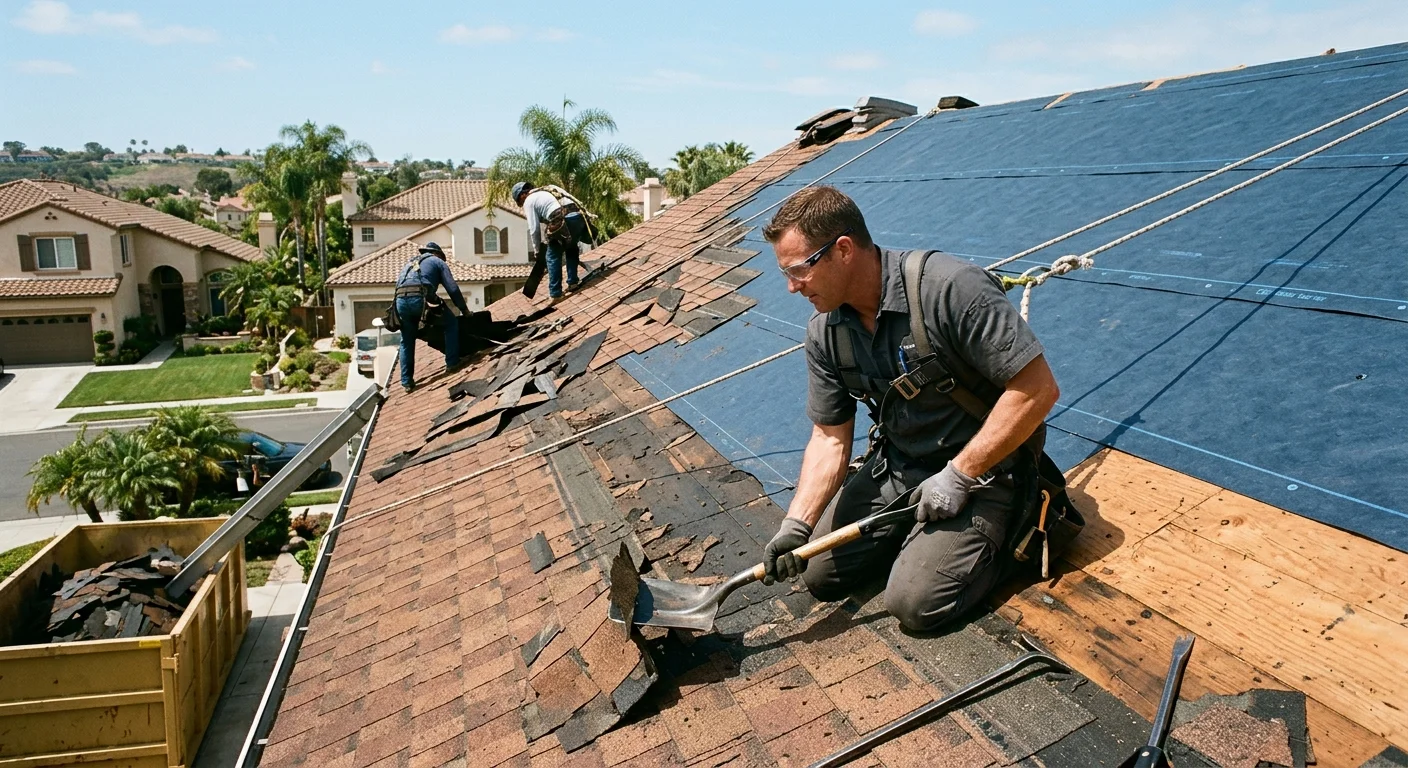
How to read lifespan versus warranty
| Shingle type | What the package often says | How to treat it |
|---|---|---|
| Three-tab | Shorter warranty class on the package | Thinner product. Often the first to show wear in sun and wind. |
| Architectural / dimensional | ”30-year” or “lifetime” marketing | Layered laminate. San Diego’s lack of freeze-thaw helps, attic heat still cooks the mat. |
| Class 4 impact-rated architectural | ”Lifetime” plus impact rating | Hail is uncommon here. Wind and heat still matter. Insurance discounts are carrier-specific. Ask your agent. We will not invent a percent. |
| Designer / luxury | ”50-year” or “lifetime” | Heavier, more asphalt per square. Still not a calendar guarantee. |
| Hip and ridge (matched) | Follows the field system when installed as specified | Cut three-tab used as ridge often dies earlier than the field. |
National consumer roundups often quote a service band for architectural shingles. San Diego avoids freeze-thaw and frequent hail, which is why many roofs last toward the long side of a given product class when they are ventilated and nailed correctly. Coastal UV, salt on fasteners, East County heat, and Santa Ana wind can pull the same product the other way. None of that is a measurement of your roof.
We do not have a proprietary inspection dataset across 67 cities. Treat every year range on the internet as a planning hypothesis. The matched C-39 should look at granules, seal strips, flashing, boots, and the attic.
What shortens shingles here
1. Attic ventilation
Shingles fail from below as often as from UV. Trapped attic heat embrittles the asphalt mat and starts curling and cupping early. Balanced ventilation is soffit intake plus ridge or high exhaust. Ask the permit office and the matched C-39 what net free vent area this attic needs. Many pre-2000 tract attics are short of that. See roof ventilation and attic heat.
2. Installation
A high-grade shingle nailed wrong fails faster than a basic shingle nailed right.
- Nails above or below the nailing strip lose hold or cut the shingle.
- Over-driven nails crush the mat. Under-driven nails leave the shingle loose.
- Skipping the starter course weakens the eave row in wind.
- Reused flashing under new shingles is a common leak at penetrations.
- Ice-and-water or equivalent at valleys and penetrations is often a warranty condition. Read the product instructions.
We will not invent a dollar figure for a skipped starter strip.
3. Overlay versus tear-off
A layover (new shingles over old) traps heat between layers and can shorten the new covering. California’s overlay rule and many manufacturer warranties also limit overlays. Specify complete tear-off unless a licensed proposal and the permit path say otherwise. We will not invent an overlay “savings” number.
4. Color and Title 24
Dark shingles run hotter in San Diego sun than light or reflective products. On a well-vented attic the lifespan gap may be small. On a tight attic, dark fields cook faster. Title 24 cool-roof rules can require listed reflectance on some reroofs, especially certain climate zones and low-slope areas. Confirm the permit, not a blog zone chart. Cool roof / Title 24.
5. Foot traffic
Hot asphalt sheds granules when walked. HVAC, solar, and dish work in August counts against the granule layer. Ask for walk pads or scheduled paths if crews will be up there often.
Microclimate without a fake year chart
| Region | What the climate does | What to ask the inspector |
|---|---|---|
| Coastal (roughly within a few miles of the ocean) | UV plus salt on fasteners and flashings | Fastener and metal condition, not only shingle age |
| Coastal valleys (Encinitas, Carlsbad inland) | Milder daily swing | Still check ventilation |
| Inland mesa (Clairemont, Mira Mesa) | Milder than East County heat | Ventilation and overlay history |
| North County inland (Rancho Bernardo, Poway) | More summer heat and UV | Attic temperature and windward seal strips |
| East County (El Cajon, Santee, Alpine) | Hot summers, Santa Ana events | Wind rating, fastening, ridge and hip |
| Mountain (Julian, Palomar) | Occasional freeze and snow load | Different failure mode than coastal salt |
Coastal metal and fastener notes: coastal salt damage. East County wind product class: 150 mph rated shingles. Those pages are still not a remaining-life stamp.
How to tell where this roof is
Age bands below are teaching labels, not a diagnosis.
Early years. Granules tight. No curling. Seal strips bonded. A mid-warranty inspection can catch nailing and flashing while labor coverage may still apply. Read the actual warranty.
Mid years. Some granules in gutters after rain is common. Slight fade. Wind resistance should still be intact if fastening was correct.
Later years. More granules in downspouts. Windward seal strips may release. Color variation across the field. Annual look becomes useful. Some carriers ask about roof age regardless of looks. See insurance non-renewal and roof age.
End of useful covering. Curling or cupping, bare mat, lifting tabs, multiple failed pipe boots, leaks in more than one area. Hip and ridge often go first if they were cut from three-tab.
End-of-life signs
In rough order of seriousness:
- Granule slurry in gutters after ordinary rain, not a handful after the first storm
- Curling, cupping, or clawing
- Bare spots where UV hits the asphalt mat
- Seal-strip failure and lifting in moderate wind
- Cracked pipe boots (rubber boots often fail years before the field is done)
- Several leaks in different places within a short span
One leak can be a repair. Repeated leaks in different planes is a replacement conversation. Roof replacement. Inspection options: roof inspection, drone inspection.
What actually extends life
- Fix attic intake and exhaust if the attic is baking hot
- Keep gutters clear so water does not back under the eave
- Replace failed boots before they stain the deck
- Install to the manufacturer’s nailing, starter, valley, and ridge instructions
- Match product class to exposure: algae-resistant granules near persistent moisture, wind-rated products where Santa Ana events hit, listed cool products where the permit requires them
We will not publish installed prices for a ridge-vent retrofit, a boot set, or a Class 4 upgrade.
Comparison without a cost-per-year table
Concrete and clay tile and standing-seam metal usually outlast asphalt as a covering class when they are installed and flashed correctly. Asphalt stays common on San Diego tract roofs because it is lighter than tile and simpler to detail on many cut-up roofs. Stay-vs-sell horizon, HOA rules, and structure decide the covering. We will not invent an annualized cost for a typical tract roof.
See tile vs shingle, tile lifespan, long-warranty shingles vs metal.
Frequently asked questions
Why does a “30-year shingle” not last 30 years? The number is a warranty structure, often full coverage for a short period then prorated. Real life follows heat, nails, and weather.
Will a shingle roof last longer in San Diego than in Phoenix? Often yes inland, because San Diego skips monsoon hail and extreme sustained heat compared with the desert. Coastal UV and salt are a different stress. Inspect this house.
The roof is older and looks fine. Replace it? Not on age alone. Get a licensed look at granules, curling, boots, and the attic. Plan replacement when those signals stack, or when a carrier or a sale requires a current covering.
Does insurance cover an old shingle roof? Covered perils (wind, hail, fire) are a policy question. Wear is not a casualty claim. Some California carriers non-renew on age. Ask the agent. We do not adjust claims.
Are “lifetime” shingles lifetime? No. Read the prorated terms and transfer rules. Designer products are heavier, not immortal.
Architectural vs designer? Architectural is the layered dimensional shingle used on most asphalt reroofs. Designer is heavier, often slate- or shake-look. Confirm bundles per square on the wrapper. Asphalt shingle types.
Can I add solar to an aging shingle roof? You can attach to a covering that still has life. Removing arrays later to reroof is extra scope. Ask the matched roofer and the solar contractor to sequence it. We will not invent a removal price. Solar removal and reroof.
Get an inspection, not a blog age
If the asphalt roof is aging, a roof inspection is how you decide repair versus replacement.
Call (760) 750-5557. We will connect you with a licensed local C-39. You contract with that roofer. Verify the license at the CSLB license check. We do not warrant remaining life.