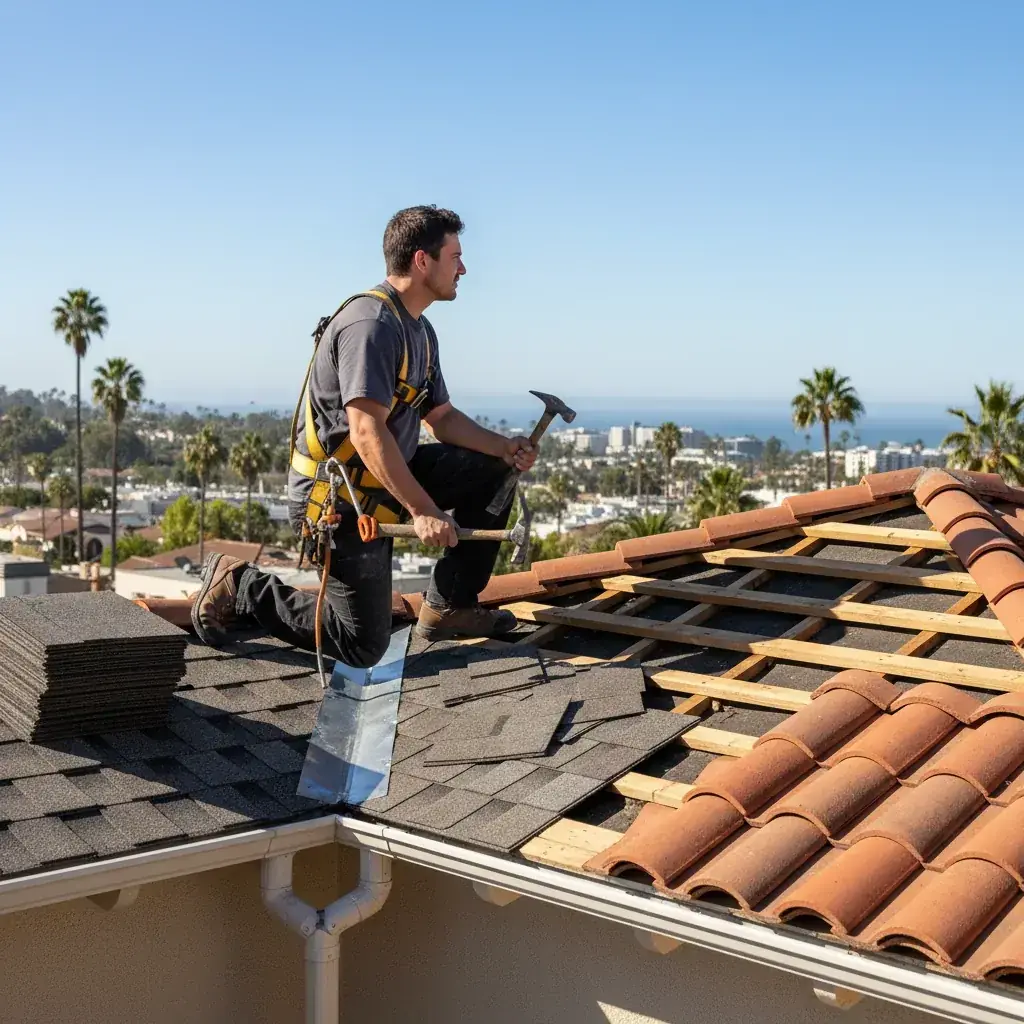
The short answer

  • Tile costs 2 to 3x more upfront, but they wash out over 50 years. A 2,000 sq ft tile roof runs $28,000 to $38,000 installed. The same home in architectural shingle is $16,000 to $20,000. Over 50 years, tile typically saves money.
  • Tile lasts 50 to 100+ years; shingle 22 to 28 (coastal) or 18 to 24 (inland). The underlayment beneath tile lasts 25 to 30, so plan on a lift-and-relay at year 30.
  • HOAs in San Diego often mandate tile. Scripps Ranch, Carmel Valley, Rancho Santa Fe, Fairbanks Ranch, and many Carlsbad and Encinitas communities require tile or restrict shingle.
  • Tile weighs 3x more. A pre-1980 home built for asphalt may need $4,000 to $9,000 in structural reinforcement before tile installation.
  • Resale value in SD luxury markets favors tile. Appraisers add $15,000 to $25,000 for clay tile on otherwise identical homes.

Most San Diego homes do best with tile if the structure can carry it. Architectural asphalt makes sense for older or lighter-framed homes, budget-constrained owners, and homes outside HOA tile mandates. For more on this, see 2026 tile roof replacement cost in San Diego.

The tile-vs-shingle debate in San Diego isn’t really a debate. It’s a checklist. Once you know your HOA rules, your structural capacity, your climate zone, and how long you plan to own the home, the answer is usually clear.

This guide walks through every factor that should go into the decision, with the real 2026 numbers across San Diego County.

The headline comparison

FactorClay tileConcrete tileArchitectural shingle
Lifespan (tile/material)75-100+ years50-75 years22-28 years (coastal); 18-24 (inland)
Underlayment lifespan25-35 years25-35 yearsBuilt-in (same as shingle)
Cost installed (2,000 sq ft, 2026)$28,000 to $38,000$24,000 to $32,000$14,000 to $20,000
Cost per sq ft (2026)$14 to $22$11 to $18$6 to $10
Weight (lb per sq ft)9 to 128 to 112 to 3.5
Class A fire ratingYesYesYes (premium lines)
Salt-air resistanceExcellentVery goodGood (paired with non-steel flashing)
HOA acceptance in SDHighestHighVariable (often restricted)
Resale value adjustment+$15,000-$25,000 (luxury)+$5,000-$10,000Baseline
Best forCoastal, historic, Mediterranean, luxuryMost SoCal tract homesBudget, lighter homes, sloped roofs without HOA mandate

Cost: upfront versus over 50 years

The biggest mistake homeowners make on this decision is comparing upfront cost only.

Upfront, a tile roof costs nearly twice what an asphalt roof does. Over the actual life of a home, that delta narrows or disappears, because asphalt has to be replaced two to three times in the same window that tile is replaced once or zero times.

50-year cost of ownership (2,000 sq ft San Diego home, 2026 dollars)

MaterialYear 1 installUnderlayment workReplacements needed50-year total
Architectural asphalt shingle$18,000n/a2 (years 25 and 50)$54,000 to $60,000
Concrete tile$28,0002 lift-and-relays at ~$10,000 each0 tile replacements$48,000 to $52,000
Clay tile$34,0002 lift-and-relays at ~$10,000 each0 tile replacements$54,000 to $58,000

Concrete tile wins on pure dollars over 50 years. Clay tile is roughly even with two asphalt replacements but holds an additional $15,000 to $25,000 in resale value in San Diego luxury markets. Asphalt wins only if you sell before year 18 or if HOA approves it as the only option.

These numbers assume realistic SD labor and material costs in 2026 and account for inflation in replacement years. Real numbers will vary by jurisdiction permit cost (see new roof cost in San Diego for the per-city breakdown).

Lifespan: what actually happens at year 25

The lifespan numbers in the headline table need one critical asterisk. The clay or concrete tile itself can last 50 to 100+ years. The underlayment beneath it lasts 25 to 35 years. The underlayment is the actual waterproofing layer.

At year 25 to 35, a tile roof needs a “lift-and-relay” service. We pull every tile, remove the old underlayment, install new synthetic underlayment, and re-lay the original tile. The tile is reused, intact. The roof is functionally new from a waterproofing standpoint. Cost runs $9,000 to $13,000 in 2026 for a 2,000 sq ft home.

Asphalt shingle, by contrast, has no underlayment-versus-shingle distinction. The whole roof comes off and a new whole roof goes on at year 22 to 28. There’s no lift-and-relay equivalent. For more on this, see what deteriorates asphalt shingles fastest in San Diego.

Practical implication: if you buy a home in 2026 with a 1995 tile roof, the tile is fine. The underlayment is at the edge of its life. Budget for lift-and-relay within five years. (More: how long does a roof last in San Diego.)

Weight: the structural question nobody asks

A clay tile roof loads at 900 to 1,200 pounds per “square” (100 sq ft). A concrete tile roof is similar. Architectural asphalt shingle loads at about 250 to 350 pounds per square.

For a 2,000 sq ft home, that’s 18,000 to 24,000 pounds of tile versus 5,000 to 7,000 pounds of shingle. A 17,000-pound difference sitting on your rafters.

Most San Diego homes built after 1980 were framed to carry tile load. Pre-1980 homes were typically framed for shingle. Older Spanish Revival homes from the 1920s and 1930s often have tile already, which means they were framed for it from day one. The risk zone is 1950s to 1979 tract homes that may have been framed lightly.

Before signing a tile contract on a 1950s or 1960s home, get a structural engineer’s confirmation that the rafters and beams can carry the load. Reinforcement, if needed, runs $4,000 to $9,000 and is a one-time cost.

Some structural engineers will charge $400 to $700 for a residential roof load assessment. That’s cheaper than discovering the problem after install.

HOA mandates: the constraint that overrides everything

In large swaths of San Diego County, the HOA already decided this for you.

HOA communities that typically require tile

CommunityRequirement
Scripps RanchClay or concrete tile required for most lots
Carmel ValleyTile required in most planning areas
Rancho Santa FeTile or specific approved alternatives only
Fairbanks RanchTile required; specific color approvals
Rancho Bernardo (specific tracts)Tile required; HOA approval mandatory
Eastlake (Chula Vista)Tile required in most villages
OlivenhainTile or wood-shake-replacement Class A composition
4S RanchTile in most pods

These are not comprehensive lists. Check your specific HOA architectural guidelines before contracting. Submission timelines run 4 to 8 weeks; some communities are longer.

HOA communities that typically allow either

CommunityNotes
Coastal Carlsbad (Aviara)Tile or premium shingle, color-restricted
Most older La Mesa, El Cajon, Santee neighborhoodsEither, no HOA
University CityEither, light HOA review
Many Oceanside neighborhoodsEither, varies by tract

Non-HOA areas

Most of unincorporated San Diego County, older Mission Hills, North Park, Hillcrest, City Heights, and Imperial Beach have no HOA roofing restrictions. The decision is purely structural and personal.

If your HOA mandates tile, the choice narrows to clay or concrete. Trying to substitute “tile-look” architectural shingle is a fight you will lose, and the HOA can force a rework at your expense.

Fire rating and WUI compliance

In Very High Fire Hazard Severity Zones (VHFHSZ), the California Building Code Chapter 7A requires a Class A fire-rated roof assembly with ember-resistant attic vents. This applies to most East County San Diego (Ramona, Alpine, Jamul, parts of Lakeside, Santee, Julian, Pine Valley) and parts of inland Riverside and Orange counties. Check your home address against the CAL FIRE Fire Hazard Severity Zone map.

In WUI zones:

  • Clay tile: Class A. Compliant.
  • Concrete tile: Class A. Compliant.
  • Architectural shingle: Class A on premium lines (GAF Timberline HDZ, CertainTeed Landmark, Owens Corning Duration). Verify the specific product line.
  • All three require Class A assembly, not just Class A material. Underlayment, ridge venting, and edge details all factor in.

For ember intrusion, tile (with proper bird-stop closures) has a slight edge over asphalt because the harder ceramic surface resists ignition longer. Both can pass WUI compliance with proper installation.

Salt-air resistance and coastal performance

For homes within three miles of the Pacific, salt aerosols are a constant. Marine fog deposits a salt film on everything.

  • Clay tile: Inert to salt. The 1925 clay tile roofs in Coronado are still original.
  • Concrete tile: Highly resistant. Minor surface coating wear over decades but tile substrate is fine.
  • Architectural shingle: Holds up well, but the fasteners and flashing under it can rust. Specify stainless or copper flashing on coastal installs.

The coastal failure mode is rarely the roofing material itself. It’s the steel under or around the material. (More: common causes of tile roof leaks.)

Aesthetic fit and resale value

San Diego architecture has a heavy Mediterranean, Spanish Revival, and Mission influence. Tile fits that vocabulary. Asphalt shingle on a Spanish Revival home looks wrong, and appraisers know it.

We’ve seen multiple San Diego luxury appraisals where switching from clay tile to concrete tile shaved $15,000 to $25,000 off market value. Switching from clay tile to asphalt shingle was even worse on Spanish Revival, Mediterranean, and Mission-style homes.

For mid-century modern, ranch, or contemporary homes, asphalt shingle or standing seam metal is the natural fit. Tile on a 1955 ranch looks pasted on.

Architectural styleBest material choice
Spanish Revival, Mission, MediterraneanClay tile preferred; concrete tile acceptable
Modern Mediterranean (post-1990 tract)Concrete tile, sometimes clay
Mid-century modern, ranchArchitectural shingle, standing seam metal
Contemporary, modern farmhouseStanding seam metal, architectural shingle
Craftsman, Cape CodArchitectural shingle, sometimes wood-shake-replacement composition
Mediterranean luxury (Rancho Santa Fe, La Jolla custom)Clay tile or specialty concrete tile

Maintenance reality

ConcernClay/concrete tileArchitectural shingle
Annual maintenanceVisual inspection, gutter cleanVisual inspection, gutter clean
Common repair (10-year mark)Cracked or slipped tile, $300 to $800Sealant on exposed nails, $200 to $500
Common repair (20-year mark)Underlayment edge wear, flashing rust, $1,000 to $3,000Granule loss patches, $400 to $1,200
Major service (25-35 year mark)Lift-and-relay, $9,000 to $13,000Full replacement, $16,000 to $22,000
Foot traffic damage riskHigh (tile cracks under point load)Low (shingle bruises but rarely cracks)
Solar install compatibilityRequires tile-replacement flashing kitsStandard flashing kits work

The foot-traffic issue is real and is the most common cause of premature tile leaks. HVAC techs, solar installers, satellite installers, and chimney sweeps all walk on roofs. On tile, they need to use rope walks or roof boards. They often don’t. (More: do solar panels damage your roof.)

Title 24 and cool roof requirements

California Title 24 Part 6 requires cool roof performance on most residential reroofs. The standard sets minimum solar reflectance and thermal emittance values.

  • Tile (light colors): Many concrete tile lines are factory-rated cool roof. Clay tile light colors (terra cotta, sand) typically meet or exceed.
  • Tile (dark colors): May require a “color shift” credit or a reflective coating.
  • Architectural shingle: Several manufacturers offer cool-roof-rated lines (GAF Timberline CS, Owens Corning Duration Cool, CertainTeed Landmark Solaris). Standard shingle colors may not qualify.

For new construction and substantial reroofs, this is a code requirement, not a preference. Check with your roofer on your jurisdiction’s specific reroof trigger.

Decision framework

Here’s the order of questions to answer.

  1. Does my HOA mandate one material? If yes, you’re choosing between clay and concrete tile.
  2. Am I in a WUI fire zone? If yes, the material must be Class A and the assembly WUI-compliant. Both materials can qualify with proper installation.
  3. Can my home structurally carry tile? Pre-1980 lighter framing may require reinforcement. Get a structural opinion.
  4. What’s the architectural style? Mediterranean / Spanish / Mission want tile. Modern / mid-century / craftsman want shingle or metal.
  5. How long will I own the home? Under 12 years, asphalt. Over 25 years, tile. In between, it depends on factors 1 to 4.
  6. What’s my budget? If tile is out of reach upfront, premium architectural shingle gives the best lifespan and resale at the lower price point.

Frequently asked questions

Can I switch from tile to shingle to save money?

Yes, in most cases, if no HOA restriction applies. Concrete or clay tile can be replaced with architectural shingle at lower upfront cost. You will lose resale value in SD luxury markets, and the home may look architecturally off if it was designed for tile. Verify the structural reduction is fine; switching from tile to shingle reduces load, which is structurally easier than the reverse.

Will my HOA allow shingle if my neighbors have tile?

Usually no. HOA architectural guidelines typically apply to all lots regardless of historical practice. Submit your material choice in writing and wait for written approval before signing a contract.

Do tile roofs need extra structural support?

For pre-1980 homes built for asphalt, yes. A structural engineer should confirm load capacity before installing tile. Reinforcement (sistering rafters, adding collar ties, beefing up bearing walls) runs $4,000 to $9,000 and is a one-time cost. Post-1980 homes built with tile in mind typically need no reinforcement.

Which holds resale value better in San Diego?

Clay tile, then concrete tile, then architectural shingle. The gap is biggest in luxury markets (La Jolla, Rancho Santa Fe, Carmel Valley, Del Mar) where clay tile can add $15,000 to $25,000 in appraised value over identical homes with shingle. In mid-market neighborhoods, the gap is smaller but still favors tile.

Does homeowners insurance care which I have?

Some carriers offer small premium discounts for tile (5 to 10 percent in California) due to better wind and fire resistance. Both materials qualify for coverage. Age matters more than material; most CA carriers will not cover roofs over 20 to 25 years old regardless of material.

What about metal roofing as an alternative?

Standing seam metal is a strong third option, particularly for fire zones and modern architecture. It lasts 40 to 70 years, weighs less than tile, handles salt air well (in aluminum or copper), and meets cool roof requirements. We compare metal directly to tile and shingle in our best roof types guide.

Working with Top Pro Roofing San Diego

A qualified roofer will install both tile and architectural shingle across all 67 San Diego County cities. Free assessments include a written recommendation that considers your HOA, fire zone, structural capacity, climate zone, and budget. We’ll tell you which material genuinely makes sense for your home and which would be the wrong call.

Call (858) 925-5546 or request an estimate.

Related reading: