TL;DR
- Membrane roof is a category: a low-slope roof that stays watertight as a continuous sheet or layered sheets, not by steep-slope overlap.
- Single-ply: TPO and PVC (heat-welded thermoplastics) or EPDM (adhered rubber). Modified bitumen: polymer-modified asphalt sheets, often two plies. Built-up: layered bitumen and felts, gravel or cap sheet.
- Attachment is a second bid: mechanically attached, fully adhered, or ballasted. Same polymer, different wind and labor story.
- Field membrane rarely starts the leak. Seams, drains, and rooftop equipment do. San Diego rain is light on paper and arrives in a few storms.
- We will not invent a service-life year or a price per square. Compare named assemblies and warranties.
Top Pro Roofing SD refers licensed C-39 roofers. We do not hold a commercial roofing license. Call (760) 750-5557.
Kearny Mesa and Miramar parks often have three different membranes on adjacent buildings. An inspection report that stops at “membrane” has not given you a spec. Commercial roofing and flat / TPO are the service paths. This page is how to read the word.
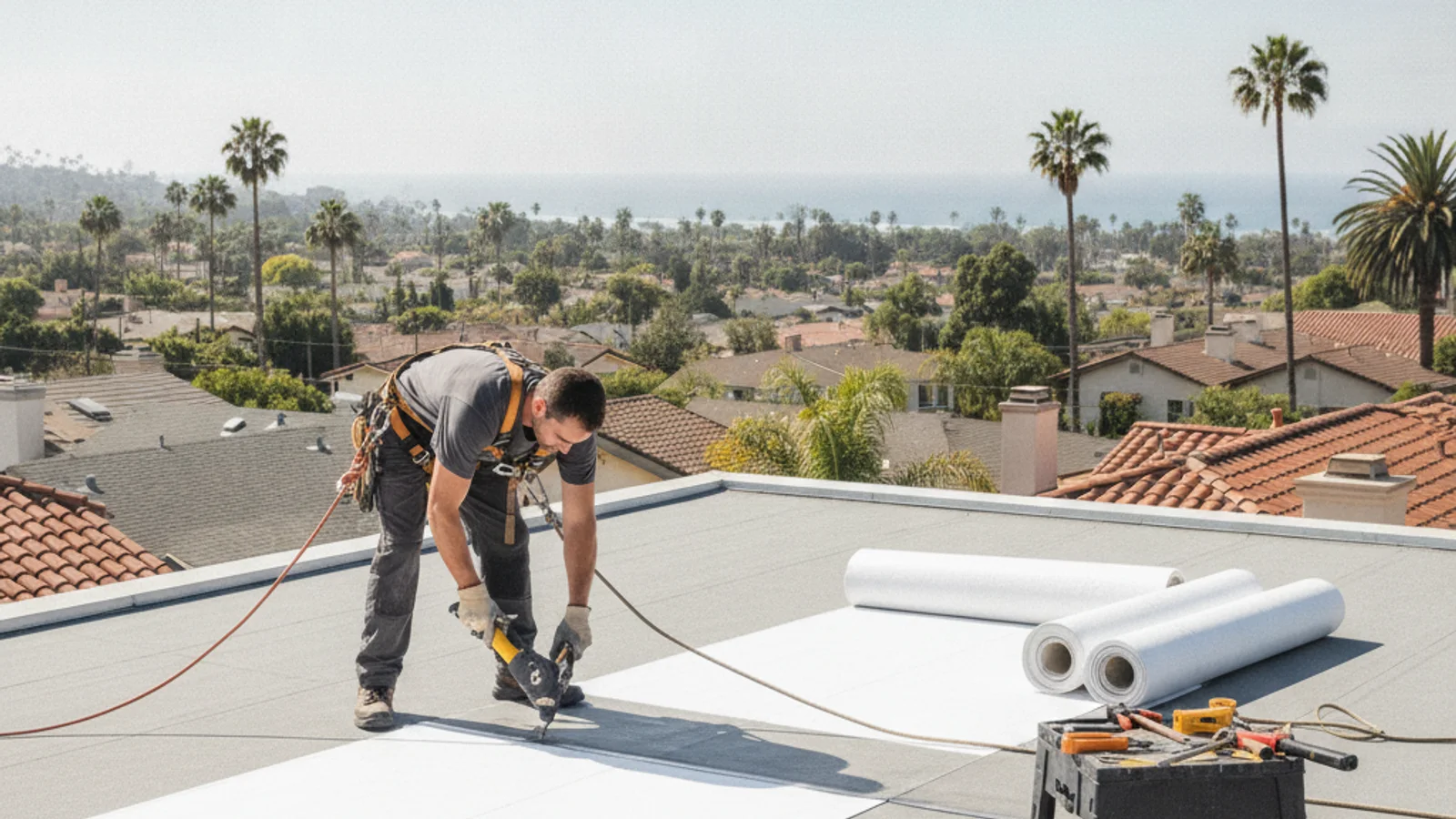
What membrane roofing means
Shingle and tile shed water by pitch and overlap. A low-slope roof holds water. Waterproofing has to be a joined surface.
California’s C-39 classification covers contractors who install products that seal, waterproof, and weatherproof structures. The materials list is broad: asphaltum, pitch, tar, felt, glass fabric, urethane foam, metal systems, tile, slate, and other roofing, waterproofing, weatherproofing, or membrane materials. Membrane sits in that one license next to steep-slope work.
Three owner-facing families:
- Single-ply. One factory sheet, seamed on site.
- Modified bitumen. Asphalt sheets modified with polymers, usually a base plus cap.
- Built-up (BUR). Alternating bitumen and reinforcing felts. Still common on older downtown, Barrio Logan, and mid-century industrial decks.
Single-ply chemistry vs modified and BUR
TPO. Thermoplastic polyolefin, usually light-colored, heat-welded laps. Common on San Diego warehouses and offices that want a reflective sheet.
PVC. Also thermoplastic and heat-welded. Specified where grease or kitchen exhaust will sit on the roof. TPO is the wrong default over a restaurant exhaust.
EPDM. Synthetic rubber, thermoset. Seams are tapes and adhesives, not a welder. See the EPDM guide.
SBS / APP modified bitumen. Torch, hot mop, cold adhesive, or self-adhered. Redundancy is extra plies. BUR adds more layers and a gravel or cap finish.
Repair culture differs. An asphalt cap patches with materials a C-39 already carries. A welded TPO/PVC sheet needs compatible membrane and a welder. Head-to-head on the two frequent local choices: TPO vs modified bitumen.
Mechanically attached, fully adhered, or ballasted
Do not compare two “TPO” numbers if attachment differs.
Mechanically attached. Plates and screws, usually in the laps. Faster. The sheet can flutter between rows. Fastener patterns tighten at corners and perimeters where uplift peaks.
Fully adhered. Whole sheet bonded. Smoother foot traffic, more labor, substrate has to be bondable.
Ballasted. Loose-laid sheet, gravel or pavers. Weight the structure must accept. Still on older buildings here.
Induction-welded plates are a middle path: mechanical plates, sheet bonded to them, fewer fasteners in the seam line.
What decides it is the uplift design for that height, exposure, and deck, not a preference. Point Loma, the Chula Vista bayfront, and a mesa-edge building are not a one-story inland warehouse. If two proposals differ on attachment, they are not the same roof.
Seams, drains, and penetrations
Seams. Made on site. Ask what probe or test was documented.
Penetrations. Sorrento Valley and Miramar R&D roofs are HVAC, exhaust, condensate, conduit, gas, antennas. Curbs, pitch pockets, and pipe boots fail when a mechanical crew works up there and does not restore the detail.
Drainage. Rain here lands in concentrated events, not a drizzle all winter. Confirm current climate normals on NOAA’s published tables if you need a number. A blocked drain does nothing in August and holds water for a week in December. Crickets, sumps, overflows, and ponding exclusions belong in the pre-bid talk. A paid roof inspection that skips those three areas is a walkaround, not an assessment.
Warranty and inspection, without fake year counts
Marketing quotes decade ranges for every polymer. We could not verify a general figure that holds for your building, thickness, attachment, traffic, and exposure. A Santee inland deck and a bayfront sheet do not age the same.
What you can hold: the manufacturer’s warranty for the named system, who it runs to, transfer on sale, labor vs material, and what voids it (ponding, unauthorized rooftop work, skipped inspections).
We could not confirm a California code that sets a private commercial inspection interval. The interval that binds you is usually the warranty. Practically, owners here look before the rains, after the last real storm, and after any equipment swap. Keep reports, the warranty, the submittal, and photos in one file.
Line up two written proposals
Named manufacturer, product, type, thickness, insulation, cover board. Attachment method and the wind basis. Tear-off vs recover and how many existing layers. Wet insulation and whether a moisture survey was done. Drain and slope work listed, not implied. Each curb and penetration. Metal edge and coping. Warranty, by whom, applicator certification required to offer it.
Ask the matched C-39 to show workers’ compensation evidence and a current CSLB record before you rank prices. License, bond, and complaints are public. Run bidders through the CSLB license check. A thin proposal is the warning, not the bargain.
When to call us
Membrane choice, attachment, and tear-off vs recover need a C-39 who has been on that roof. Call (760) 750-5557 and we will connect you with a licensed local roofer.