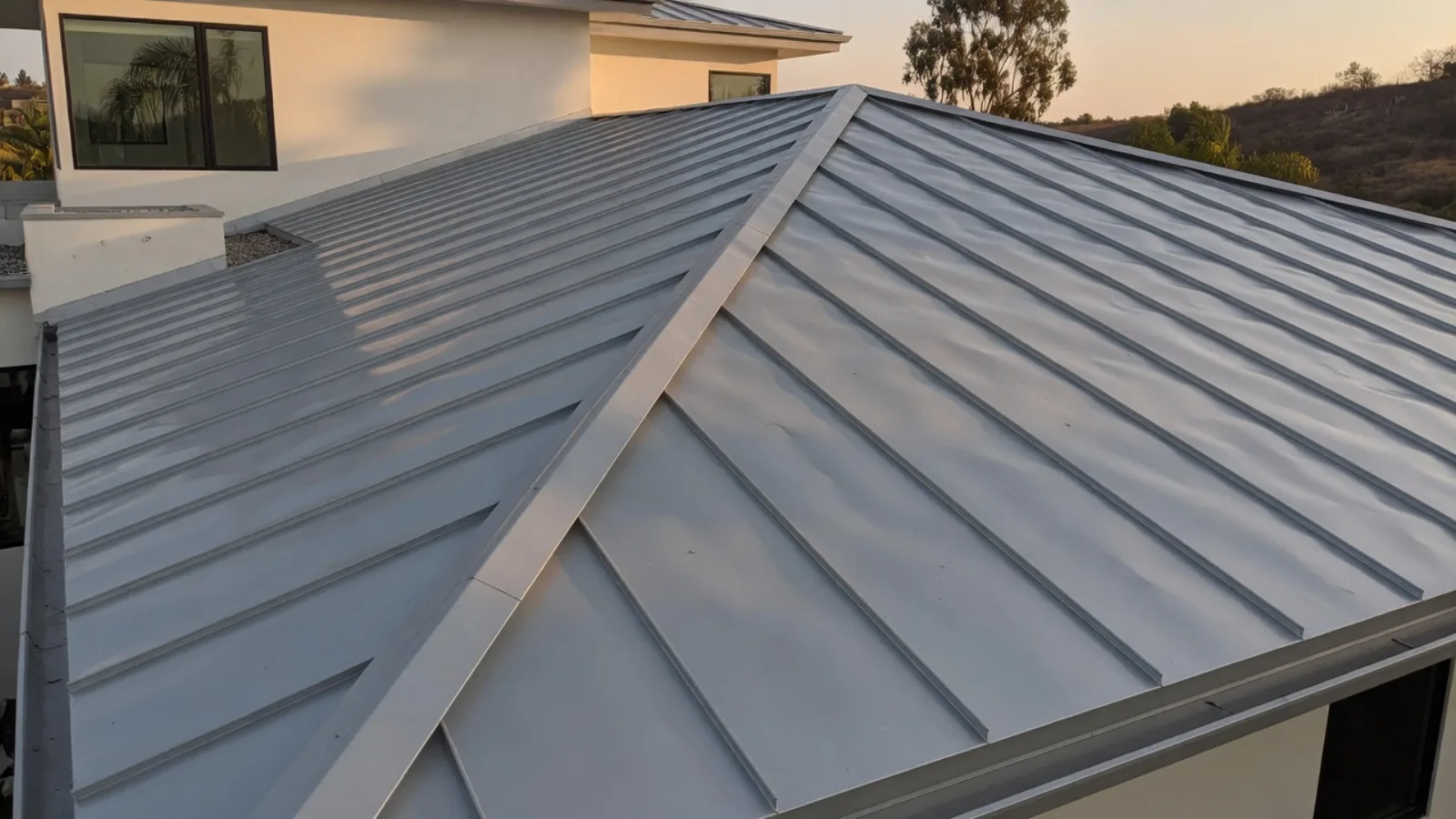
Oil canning is the visible waviness in the flat part of a metal panel. The Metal Construction Association calls it elastic buckling or stress wrinkling. It shows on steel, aluminum, zinc, and copper. It is not a synonym for a leak, and it is not a synonym for a failed roof.
Top Pro Roofing SD refers licensed independent C-39 roofers. We do not fabricate panels. Call (760) 750-5557. Confirm the license on the CSLB lookup. Service: metal roofing.
Coating chemistry is a different page: Galvalume vs galvanized. Profile: standing seam vs stone-coated.
What the MCA bulletin actually says
The MCA technical bulletin “Oil Canning in Metal Roof and Metal Wall Systems” defines oil canning as visible waviness in the flats. Differential stresses in panels with a high width-to-thickness ratio buckle the metal out of plane. Lighting changes how much you see. Late-day sun on a low-slope west face in Carlsbad will show waves a noon photo from the sidewalk misses.
The bulletin lists mill and coil stresses, fabrication, over-engagement of the coverage width, thermal movement when panels cannot float, and overdriven fasteners among the causes. Thicker metal, narrower flats, stiffening ribs, tension-leveled coil, floating clips, and lower-gloss finishes reduce how obvious it is. Manufacturers cannot fully prevent it. The MCA treats the condition as generally aesthetic.
We will not invent a 10-foot viewing rule or a rejection clause. If the project spec names a standard (some specs cite ASTM E1514 language on oil canning), that spec governs. Ask for the written spec, not a blog.
When a wave is still worth an inspection
A uniform mill wave in a wide architectural standing-seam flat, with fasteners seated and seams closed, is the textbook aesthetic case.
Ask for a closer look when:
- Waves line up with screw rows on a through-fastened panel. Overdriven screws pull the flat down. That is an install issue, not mill texture.
- A new dent or crease appeared after a crew walked the roof (solar, HVAC, satellite).
- A seam is open, a clip line is walking, or you have an interior stain. Waviness and a leak can coexist. The leak still needs a source: roof leak repair.
- Coastal fasteners are rusting and the panel is pulling. That is coating and fastener, then maybe distortion: will salt damage a metal roof.
Do not climb a standing-seam roof in socks to “press the wave out.” You will add oil canning.
What San Diego sun and heat do to the look
Inland south and west slopes (El Cajon, Poway, Escondido) run hotter. Darker, glossier panels show waviness more than a matte lighter color. Thermal cycling is why floating clip systems matter on long standing-seam runs. A panel locked tight at both eaves has nowhere to grow at noon.
Coastal lots add salt at the fasteners. The wave you see may be mill. The rust at the screw may be the actual repair. Split those on the quote.
Corrugated and stone-coated profiles have narrower flats. They show less oil canning by geometry. That is one reason they look “flatter” from the street. It is not proof they are a better roof. See corrugated metal roofing.
What to put in writing before anyone orders coil
- Panel width, gauge, and whether the coil is tension-leveled.
- Clip or fastener type, and whether the panel can float.
- Finish gloss and color, because glare sells the wave.
- Whether oil canning is acknowledged in the manufacturer literature as inherent.
- A mock-up only if the spec requires one, with the honest note that a small mock-up may not show the finished field.
You contract with the matched roofer. Call (760) 750-5557 if you need a licensed independent C-39 to separate mill waviness from overdriven fasteners on this roof.