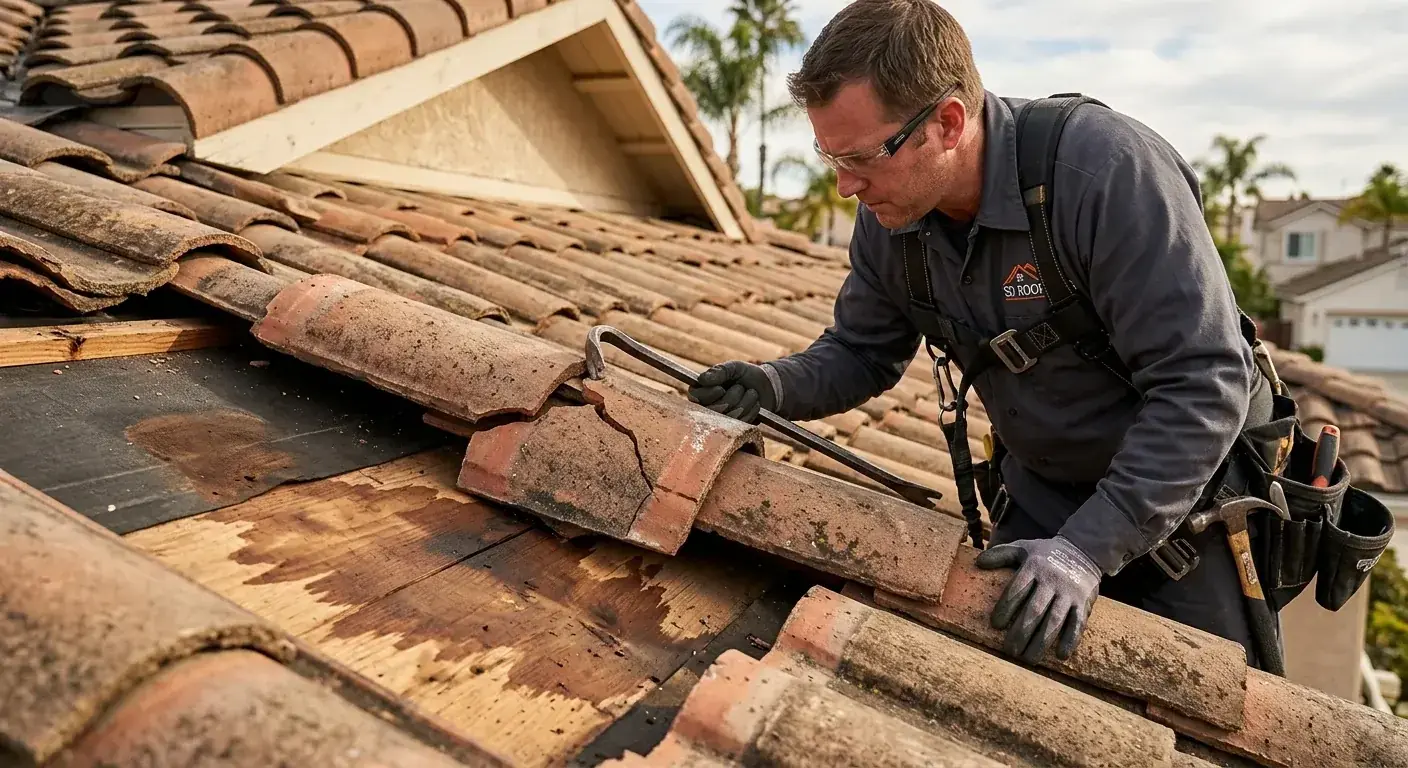
The short answer
- A leak is minor when it comes from one isolated, accessible failure (a pipe boot, a cracked tile, a single flashing joint) on a roof with years of life left, the wet area is small and contained, and no decking or framing is involved.
- A leak is major when water reaches multiple spots, the deck or rafters are soft, the underlayment has failed across a slope, or the roof is past its expected age. That can mean a section repair, a lift-and-relay, or a replacement conversation.
- The stain on your ceiling does not tell you which one you have. Water travels along framing before it drips, so a quarter-sized spot can sit under a wide area of soaked decking.
- The fastest honest test: how many separate spots, how old is the roof, and is the wood firm or spongy. Two of those three pointing the wrong way means treat it as major until a C-39 says otherwise.
Top Pro Roofing SD is a referral service. We connect San Diego County homeowners with CSLB-licensed independent roofers. We do not climb the roof, we do not diagnose from this page, and we do not publish leak-repair prices. Call (760) 750-5557. You contract with the matched contractor.
A small brown ring can be a single failed boot or the first visible sign of a system that is done. Both look the same from the living room. Use the table below, then get eyes on the wood.
What separates a minor leak from a major one
Severity is not the size of the patch. It is how many failure points there are, whether water has reached the structure, and how much roof life is left. The visible wet spot is the least reliable signal.
| Factor | Minor leak | Major leak |
|---|---|---|
| Failure points | One isolated spot (boot, tile, single flashing joint) | Multiple spots, or one large failed area |
| Decking / framing | Dry, firm wood | Soft, spongy, sagging, or visible rot |
| Roof age | Well within expected life | Past or near end of expected life |
| Underlayment | Intact, localized issue | Failed across a slope (common on old tile) |
| Water spread | Small, contained, stops when rain stops | Spreads, returns, or shows in several rooms |
| Usual fix | Targeted repair | Section repair, partial reroof, or full replacement |
If everything in your situation lands in the left column, you likely have a minor leak. If two or more land in the right column, treat it as major and get it inspected before the next rain. Repair-versus-replace once severity is known: roof repair vs replacement. This page will not invent a dollar column for either side.
The four signs that quietly turn a minor leak major
A leak rarely starts major. It starts small and gets ignored, usually because San Diego goes months without rain and the stain dries between storms.
Soft or spongy decking. Press the ceiling near the stain, or have a roofer press the deck from the attic. Firm wood means the water is recent and still near the surface. Spongy wood means it has been wet through more than one season, and the decking may need replacement before new covering goes down. That is the biggest cost multiplier, even when this page names no dollars.
More than one wet spot. One drip is a failure point. Two or three drips in different parts of the house often means the underlayment is at end of life, not three separate punctures. On San Diego concrete and clay tile, the tile can still look sound after the felt underneath has failed. That pattern points to a lift-and-relay or replacement, not a patch. We will not invent a tile-year or felt-year guarantee. Ask the C-39 to date the underlayment on this roof.
A leak that keeps coming back. If the same spot reappears after a previous repair, the real entry was never found. Water can enter near a chimney and surface ten feet away down a rafter. A returning leak is a diagnostic failure, not a minor one.
Roof age past the threshold. A leak on a young shingle roof is often an event (a boot, a flashing joint, a missed nail). The same leak on a late-life roof is a symptom. If you are not sure where the covering stands, the roof-age guide walks through the call without treating warranty years as a lifespan.
San Diego specifics that change the picture
National cost guides miss the local weather and the tile stock.
Rain comes in bursts, so leaks hide. Rain here is seasonal. Confirm current climate normals on NOAA’s published tables if you need a number. A minor leak can sit dry for months, then soak the deck across back-to-back atmospheric rivers. By the time you see the stain, a leak that was small in November can be structural by February. The dry season is not a free pass. A stain you noticed last winter and forgot about still deserves a look.
Coastal salt air degrades flashing faster. From the coast through Encinitas, Carlsbad, and Point Loma, salt air corrodes metal flashing and fasteners faster than inland. A flashing leak that would be a clean joint repair in El Cajon can arrive with rusted metal near the water.
Tile lies about its condition. Spanish-style and tract tile dominate Carmel Valley, Rancho Bernardo, and Scripps Ranch. Intact-looking tile over failed underlayment is the common “looks minor, is major” pattern. Do not judge a tile roof by the tile.
Permits and HOAs. A true minor repair (one boot, a few tiles) is often treated as maintenance, but that is not a county-wide free pass. For City of San Diego jobs, start with Information Bulletin 123. Read the current bulletin. Ask Development Services whether this scope needs a permit. We will not paraphrase its exemption classes. Other cities write their own rules. Many master-planned communities add HOA material and color rules. Factor that in the moment a leak reads as major. Walkthrough: San Diego roof permit process.
What actually sets the bill (no invented ranges)
Cause and access set the price, not the word “minor.” A pipe boot, a few slipped tiles, or a single flashing joint is a different job from a valley rebuild, soft deck, or a slope of failed felt. We will not publish a 2026 San Diego leak menu. Ask the matched C-39 for a written scope that names the entry, the cover type, and whether decking or underlayment is in the work.
Fee factors without treating this page as a rate card: roof leak repair cost. If water is dripping now: active roof leak first 60 minutes.
How to check it yourself before calling
You can sort minor from major in about fifteen minutes without getting on the roof.
From inside, count the wet spots and note whether they are in one room or several. Press the ceiling edge of the stain. Firm is good, soft is not. In the attic with a flashlight on a dry day, look for water tracks, dark streaks down the rafters, and damp or crumbling decking. Daylight through the deck is an automatic major. From the ground with binoculars, look for missing or slipped tiles, lifted shingles, or rust around flashing. If you see one clear cause, one wet spot, firm wood, and a roof that is not old, you very likely have a minor leak. Anything else, get a C-39 on it before the next storm. Step-by-step: how to find a roof leak. Service path: roof leak repair.
Frequently asked questions
Can a minor roof leak become major on its own? Yes, and in San Diego it is common. A small leak that dries between winter storms keeps soaking the same wood each rain. Over a season or two that rots the decking. The leak does not grow. The damage behind it does.
Does the size of the ceiling stain tell me how bad the leak is? No. Water tracks along rafters and decking before it drips. A small stain can sit under a wide area of wet wood. A large stain can come from one slow drip that spread sideways. Judge severity by the number of spots, the firmness of the wood, and the roof’s age, not by stain size.
Is a leak around one flashing point minor or major? Usually minor if the metal is sound and it is one joint. It moves toward major when coastal salt has corroded the flashing and fasteners, or when water has been entering for several seasons and reached the deck. A roofer can tell in one visit by checking the metal and the wood behind it.
Why does my tile roof leak in several places when the tiles look fine? Because tile often outlives its underlayment. Once felt or an old membrane fails, water gets past intact tile in multiple spots. That is a major leak pattern that usually calls for a lift-and-relay, not a patch. Confirm on this roof, not from a year chart on a blog.
Should I wait until the rainy season to fix a minor leak? No. San Diego’s dry months are the better window: the roof is dry, and you fix it before storms that turn minor into major. Waiting only gives the next atmospheric river a head start.
When is a leak an emergency versus something that can wait a few days? Active dripping during a storm, water near electrical, a sagging ceiling, or daylight through the deck are emergencies. A dried, single, old stain on a newer roof can wait for a scheduled inspection. When in doubt, treat structure or electrical involvement as urgent.
The bottom line
Do not let the calm look of a small stain decide this. Count the spots, press the wood, check the roof’s age. If it is one isolated, accessible failure on a roof with life left, you have a minor leak and a targeted repair. If water has reached the structure, shows in more than one place, or the roof is old, it is major. Confirm it before the next storm rather than after.
Call Top Pro Roofing SD at (760) 750-5557. We match you with a licensed independent roofer who can tell you which column you are in and show you what they found. We do not quote the job from this website.