TL;DR
Partial roof replacement is real, and it works in the right situation. The classic case in San Diego: a south or west-facing slope that’s burned out from UV while the north-facing side still looks fine. You replace just the bad slope, save 40 to 60 percent against a full tear-off, and buy yourself meaningful time before the rest of the roof needs to come off.
The trade-offs are honest ones. New shingles won’t match the old ones until they weather, which takes 2 to 5 years depending on the manufacturer and the exposure. Manufacturer warranties get shorter or limited because the system isn’t installed in one shot. And the other slopes are still on the clock, so you’re paying twice over the life of the roof instead of once.
If a single slope is clearly the worst and the rest of the roof has 7 plus years of usable life, partial replacement wins on math. If the whole roof is within 3 to 5 years of needing replacement anyway, full replacement wins on math and on warranty. Most of the time, the right answer becomes obvious once a roofer walks all four slopes instead of just the one you can see from the driveway. The full breakdown on the 25 percent rule for California roofing goes deeper.
When partial replacement makes sense
Five scenarios where partial replacement is the right call.
One slope has burned out from UV exposure while the others haven’t. This is the most common reason. On a typical hip or gable roof in San Diego, the south-facing and west-facing slopes take 60 to 80 percent more UV over a roof’s lifetime than the north-facing slope. By year 15 to 20 on an architectural asphalt shingle, the south side can show heavy granule loss, brittleness, and bald spots while the north side still looks close to new. Replacing just the bad slope gets you another 15 to 20 years on that exposure while the other slopes finish their natural life.
Localized storm damage on one elevation. Wind damage from a Santa Ana event sometimes hits one face of the roof hard and leaves the rest alone. If the insurance scope covers a full slope and the rest of the roof is in good shape, partial replacement is the clean fix. The insurance company won’t pay for slopes that aren’t damaged.
Coastal salt corrosion on one elevation. Homes in Encinitas, Cardiff, Solana Beach, and Del Mar that face the ocean often see accelerated wear on the west or southwest slope from salt spray. The protected sides can outlast the exposed side by 5 to 8 years. If you’re 12 years into a 25-year shingle and only the ocean-facing slope is failing, partial works.
Budget reality with a roof that still has life in it. If three of four slopes have 10 plus years left and one slope is leaking now, full replacement is hard to justify. Partial replacement on the failing slope gives you years to plan and save for the rest.
A clear waterline between old and new. If the slopes don’t visually share a sightline from the street or the yard, color mismatch matters less. Steep hip roofs and complex rooflines often have slopes that aren’t visible from the same angle, which makes a partial replacement look intentional instead of patchy.
If the situation matches one of these, partial is a real option worth pricing. The next step is usually an inspection that walks every slope, not a guess from the ground.
When partial replacement doesn’t make sense
Six scenarios where full replacement is the better call even though partial sounds cheaper.
The whole roof is within 3 to 5 years of needing replacement anyway. If every slope is showing similar wear and you’re going to pay for a full tear-off soon, doing a partial now is paying twice. The mobilization cost, the permit, the dump fees, the crew day rate, all of that gets paid again when the rest of the roof comes off.
The roof has multiple leak sources across different slopes. Partial replacement only solves one slope. If you’ve had leaks on the north slope, the south slope, and around the chimney, the system is failing, not one part of it. Full replacement is the right move.
The deck is compromised under multiple slopes. Once the plywood or OSB sheathing is rotted or delaminated in more than one area, the labor to peel back, repair, and re-roof multiple slopes separately costs nearly as much as a full tear-off without giving you the benefit of a unified warranty.
You’re replacing a tile roof. Concrete or clay tile partial replacement is rare and usually a bad idea. Tile fields rely on a continuous underlayment system. Cutting it and tying in a new section creates leak risk at the seam. Tile roofs in San Diego usually get repaired in place or fully redone, not partially replaced. For more on tile specifically, see our clay tile roof repair guide.
The visible-from-street slopes are the bad ones. If the failing slope is the front of the house and the back is fine, you’re going to live with the color mismatch on the most visible elevation for years. Most homeowners regret this within the first 12 months.
Resale is in the next 24 to 36 months. Buyers and inspectors notice mismatched roofs. A clean full replacement adds more to resale value than a partial that needs explaining. If you’re planning to sell, do the math on what a buyer’s inspector is going to say.
When the situation lands in this group, the partial-replacement savings disappear once you account for the second job that’s still coming, the warranty gaps, and the resale conversation.
The color matching problem
This is the part most homeowners underestimate. New asphalt shingles arrive saturated and rich. Old shingles have weathered for years. They’ve lost granules, oxidized, and faded. Even when you order the exact same product code from the exact same manufacturer, the new slope looks brighter and more uniform than the old slope. For more on this, see what deteriorates asphalt shingles fastest in San Diego.
The new shingles do weather toward the old ones, but it takes time. The exact timeline depends on the manufacturer, the color, and the exposure.
| Manufacturer & line | Typical color match timeline | Notes |
|---|---|---|
| GAF Timberline HDZ | 2 to 4 years | Darker colors blend faster. Weathered Wood and Charcoal close the gap quickest. |
| CertainTeed Landmark | 3 to 5 years | High-contrast colors like Moire Black take longer. Earth tones blend sooner. |
| Owens Corning Duration | 2 to 4 years | SureNail technology shingles match well within 3 years on west and south exposures. |
| Malarkey Vista | 3 to 5 years | Granule oxidation rate varies more by color. Confirm dye lot before installing. |
| Atlas Pinnacle Pristine | 3 to 4 years | Scotchgard coating affects how granules weather. New side stays cleaner longer. |
Two practical tactics help. First, order shingles from the same color family but consider going one shade darker on the replacement slope so the brighter new color reads closer to the weathered old one. A good roofer will pull samples and stage them against the existing roof before ordering. Second, time the partial for late summer or early fall so the new slope has a full UV season to start weathering before anyone really studies the difference.
If the slopes aren’t visible at the same time from any common vantage point, the timeline matters less. If they are, plan to look at a two-tone roof for a few years.
Warranty implications
This is where partial replacement gets nuanced.
Manufacturer warranties. Most asphalt shingle manufacturers offer a limited lifetime warranty on the shingle product itself. That warranty stays in force on the new slope based on its install date. The old slopes are still on their original warranty clock, which means they expire earlier than the new section.
The bigger issue is the system warranty, sometimes called the enhanced or platinum warranty, which covers labor, materials, and tear-off for a defined period when the entire roof system from the same manufacturer is installed by a certified contractor. Partial installations almost never qualify for system warranties. You get the basic product warranty on the new shingles, not the enhanced labor coverage.
Workmanship warranties. Contractor workmanship warranties on partial replacement usually cover only the new slope and the tie-in point where new meets old. Most reputable roofers offer 5 to 10 years on the workmanship of the new section, but they won’t warranty the old slopes they didn’t install.
Tie-in leak risk. The transition between new and old materials is the highest-risk point on a partial replacement. A good crew uses a step-flashing or weave detail to integrate the new field with the old field, and the workmanship warranty should explicitly cover that seam. Ask for that in writing.
Insurance implications. California homeowners insurance generally doesn’t penalize partial replacement, but a full roof tear-off can sometimes lower premiums by resetting the actuarial age of the roof. If your insurer offers a discount for new-roof condition, partial replacement may not qualify.
If long-term coverage matters more than short-term savings, full replacement wins on warranty math.
Cost comparison: full vs partial on a 2,000 sq ft home
Numbers below assume a typical San Diego single-story or simple two-story home with a 2,000 square foot footprint and about 25 squares of roof area on architectural asphalt shingles, mid-range product. Actual pricing varies by access, pitch, and tear-off conditions.
| Scope | Typical 2026 SD cost range | What’s included |
|---|---|---|
| Repair only (one slope, no replacement) | $800 to $2,500 | Patch, flashing, localized shingle replacement. Doesn’t extend roof life. |
| Partial replacement (one slope, ~6 squares) | $4,500 to $8,000 | Tear-off of one slope, new underlayment, new shingles, ridge tie-in, dump fees. |
| Partial replacement (two slopes, ~12 squares) | $8,000 to $14,000 | Same as above, doubled. At this scope, full replacement starts to make sense. |
| Full replacement (entire roof, ~25 squares) | $15,000 to $24,000 | Full tear-off, new underlayment, new shingles, new flashings, system warranty eligible. |
The math gets honest fast. Partial on one slope at $6,500 versus full at $19,000 saves about $12,500 today. But if the other slopes need to come off in 8 years and that job costs $22,000 by then with inflation, the total spend is $28,500 versus $19,000 today. Partial wins only when the other slopes really do have 12 plus years of life and the immediate budget pressure is real.
We break the cost math down further in our 2026 new roof cost guide for San Diego, and the larger decision framework lives in roof repair vs replace.
How partial replacement differs from a repair
These two get confused often, so it’s worth being precise.
A roof repair addresses a specific problem. A leak, a damaged area, a few missing shingles. The roofer fixes the failure point and leaves the rest of the roof alone. Repairs use existing materials where possible and don’t reset the slope’s lifespan. Typical scope is hours to a day. Cost is usually under $2,500.
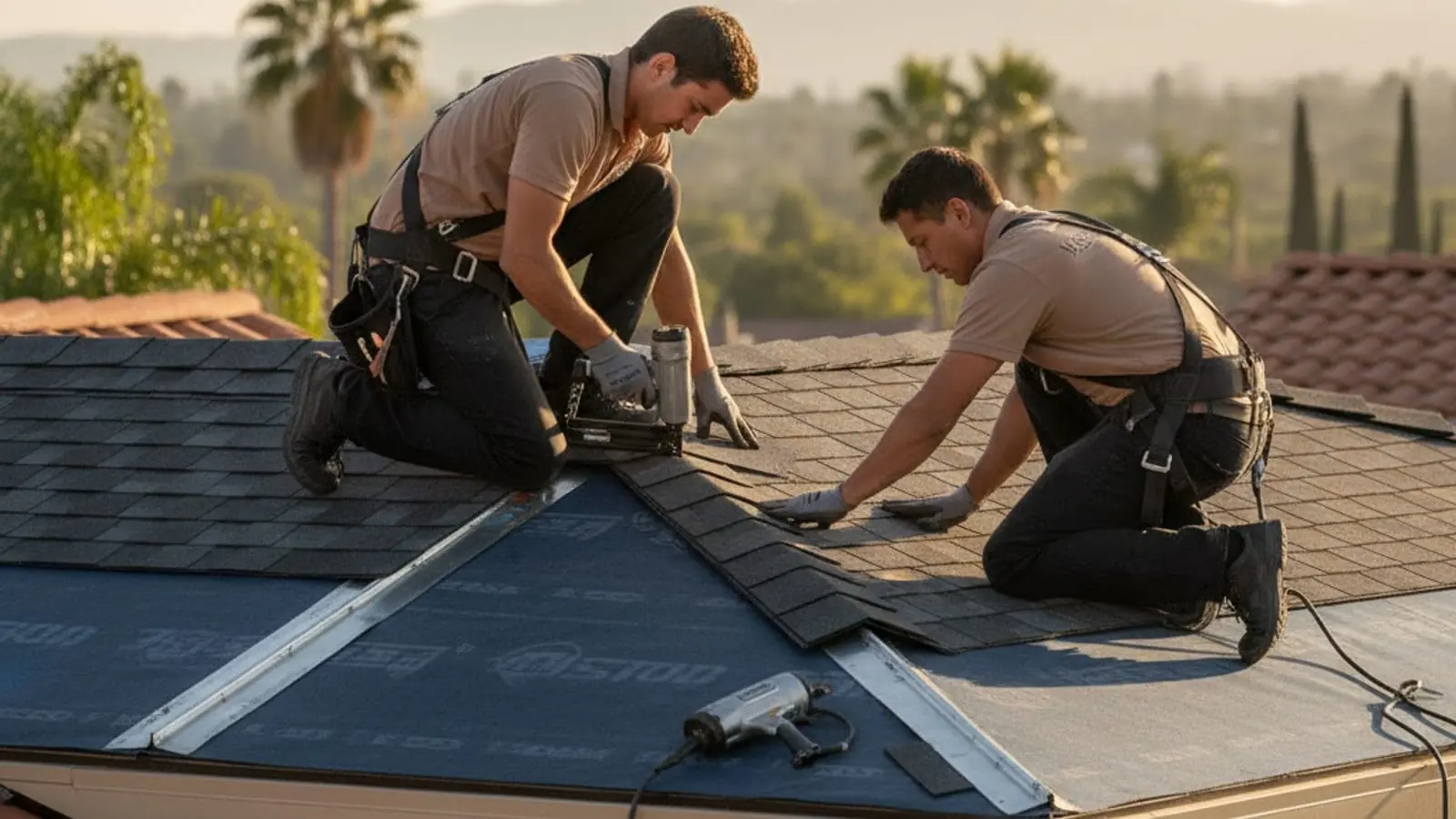
A partial replacement removes and replaces an entire slope or defined section down to the deck. New underlayment, new shingles, new flashings on that section, full tear-off of the old material. The new section gets its own lifespan reset. Typical scope is 1 to 3 days. Cost is usually $4,500 to $14,000.
The difference matters because they solve different problems. Repair is for localized failure. Partial replacement is for an exhausted slope that’s beyond patching. If the same area on a slope keeps needing repairs every winter, that’s the slope telling you it’s done. For more on the patch decision, see can I patch a roof myself and our broader signs you need a new roof guide.
San Diego microclimate cases
The county isn’t one climate. The right partial replacement decision depends on where the house sits.
Inland valleys (Poway, Escondido, Ramona, Valley Center, Alpine). South and west-facing UV burnout is the dominant failure mode. Summer roof surface temperatures hit 150 to 170 degrees Fahrenheit on dark shingles. The sun side ages 1.5 to 2 times faster than the shade side. By year 15 to 18 on a 25-year shingle, you can have a south slope that’s failing and a north slope that has 8 to 10 years left. Partial replacement on the south slope is a textbook case here.
Coastal corridor (Encinitas, Cardiff, Solana Beach, Del Mar, La Jolla). Salt corrosion drives wear on the ocean-facing elevation. West and southwest slopes take the brunt. Metal flashings, vents, and exposed nails corrode faster on these exposures. Asphalt granules lose their bond. Partial replacement on the ocean-facing slope is common in coastal neighborhoods. We covered the coastal pattern in detail in coastal roof salt damage in San Diego.
South Bay and inland border (Chula Vista, Otay Mesa, San Ysidro). A blend of UV and modest salt exposure. Failures usually show up first on the south-facing slope but at a slower rate than further inland.
Urban core (Mission Hills, Hillcrest, North Park, Mid-City). Tree shade and shorter sightlines make slope-by-slope variation less predictable. Partial replacement works here but requires a careful walk because shade pockets can preserve a slope longer than expected.
For more on how long different roof types last across these microclimates, see how long does a roof last in San Diego.
Permits and code requirements
California requires a permit for roof replacement, and that includes partial replacement when the work involves tear-off and re-roofing to the deck.
Permit threshold. Per the 2022 California Residential Code Section R907 and most San Diego County jurisdictions, any re-roofing that involves more than 25 percent of the roof area within a 12-month period triggers a permit and full code compliance for the replaced area. Partial replacement of one slope on most homes exceeds 25 percent, so a permit is required.
Cool roof and Title 24. California’s Title 24 energy code requires cool roof products on new roof installations in most San Diego climate zones. For partial replacement that exceeds the 25 percent threshold, the new section generally has to meet cool roof requirements even if the rest of the roof doesn’t. This affects shingle selection and can constrain color matching. We covered the Title 24 detail in cool roof Title 24 San Diego.
Sheathing inspection. A permitted partial replacement requires the roofer to call for a sheathing inspection once the old material is off and before new underlayment goes down. Skipping this step is one of the most common shortcuts unlicensed roofers take, and it’s how problems get covered up.
Disclosure on resale. Permitted partial replacements show up in city records and on real estate disclosures. Unpermitted work creates resale problems. Always pull the permit.
A licensed roofer should handle the permit. If a contractor offers to skip the permit to save money, that’s a signal to call someone else.
How a good roofer decides slope-by-slope on inspections
The honest answer to “should I do a partial or a full” comes from walking the roof, not from a phone call. Here’s the framework roofers use during inspections.
Step 1: Walk every slope. Granule loss, brittleness, lifted shingles, exposed mat, nail backout, flashing condition. Each slope gets assessed separately and scored on remaining useful life.
Step 2: Check the deck. A moisture meter and a careful visual on the underside in the attic. If the deck is compromised under more than one slope, partial gets harder to justify.
Step 3: Inspect penetrations and tie-ins. Vents, chimneys, skylights, valleys. If the failure points cluster on one slope, that’s a partial candidate. If they’re spread out, that’s not.
Step 4: Look at history. How old is the roof, what’s the manufacturer’s published lifespan, has there been previous work, were any previous repairs done well or done cheap.
Step 5: Run the cost math. Partial cost today plus the projected full cost in years X, versus full cost today. If the partial plus future full is meaningfully more than a single full now, we say so.
Step 6: Match-test the shingle. Pull samples, hold them against the existing roof in direct sun, talk through what it’ll look like for the next 3 to 5 years.
Most inspections take 45 to 75 minutes. A real recommendation comes out of that, not out of a sales script. If a contractor recommends partial or full without walking the whole roof and checking the deck, get a second opinion. For a deeper dive on tear-off vs overlay, which is a related decision, see roof overlay vs tear-off in California.
FAQ
Can I really replace just one slope of my roof?
Yes, in the right situation. Partial replacement is a legitimate option when one slope is meaningfully worse than the others, the deck under it is sound, and the rest of the roof has 7 plus years of usable life. It’s not the right call when the whole roof is aging at the same rate.
How much can I save with partial replacement?
On a typical SD single-family home, partial replacement of one slope usually runs 40 to 60 percent less than a full tear-off. The exact savings depend on how much of the roof is being replaced, access, and pitch.
Will the new slope match the old ones?
Not immediately. New shingles weather toward the old ones over 2 to 5 years depending on the manufacturer and the color. If both slopes are visible from the same vantage point, expect a visible color difference during that window. Pick a color slightly darker than the existing if you want the gap to close faster.
Does partial replacement void my manufacturer warranty?
It doesn’t void the warranty on the existing shingles, which stays on its original clock. The new slope gets its own product warranty. What partial replacement usually does void is eligibility for an enhanced system warranty that requires the entire roof to be installed at once by a certified contractor.
Do I need a permit for partial replacement?
Yes. If the partial scope exceeds 25 percent of the total roof area, California code requires a permit and code compliance for the replaced area. Most one-slope partial replacements trigger this threshold.
How long does partial replacement take?
For a single slope on a typical home, 1 to 3 days from tear-off to cleanup. Weather and access can extend that. A full replacement on the same home usually runs 3 to 5 days.
Will partial replacement hurt my resale value?
It depends on how it looks and what’s been done. A partial replacement on a visible front slope that doesn’t match the rest of the roof can give buyers pause. A partial on a back slope that matches well can be a non-issue. Document the permit, keep the warranty paperwork, and be ready to explain the work to a buyer’s inspector.
When to call us
If you’re trying to decide between partial and full replacement, the answer comes from a real inspection, not from a quote over the phone. The vetted roofer in our network walks every slope, checks the deck, assesses the tie-ins, and runs the cost math both ways so you can make the call with real numbers in front of you.
We do partial replacements when they’re the right answer. We say so when they’re not. Either way, you’ll know which slope has how many years left and what the second job is going to cost when it comes.
If you want a slope-by-slope assessment on your roof, get in touch and we’ll set up a walk-through. The inspection is free, the recommendation is straight, and the bid will lay out partial and full side by side so you can see the trade-off in writing. For a full breakdown of San Diego roof replacement pricing by material type, see the San Diego roof replacement cost guide.