TL;DR

Clay tile itself rarely fails. A fired-clay tile from 1925 will outlive every roofer who’s ever set foot on it. What fails is the underlayment beneath, which gives out around the 25 to 30 year mark. So when a Mission Hills owner calls about a “clay tile repair,” nine times out of ten the tile is fine. The felt under it isn’t. For more on this, see 2026 tile roof replacement cost in San Diego.

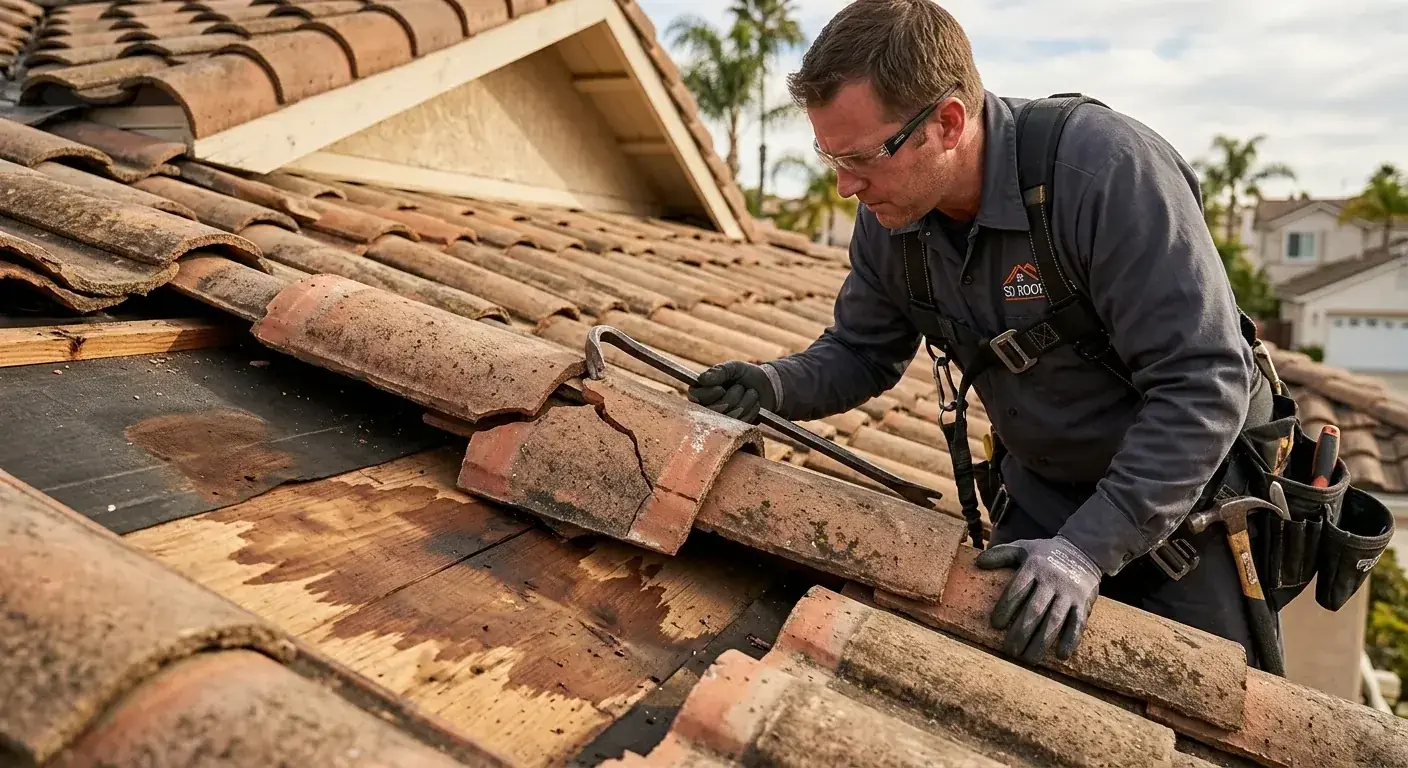
That’s the single most important thing to understand before you spend money. A real clay tile repair is almost never a tile job. It’s an underlayment job done carefully through the tile, with each piece lifted, set aside, and reseated without cracking.

The other piece that trips people up is matching. Vintage clay tile from a 1920s Spanish Revival in Kensington or Old Town isn’t sitting on a pallet at the supply house. You source it from boneyards, salvage yards, or a custom kiln run that takes weeks. A roofer who shows up with a stack of new red tile from Home Depot and calls it a match has just devalued the house.

If you’ve got broken tiles, a leak, or a roofer telling you the whole roof needs to come off, read this before you sign anything.

What Actually Goes Wrong With Clay Tile Roofs

Clay tile is one of the most durable roofing materials on the planet. Fired clay is essentially ceramic, and ceramic doesn’t rot, doesn’t burn, and doesn’t decay in UV. The Class A fire rating it carries is the highest assigned by the International Code Council, and that rating doesn’t drop with age the way it can on some asphalt products.

What clay tile does do is break, slip, and outlive the things underneath it.

Here’s the honest list of what goes wrong:

Underlayment failure under the tile. This is the big one. The asphalt-saturated felt or synthetic underlayment beneath the tile is what actually keeps water out of your house. Tile sheds the bulk of the water, but anything that gets past the tile, which is plenty in a wind-driven storm, hits the underlayment. Once that fails, you get leaks. Felt has a 25 to 30 year service life in San Diego’s climate. Most clay tile roofs in Mission Hills or Coronado built in the 1920s have been relayed two or three times already. The tile gets reused. The underlayment gets replaced.

Cracked or broken tiles. Foot traffic from solar installers, satellite techs, gutter cleaners, and HVAC crews is the number one cause. Clay tile is brittle in cold morning temperatures and snaps under a misplaced boot. Hailstones in San Diego are rare, but they happen. Falling palm fronds and eucalyptus branches do real damage. For a deeper look at what causes the leaks themselves, see common causes of tile roof leaks in San Diego.

Tile slip. Tiles are held in place by gravity, mortar bond, or nails. Mortar dries out and lets go. Nails corrode in coastal air. Battens warp. The tile slides downslope and either falls off the eave or jams against a tile below it, creating a dam that pools water.

Mortar cracks. On ridges, hips, and rake edges, mortar bedding holds the cap tiles down. That mortar cracks over decades from thermal cycling. Once it cracks, the cap tiles loosen, and wind lifts them clean off. This is the most visible failure mode and the one homeowners notice first.

Efflorescence and surface lime bloom. White chalky deposits on the tile surface come from minerals leaching out of the clay or from mortar runoff. It’s cosmetic on real fired clay, and it usually weathers off. On lower-grade tile or concrete tile mixed in as repair work, it can be permanent. This is one reason genuine clay matters.

Birds, rats, and bee colonies. Open tile ends at the eave are an invitation. Once a colony establishes itself, you’ve got organic debris packed against the underlayment, which traps moisture and accelerates the failure of everything beneath.

Types of Clay Tile You’ll See in San Diego

Knowing what type of tile sits on your house determines how it’s repaired, where you source the match from, and what it’ll cost. There are essentially five shapes you’ll see on San Diego homes.

Tile TypeEra / StyleWhere You’ll See ItSource Difficulty
Two-piece mission (barrel + pan)1900s to 1940s, Spanish Revival, MediterraneanMission Hills, Coronado, Old Town, La Jolla, KensingtonHard. Most vintage runs are out of production.
S-tile (single-piece interlocking)1960s to presentScripps Ranch, Carmel Valley, Rancho Bernardo HOAsEasy. Still made by US Tile, MCA, Ludowici.
Flat shingle clay1920s Tudor, English Cottage, some CraftsmanOlder parts of North Park, University Heights, HillcrestMedium. Some sizes still made. Vintage colors hard.
French clay (interlocking flat)1910s to 1930s, French EclecticRare. Scattered in Old Town, CoronadoVery hard. Often custom kiln runs required.
Antique handmade barrelPre-1920, original Spanish ColonialOld Town historic district, a handful of estate homesExtremely hard. Boneyard or salvage only.

Two-piece mission tile is the one most people picture when they think Spanish Revival. It’s a literal pan tile sitting concave-side-up, with a barrel tile sitting convex over the seam. Heavy, beautiful, and a nightmare to walk on. Most Mission Hills and Old Town homes from the 1920s and 1930s use this profile.

S-tile is the modern compromise. One piece that combines the pan and barrel shape into a single S-curve. Lighter, easier to install, and what most HOA-tiled communities in North County use. If your home was built after 1970, this is almost certainly what’s on it.

Flat shingle clay looks more like a slate or a thick shingle. You see it on 1920s Tudor homes and some Craftsman houses where the original spec called for tile instead of wood shake.

If you’re trying to figure out what you actually have versus concrete tile, the concrete versus clay tile breakdown walks through how to tell the difference in five seconds. Knock test, weight test, color depth.

The Repair Scope Ladder

Most homeowners don’t know whether they’re looking at a $200 repair or a $20,000 one. The scope ladder below is what roofers use to estimate after an inspection.

Repair ScopeWhat’s InvolvedTypical Cost (San Diego, 2026)
Single tile replacementOne to three broken tiles, no underlayment work$185 to $450
Multi-tile section10 to 30 tiles, possible mortar work on ridge or hip$650 to $1,800
Targeted leak repairLift and reset a 4x4 to 8x8 section, replace underlayment locally, flash penetrations$1,400 to $3,200
Partial relayLift one slope, replace underlayment, reuse tile, replace any broken pieces$4,500 to $8,500
Full lift-and-relayStrip entire roof, replace all underlayment, reuse 90 percent of original tile, source matched tile for the rest$14,500 to $22,000
Full replacement (new tile)Remove existing tile and dispose, new tile and underlayment$28,000 to $55,000+

A few notes on these numbers.

The single tile and multi-tile numbers assume the roofer can actually access your roof safely without scaffolding. Two-story homes in Mission Hills with steep pitches sometimes need a lift, which adds $400 to $900.

The full lift-and-relay is the sweet spot for most older Spanish Revival homes. The tile is fine. The underlayment is shot. You pull the tile, lay new high-temp synthetic underlayment, and put the original tile back. You’re paying for labor, not material, because the tile is already paid for. It’s been on your roof since Calvin Coolidge was president.

For broader cost context on tile work specifically, see tile roof cost in San Diego. And if you’re weighing tile against a shingle alternative, tile versus shingle covers that decision.

Vintage Tile Matching, And Why It Matters

This is where clay tile repair separates from every other kind of roofing work.

A 1928 Spanish Revival in Mission Hills has tile made in a kiln that closed before World War II. The clay came from a specific pit. The firing temperature was different. The color variation across a single batch was wider than anything you’d get from a modern run. That’s why old clay roofs have that mottled, sun-faded, lived-in look that new tile can’t fake.

When a roofer replaces five broken tiles with bright new red mission tile, the patch screams from the street. The house loses its visual integrity. In a historic district like Old Town or parts of Coronado, it can also trigger a code complaint.

There are essentially three ways to source matched vintage tile:

Boneyards. Established roofing companies that have worked the historic neighborhoods for decades keep stockpiles of salvaged tile. When a Mission Hills owner does a full tear-off, the usable tile goes into the boneyard. Years later, when a Kensington owner needs to match a similar 1930s profile, the tile comes back out. This is the cheapest path and usually the closest match. Not every roofer has a boneyard. Most don’t.

Architectural salvage yards. Places that specialize in salvaged building materials sometimes have palletized vintage tile from demolition projects. Quality varies. Color match is hit or miss. You’re paying salvage rates, which can be reasonable or absurd depending on what’s in stock.

Custom kiln runs. A handful of US tile manufacturers will do a custom color and shape match for a fee, usually with a minimum order in the hundreds of pieces. Lead time runs 8 to 14 weeks. This is what you do when a boneyard search comes up empty and the historic match matters.

A common middle path is to harvest the back of the roof, which faces the alley and nobody sees, and use that tile to repair the visible front. The back gets patched with whatever modern tile is close enough. This sounds like a hack. It’s actually standard practice on historic restoration work, and it preserves the curb-facing integrity at a fraction of the cost of a custom kiln run.

For homes in Rancho Santa Fe, where tile is HOA-mandated and the architectural standards are tighter, the bar is higher and the Rancho Santa Fe tile roof repair playbook walks through the specifics.

Spanish Revival Neighborhoods, And What Tends to Fail

Some neighborhoods have predictable failure patterns based on the era they were built and the conditions they sit in.

NeighborhoodTypical EraCommon Tile TypeMost Common Issue
Mission Hills1920s to 1940sTwo-piece missionUnderlayment failure, mortar cracks at ridges
Kensington1920s to 1950sTwo-piece mission, some flatSlipped tiles, cracked field tiles
Mission Beach1920s to 1930sTwo-piece missionSalt corrosion of fasteners, slipped tiles
Old TownPre-1920 originals, some 1930sAntique barrel, two-piece missionMortar failure, full underlayment expiration
Coronado1900s to 1940sTwo-piece mission, French claySalt damage, mortar cracks, vintage match difficulty
La Jolla1920s to 1940s, plus modern infillTwo-piece mission, S-tile mixMixed-era patching gone wrong, salt damage
North Park1920s to 1930s Craftsman and SpanishFlat clay, some missionPenetration flashing, broken field tiles
University Heights1920s to 1930sFlat clay, missionTree-fall breakage, underlayment age
Hillcrest1920s to 1940sMission, flatPenetration leaks around added HVAC
Scripps Ranch1980s to 2000s HOAS-tileSolar install damage, broken field tiles
Carmel Valley1990s to present HOAS-tileStorm-broken tiles, HOA-mandated match
Rancho Santa FeMixed eras, custom estatesMission, S-tile, customVintage matching, HOA architectural review

A pattern that shows up over and over: salt corrosion on coastal homes eats the nails and the metal flashings long before the tile or even the underlayment gives out. A 40-year-old Coronado roof can have perfect tile, intact underlayment, and completely failed nails. The whole thing is held up by gravity and habit. That’s not a maintenance call. That’s a relay. For more on this, see whether salt will damage a metal roof.

For coastal homes specifically, the coastal roof salt damage data breaks down what actually fails first within a half-mile of the ocean.

Why Most General Roofers Can’t Repair Clay Tile Properly

This is going to sound harsh. It’s also true.

The average roofing crew in San Diego does asphalt shingles. That’s the volume work. Tear-off, dry-in, shingle. A good shingle crew can put a roof on a 2,000 square foot house in two days. Clay tile is a different trade with a different skill set, and the crossover is smaller than you’d think.

Here’s what a tile-specific repair actually requires:

A worker who can walk on tile without breaking it. There’s a footwork pattern. You step on the lower third of the tile, where it’s supported by the tile below. You don’t step on the unsupported nose. Crews that don’t do this regularly leave a trail of cracked tile behind them and then quote the homeowner to fix the damage they just caused.

The ability to selectively lift and reseat tile without breaking the surrounding pieces. This is technique built on hundreds of hours of doing it. There’s no YouTube shortcut.

A relationship with a tile supplier and access to a boneyard. Without these, the matching question can’t be answered.

Knowledge of historic patterns. A 1925 Mission Hills home doesn’t lay out tile the same way a 1995 Carmel Valley S-tile roof does. Course spacing, headlap, and ridge detail all differ.

The signal to look for on a quote: if the roofer can name the manufacturer of your existing tile, or at least the era and likely source, you’re talking to someone who actually does this work. If they keep calling it “the red tile,” walk away.

For general tile roofing service work, our tile roofing service page outlines what’s actually in scope. Anything beyond a one-off broken tile is a proper inspection.

HOA Considerations in Tile-Mandated Communities

Roughly a quarter of San Diego County housing units sit inside an HOA, and a meaningful chunk of those have tile-mandated CC&Rs. Scripps Ranch, Carmel Valley, parts of Rancho Bernardo, most of Rancho Santa Fe, and pockets of 4S Ranch all require tile and often dictate the specific profile and color.

Two things to know:

The HOA architectural committee usually has approval rights on visible repairs. A multi-tile replacement that requires sourcing new tile typically needs an architectural change form, samples, and a sign-off. Skipping this can result in a fine and a forced redo.

The mandated tile may no longer be in production. This is the Rancho Bernardo problem. A development from 1986 specified a tile that the manufacturer discontinued in 1998. The HOA still requires “matching tile.” A good roofer brings the HOA two or three close-match options, gets architectural approval in writing, and proceeds. A bad roofer ignores the HOA and gets the homeowner cited.

Get the architectural form in your hands before the repair starts. Not after.

Class A Fire Rating Preservation

Clay tile carries a Class A fire rating, which is the highest assigned under the ASTM E108 and UL 790 standards adopted by the International Code Council. For homes in San Diego’s wildland-urban interface areas, that rating isn’t optional. It’s required by California Building Code Chapter 7A, which applies to most of the eastern and northern parts of the county.

The rating is an assembly rating, not just a tile rating. That means the underlayment, the ridge venting, and the bird stops at the eaves all have to meet the Class A spec. A repair that uses standard 30-pound felt instead of a fire-rated cap sheet downgrades the assembly. In a fire investigation after a loss, the insurance company will check this. So will the building department.

When you get a repair quote, ask which underlayment product the roofer is using and whether it carries a Class A listing as part of the tile assembly. If they can’t answer, that’s a flag.

Licensing and What to Verify

Any roofer working on your tile roof needs an active C-39 roofing contractor license from the California Contractors State License Board. You can verify any license number for free at the CSLB license check. The board lets you confirm the license is active, the bond is in place, and there are no unresolved complaints.

Pull the license number off the quote. Verify it before you sign. This takes 90 seconds and protects you from the substantial pool of unlicensed operators who run cash-only tile patch work in San Diego, do mediocre repairs, and disappear when leaks return.

FAQ

How long does clay tile actually last?

The tile itself lasts 75 to 100 years and often longer. The underlayment beneath it lasts 25 to 30 years in San Diego’s climate. The nails or fasteners holding the tile down last 20 to 50 years depending on whether they’re galvanized, stainless, or copper, and how close the home is to salt air. Most “tile roofs” in San Diego are on their second or third underlayment by the time they hit a century.

Can I walk on my clay tile roof?

You shouldn’t, and neither should your solar guy. Clay tile cracks under point loads applied to the wrong spot. If you have to access the roof for any reason, a professional with proper footwear and technique should do it. If you’re getting solar installed, ask the installer specifically how they protect tile during the install, and budget for replacement of broken tiles after the install is done.

Why did my roofer say the whole roof needs replacement when it’s just one leak?

Sometimes it’s a sales tactic. Sometimes it’s accurate. If the underlayment is 40 years old, a single leak is the first of many, and a targeted repair is throwing money at a roof that’s about to need a full relay anyway. Ask for the age of the underlayment in the inspection report. If it’s past 25 years, a relay is probably the honest call. If it’s 12 years old, you’ve got a targeted repair situation and a roofer trying to upsell.

Do I need matching tile or can I just use new red tile?

Depends on visibility, HOA rules, and how much you care about the value of the house. On a historic Spanish Revival, a mismatched patch is a visible defect that comes up at resale. On the back slope of a 1990s S-tile roof, a close-color modern match is usually fine. The architectural review for your HOA, if you have one, will tell you exactly what’s required.

Will my homeowner’s insurance cover clay tile repair?

Sometimes. Sudden damage from a windstorm, hailstorm, or fallen tree is usually covered. Slow underlayment failure from age is almost never covered. Document the cause carefully. For more on what insurance does and doesn’t cover, see our breakdown of insurance and roof leaks.

How do I find a tile specialist versus a general roofer?

Ask three questions. Do you have a tile boneyard? Can you name the era and likely manufacturer of my existing tile? Have you done historic Spanish Revival repair work in Mission Hills, Coronado, or Old Town? Honest answers to those three weed out the crews that shouldn’t touch your roof.

What’s the warranty on a clay tile repair?

A workmanship warranty on a targeted repair typically runs 2 to 5 years. A full lift-and-relay should carry a workmanship warranty of 10 years and an underlayment material warranty from the manufacturer of 20 to 30 years. If a roofer offers a “lifetime warranty” on a single tile replacement, read the fine print. It’s almost always meaningless.

When to Call a Clay Tile Specialist

Call right away if you’ve got water staining on an interior ceiling under a tile roof, even a small one. Tile leaks don’t stay small. The underlayment is either failing locally or generally, and the longer it sits, the more decking gets soaked, and decking replacement adds thousands to the eventual repair.

Call within a week or two if you can see broken tiles from the ground, slipped tiles on a slope, or visible mortar damage at ridges and hips. None of these are emergencies, but they all worsen with the next wind or rain event.

Call before any solar install, satellite work, or HVAC change on the roof. Get a tile-specific inspection in writing first, document existing condition, and require the contractor to use a tile specialist for any tile removal and reinstallation. This is the single smartest thing a tile-roof owner can do.

Top Pro Roofing San Diego does tile work across the Mission Hills, Kensington, Coronado, La Jolla, and Old Town corridors, including underlayment relays, vintage tile sourcing, and architectural review coordination with HOAs. For a free roof inspection, give us a call, and we’ll come out and tell you honestly whether you’ve got a $300 tile fix or a $15,000 relay on the horizon. Most of the time it’s neither extreme, but you deserve an answer that’s actually based on what’s on your roof, not what’s easiest to quote.