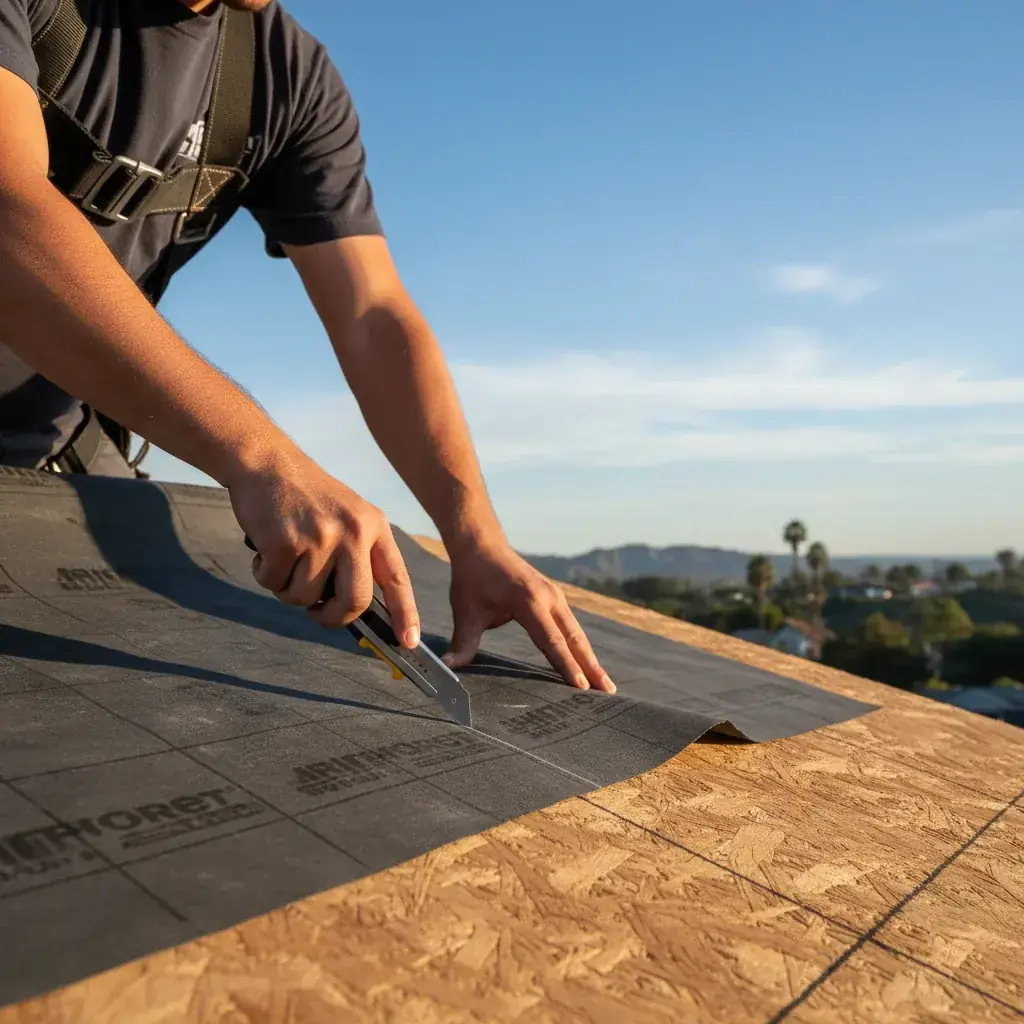
TL;DR
Four products show up on San Diego reroofs: 15-lb felt (legacy), 30-lb felt (still code-legal, shorter life in this heat), synthetic (the usual shingle default), and self-adhering peel-and-stick (tile fields, low slope, and leak-prone details). Ice-and-water shield at valleys, eaves, and penetrations is still the right detail even though we do not get ice dams. If a 2026 bid lists 15-lb felt as the field sheet, get another bid.
Ask the matched roofer to name ASTM type, brand, and where peel-and-stick vs synthetic will sit. We will not invent per-square prices. Top Pro Roofing SD refers. We do not install. Call (760) 750-5557.
Is peel-and-stick underlayment required in California?
No. California does not require self-adhered underlayment on every residential reroof. 30-lb felt that meets ASTM D226 Type II is still a legal floor in many steep-slope assemblies. That is the floor, not a 25-year San Diego spec.
Peel-and-stick shows up here for three reasons that have nothing to do with ice:
- Tile roofs. Tile sheds water. The underlayment is the waterproofing. A self-adhered sheet seals around nails and is meant to live closer to the tile’s life than felt does.
- Low-slope and valley work. Self-adhered membrane is the right product at eaves, valleys, and penetrations even when the field is synthetic.
- Hot inland attics. Felt dries and cracks. High-temp synthetics and self-adhered membranes are built for that heat.
A bid that uses peel-and-stick only at valleys and ice-and-water at eaves can be a sound hybrid. A bid that uses 15-lb felt across the field is not.
What underlayment actually does
It sits between the plywood or OSB deck and the visible covering (shingles, tile, metal, or a low-slope membrane). Three jobs:
- Secondary water barrier when wind-driven rain, capillary water under tile, or a flashing miss gets past the covering.
- Slip sheet so tile edges and fasteners do not chew the deck.
- Temporary weather plane during the install window.
On tile, this matters more. Tile is not a waterproof membrane. When a San Diego tile roof “fails,” the tile is often still fine. The sheet under it is not. That is the whole point of tile roof lift-and-relay.
Type 1: 15-lb asphalt felt (legacy)
Thin organic or fiberglass mat saturated with asphalt. Meets ASTM D226 Type I. Some organic-felt sheets are listed to ASTM D4869 instead of, or in addition to, D226. Ask the matched roofer which ASTM the roll actually meets. Rolls are small, so you get more seams.
Why it is mostly retired:
- Tears in wind during install
- UV cooks it fast if it sits uncovered
- Goes brittle in San Diego sun years sooner than the covering
- Wrinkles telegraph through thin shingles
A 2026 quote that still lists 15-lb felt as the field sheet is racing material cost. Most careful crews in the county will not install it.
Type 2: 30-lb asphalt felt (still common)
Same family, heavier, ASTM D226 Type II. Holds fasteners better. Still cheap and still legal. Still the default on some budget tile jobs.
Where it can make sense: a short hold before sale, or a homeowner who already plans a lift-and-relay in a couple of decades and signs off after hearing the heat and salt trade-off.
Where it does not: you want the sheet to outlast the covering, you are on salt air, or you are in East County attic heat.
Life is shorter inland and on south and west slopes than on a shaded coastal roof. Treat years as a conversation with the inspector on this attic, not a warranty. Coastal covering choice is a separate issue: best roof material for coastal climates.
Type 3: Synthetic underlayment (the usual shingle default)
Woven polypropylene or polyethylene, often with a walkable coating. This is the standard field sheet under asphalt shingles on careful San Diego bids.
Why crews like it:
- Lighter rolls, fewer seams
- Higher tear strength
- Longer UV exposure window than felt (read the wrapper; brands differ)
- Less wrinkle telegraph
- Walkable in dew
- Often part of a manufacturer system warranty when it matches the shingle line
Products you will see named on local quotes (confirm the current spec sheet):
| Brand / product | What to verify on the bid |
|---|---|
| Owens Corning ProArmor | UV days, system pairing with OC shingles |
| GAF Tiger Paw | Slip rating, system vs standalone warranty |
| CertainTeed RoofRunner | Weight, exposure window |
| IKO StormTite | Exposure window (often shorter than the others) |
A matched roofer usually pairs synthetic to the shingle brand so you keep the system paperwork. Ask them to print remaining-life expectations for this ventilation, not a catalog maximum.
Type 4: Ice-and-water shield (peel-and-stick, details)
Rubberized asphalt with a peel-off backer. Bonds to the deck and seals around fasteners. Meets ASTM D1970.
The name is wrong for San Diego. We do not get ice dams. The product still matters because it is waterproof, not merely water-resistant. Use it where water actually concentrates:
| Zone | Why it is here |
|---|---|
| Eaves | Backed-up gutters and wind-driven rain |
| Valleys | Highest water volume on the roof |
| Skylights, chimneys, vents | Most flashing leaks start here |
| Hips and ridges on tile | Mortar joints are leak paths |
| Low-slope sections | Felt or light synthetic is not enough |
| High-wind rakes (Alpine, Jamul, Ramona) | Santa Ana uplift |
If ice-and-water is missing at valleys and eaves, ask why. Price it as a line, not as a blog adder.
Type 5: Full-coverage self-adhering peel-and-stick
Same chemistry as ice-and-water, over the whole deck. Common on:
- Tile jobs where you want the sheet closer to the tile’s life
- Low-slope and flat sections
- Coastal houses with hard wind-driven rain and short eaves
- Restorations where the deck has to stay closed for decades
Names you will see on peel-and-stick bids: Polyglass Polystick, Henry Blueskin, Boral TileSeal. Those are typically SBS- or APP-modified sheets with a polyester or fiberglass scrim. Confirm high-temp rating for inland attics. GAF VersaShield is a different product: mechanically fastened fire-resistant deck protection, not a self-adhering field membrane. Ask which of those is actually on the quote.
This is the expensive field option. Ask for it as its own column next to synthetic. For tile project scope, see tile roof replacement.
How to compare cost without fake per-square numbers
Pricing moves with pitch, tear-off, access, and which sheet is in the field vs the details. Ask for:
| Line | What the bid should name |
|---|---|
| Field underlayment | Brand, ASTM type, square count |
| Detail membrane | Where ice-and-water or peel-and-stick sits, in feet or squares |
| Tile vs shingle assembly | Whether the field is felt, synthetic, or full peel-and-stick |
| High-temp listing | Especially inland and under tile |
| Warranty | Manufacturer PDF plus workmanship, in writing |
A square is 100 square feet of roof area. Ask how they measured yours.
San Diego microclimates
Underlayment ages from heat, UV through tile gaps, and wet-dry cycling.
Coastal (Carlsbad, Encinitas, La Jolla, Pacific Beach, Imperial Beach). Salt ages asphalt felt. Synthetic and peel-and-stick hold up better. On tile, peel-and-stick is the safer field call.
Central inland (Mira Mesa, Tierrasanta, Rancho Bernardo, El Cajon). Moderate attic heat. Synthetic is the usual shingle field. 30-lb felt is already a compromise at two decades.
East County (Alpine, Jamul, Ramona, Julian). Brutal attic heat. Felt that looks fine on a Ramona tear-off at year 15 can crumble in your hands. Spec high-temp synthetic or peel-and-stick. Do not “save” the job on 15-lb felt.
What failure looks like
- A brown ceiling stain under a valley or skylight after a long rain.
- Tile that looks fine from the street but feels soft underfoot (deck rot).
- Stained or sagging plywood in the attic.
- Asphalt grit in gutters that does not match the shingle color.
- An inspection note: deteriorated underlayment, past serviceable life.
Tile hides all of this from the curb. By the time the ceiling stains, you may be buying deck sheets as well as a new sheet.
Why lift-and-relay exists
Clay and concrete tile are often rated for 50 years and beyond. 30-lb felt is not. That gap is tile lift-and-relay.
1970s-1980s San Diego tile jobs almost all sat on felt. When the felt gives up, you either lift the same tile and replace the sheet, or you buy a new tile field. If you are installing new tile now, putting 30-lb felt under it again is planning to do this job twice. Spec peel-and-stick or a tile-rated high-temp synthetic so the layers age together. Climate life: how long a roof lasts in San Diego.
Title 24 vs underlayment
California Title 24 cool-roof rules live on the covering (reflectance and emittance), not on the felt vs synthetic choice. Confirm product IDs with the contractor and the AHJ. Some reflective self-adhered sheets can cut deck heat a little. That is not a substitute for a listed cool roof. Radiant-barrier rules, when they apply, are a separate assembly conversation in Climate Zones 7 and 10. If a salesperson talks about Title 24 only as underlayment, that is a flag. See cool roofs and Title 24.
FAQ
Is felt still allowed in San Diego?
Yes. ASTM D226 Type II felt still meets many code floors. Whether you want it under a roof you will keep for decades is a different question. Confirm the approved assembly with the AHJ.
Can I put synthetic under tile?
Yes, if the product is rated for tile (look for Type II equivalent language and high-temp listing). Peel-and-stick is the longer play because the tile will outlast a mid-grade synthetic.
Does underlayment matter under metal?
Yes. Metal moves every day and abrades the sheet. Synthetic in the field plus peel-and-stick at eaves and valleys is the usual careful spec.
How do I know the current sheet is done?
A roof inspection that includes the attic, not only the curb. If the roof is past about 20 years on felt, plan for it.
Can I add a second layer of underlayment over the old one?
Not as a real reroof. Leaving a failed sheet under new material wastes the job. Tear-off is the honest path. Overlay rules for the covering are a different page: overlay vs tear-off.
What about hot-mop or torch on a flat section?
That is a low-slope membrane system, not steep-slope underlayment. Under about 2:12 you are in TPO, modified bitumen, or built-up territory.
Will insurance care which sheet I use?
Some carriers discount listed impact or wind assemblies, which include a specific underlayment. Ask your agent before materials are ordered.
What a careful bid looks like
Asphalt shingle reroof: named synthetic matched to the shingle line, plus ice-and-water at valleys, eaves, skylights, chimneys, and vents.
Tile reroof or lift-and-relay: full-coverage peel-and-stick, or a tile-rated high-temp synthetic the homeowner accepted in writing, plus detail membrane at waterways.
Metal: synthetic field plus peel-and-stick details.
Low slope (under 4:12): full peel-and-stick or a true low-slope membrane. No felt field.
15-lb felt stays off the job. 30-lb felt only if you asked for it after the heat and salt talk, and you sign that choice.
If two bids disagree on the underlayment line, that is often where a cheap number hides a short roof. Related: roof underlayment guide, tile roofing, roof replacement, best time to replace.
Standards already named on this page: ASTM D226, ASTM D4869, ASTM D1970. Match the quote to the standard for your roof type. Call (760) 750-5557.