TL;DR

A San Diego tile roof needs four things to hit its design lifespan: a visual check from the ground every spring and fall, gutter and valley clearing twice a year, a professional inspection every five years (or after any major storm), and an honest budget for a lift-and-relay around year 20 to 30. The tile itself is nearly indestructible. The underlayment beneath it is the real timer, and it’s the thing most homeowners forget exists until water shows up on a ceiling.

If you only remember one line from this guide, remember this: do not walk on your tile roof, do not pressure wash it, and do not skip the underlayment conversation just because the tile still looks new.

Tile lifespan in San Diego (and the underlayment trap)

Tile roofs are sold on lifespan. Concrete tile lasts 50 years or more, clay tile commonly hits 75 to 100, and you’ll see Spanish-revival clay roofs in Mission Hills and La Jolla that are pushing a century. All of that is true. None of it is what actually fails.

What fails is the underlayment, the asphalt-saturated felt or synthetic membrane laid between the tile and the plywood deck. That layer does the real waterproofing work. The tile sheds bulk water, but wind-driven rain, capillary action, and the occasional cracked tile all push water onto the underlayment. And the underlayment ages on a much shorter clock than the tile sitting on top of it.

Here’s the lifespan picture by tile type, underlayment type, and San Diego microclimate:

Tile + underlaymentCoastal (La Jolla, Encinitas, Carlsbad)Inland valleys (Escondido, Poway, San Marcos)Mountain & east county (Ramona, Alpine, Julian)
Concrete tile, 30-lb felt22-28 years25-32 years18-25 years
Concrete tile, synthetic underlayment32-40 years35-45 years28-38 years
Clay tile, 30-lb felt25-32 years28-35 years20-28 years
Clay tile, synthetic underlayment40-55 years45-60 years35-50 years
Clay tile, peel-and-stick membrane50-75 years55-80 years45-65 years

A few notes on why coastal and mountain ranges shrink:

  • Coastal homes take chronic marine-layer moisture and salt aerosol. Salt corrodes the galvanized nails and fasteners holding the underlayment down, and chronic damp accelerates felt breakdown. Anything west of the 5, especially the Cardiff, Solana Beach, and Bird Rock pockets, runs at the shorter end.
  • Inland valleys have the gentlest climate for underlayment. Dry summers, mild winters, fewer freeze cycles. The longest underlayment lives in the network are in inland tract neighborhoods like 4S Ranch, Rancho Bernardo, and Carmel Valley.
  • Mountain and east county get the most UV at altitude plus actual freeze-thaw cycles in Julian and parts of Alpine. Both punish felt.

For more on this failure pattern, the signs of tile-roof underlayment failure in San Diego post walks through what to look for from the inside of the house, and the lift-and-relay guide explains the mid-life intervention that resets the clock.

The maintenance schedule that actually keeps tile alive

There are three different jobs here, on three different cadences. Most maintenance guides blur them together, which is why most homeowners do none of them.

TaskFrequencyWho does itTimeCost
Ground-level visual checkTwice a year (spring, fall)Homeowner20 minutes$0
Gutter and valley clearingTwice a year (post-fall, pre-rainy season)Homeowner or gutter service1-3 hours$0-$250
Post-storm walkaroundAfter any wind event over 40 mph or rain over 1 inchHomeowner15 minutes$0
Professional roof inspectionEvery 3-5 years (annually after year 15)Licensed roofer1-2 hours$250-$500
Tile-soft wash by professionalEvery 5-10 years if visibly mossy/dirtySpecialty roof cleanerHalf day$600-$1,800
Underlayment lift-and-relayOnce, between year 20 and 35Tile-roof specialist1-2 weeks$18,000-$45,000

Two things worth flagging on this table. First, the gutter clearing is more important than the visual check. Clogged gutters back water up under the bottom course of tile and dump it directly onto the fascia, the rafter tails, and the top of the wall. That’s how tile-roof homes get rot at the eaves while the field of the roof looks perfect.

Second, the cost of a single lift-and-relay is less than the cost of a full tear-off and tile replacement, but it only works if it’s done before the underlayment failure has rotted the deck. Wait too long and the math flips. Maintenance is what keeps that intervention on the cheaper side.

The annual ground-level check (what a homeowner can actually do)

Two times a year, walk the perimeter of the house with a phone camera and a pair of binoculars. You’re looking for five things, all visible from the ground:

  1. Slipped or missing tiles. A tile that has slid an inch or two down the slope, or a visible dark gap where a tile is missing. Almost always caused by a broken or corroded fastener. The course around it is now compromised in wind.
  2. Cracked or chipped tiles. Hairline cracks are easy to miss from the ground; that’s what the binoculars are for. Look especially at hip and ridge tiles, which take the worst sun and the heaviest wind, and at any tile that sits over a valley.
  3. Sagging or wavy ridge line. A ridge that’s no longer straight usually means the mortar bedding has failed or the ridge board has rotted underneath. Common on roofs over 25 years old that never had a midlife inspection.
  4. Moss, lichen, or vegetation in valleys. Anything organic growing on the roof is holding moisture against the tile and the underlayment beneath. Coastal homes in Encinitas, Leucadia, and Cardiff are the worst for this because of the marine layer.
  5. Daylight at the eaves or in the attic. Stand under the overhang and look up at the underside of the roof deck. Any sunlight visible through the deck or any water staining on the rafters is a sign of an active leak you haven’t found yet. Same check in the attic with a flashlight.

Photograph everything from the same angle each time so you can compare year over year. The biggest tells on a tile roof are slow changes nobody noticed.

What a homeowner should not do: get on the roof. Not even to look. Walking on tile, especially clay, cracks tile silently under your weight. Each cracked tile is now a future leak. The Tile Roofing Industry Alliance is clear on this, and every tile manufacturer’s warranty echoes it. If something needs a closer look, that’s what the professional inspection is for.

Semi-annual and post-storm tasks

Once before the rainy season (late October in San Diego) and once after (early April), do the following:

  • Clear every gutter and downspout. Leaf debris, palm fronds, jacaranda blossoms, and pine needles all collect in valleys and gutters. Use a gutter scoop, not a pressure washer. Flush with a garden hose at low pressure to confirm flow.
  • Clear the valleys. Tile roof valleys collect debris from the slopes on either side, and a debris dam in a valley sends water sideways under the tile. From a ladder at the eave, use a soft-bristle brush on a pole or an extension blower to clear them. Stay off the roof.
  • Check the attic. Look at the underside of the deck for daylight, staining, or fresh moisture after the first rain of the season. The attic is where you’ll see underlayment failure six to twelve months before it shows up on a ceiling.
  • Walk the perimeter after any storm. Any storm over 40 mph or with measurable rain. You’re looking for tiles in the yard, fresh debris piles, or new water marks on the soffit.

Coastal homes should add a third gutter cleaning in late February. The combination of January-February rain plus year-round marine moisture loads gutters faster than the standard twice-a-year cadence handles.

The five-year professional inspection

A real tile-roof inspection is not a five-minute walkaround. A specialist should spend an hour to two hours on the roof and in the attic, and should produce photo documentation of what they find. Here’s what should be on their checklist:

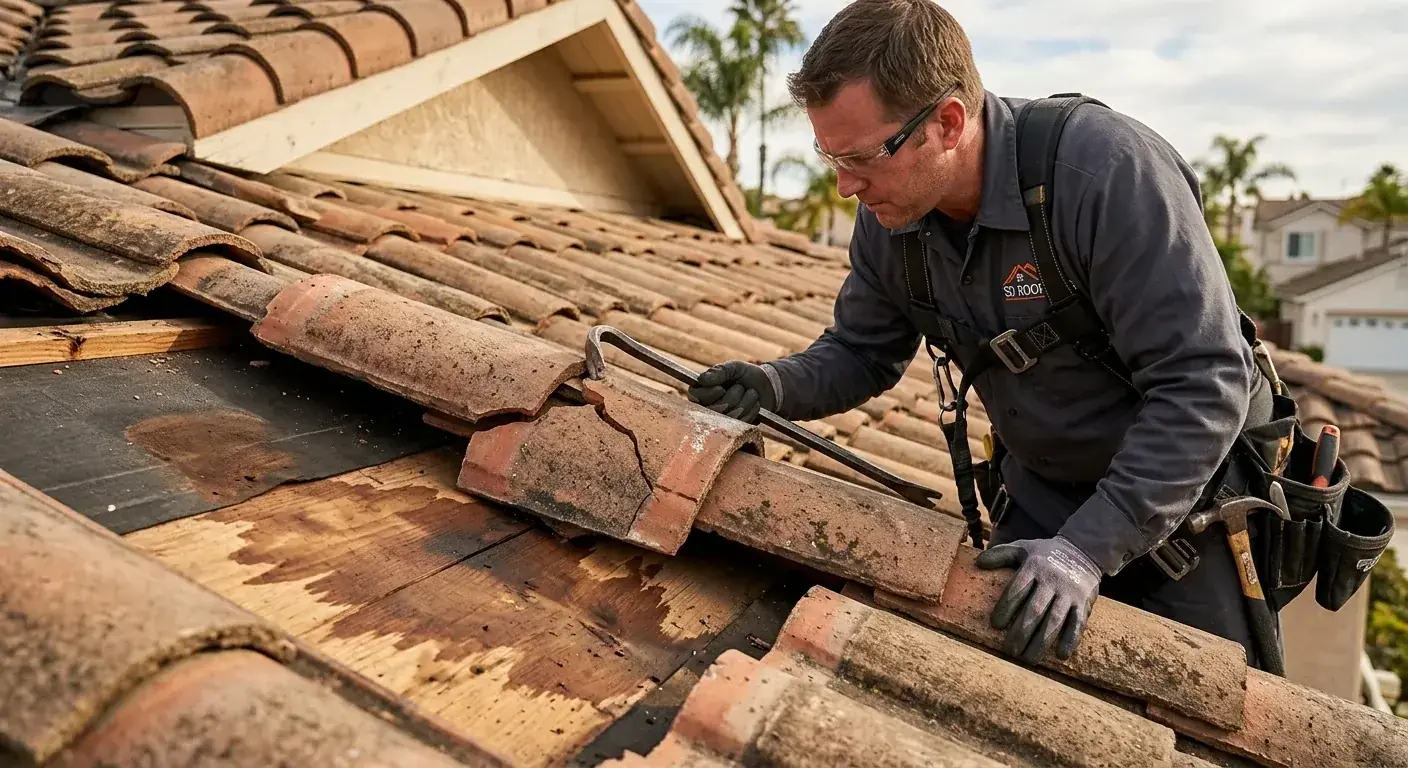
  • Underlayment age and condition. They’ll lift several tiles in different parts of the roof, especially on south and west exposures, to look at the underlayment directly. They’re checking for brittleness, granule loss, tears at fastener heads, and exposed asphalt.
  • Fastener condition. Galvanized nails corrode in coastal air. Stainless or copper fasteners last longer. They should report what fasteners they find and whether any are pulling loose.
  • Flashing at penetrations. Vent pipes, chimneys, skylights, and the wall step-flashing where a roof meets a vertical wall. These are the single most common leak sources on any tile roof.
  • Ridge and hip mortar. Older San Diego tile roofs were ridge-set in mortar, and the mortar cracks and falls out over time. Newer installations use a foam-and-mechanical-fastener system that holds up much longer.
  • Valley metal condition. Galvanized valley pans corrode through, especially in coastal homes. Once a valley pan rusts, the underlayment beneath becomes the only thing waterproofing that section.
  • Broken or cracked tile count. Five to ten broken tiles on a typical tract roof is normal. Thirty or more usually means foot traffic damage from a previous solar installer, satellite-dish installer, or HVAC technician who walked on the tile.
  • Deck condition. While tiles are lifted, the inspector should sound the deck with a hammer to find soft spots. Soft deck means the underlayment has been leaking long enough to rot the plywood beneath.

Until the roof hits year 15, every three to five years is plenty. After year 15, every other year. After year 20, annually. The inspection report is what tells you whether you’re on the maintenance track or the lift-and-relay track.

When a homeowner is choosing an inspector, the right questions are: how many tile roofs do you inspect a year, do you carry replacement tile in your truck, and will you give me a written report with photos. We vet every tile-roof specialist in our San Diego network for exactly this, and you can verify any contractor’s CSLB C-39 license at the CSLB license check before hiring.

Walking on tile (the rule, the exceptions, and the technique)

The rule is do not walk on your tile roof. The exceptions are narrow, and they all apply to trained professionals, not homeowners.

Concrete tile can be walked on if the technician knows how, and even then it gets cracked. Clay tile, especially older Spanish two-piece barrel tile, cracks under almost any foot traffic. The damage is often invisible the day it happens. The hairline crack only opens up later under thermal cycling, and the leak shows up two winters later, far away from where the technician actually stepped.

When a technician must be on the roof, the technique matters:

  • Step on the lower third of each tile, never the middle and never the head (top edge). The lower third is supported by the tile below it.
  • Walk perpendicular to the courses, not along them, and put weight on the balls of the feet to distribute load.
  • Use a roof ladder or foam pads on steep sections to spread weight across multiple tiles.
  • Inspect every tile walked on afterward and replace any cracked tile before leaving the job.

If a contractor proposes to walk your tile roof without any of this discipline, that’s a flag. If a solar installer, satellite installer, or HVAC technician needs roof access, ask in writing how they will protect the tile and who pays for cracked-tile replacement. The number of tile roofs compromised by solar-panel installations on otherwise healthy roofs is significant.

Common San Diego tile problems by region

RegionMost common problemWhy it happens here
La Jolla, Bird Rock, Pacific BeachSalt-corroded fasteners, fastener pull-throughSalt aerosol within 1-2 miles of the coast
Encinitas, Leucadia, Cardiff, Solana BeachMoss and lichen in valleys, accelerated underlayment ageChronic marine layer, weak summer sun-bake
Carlsbad, Oceanside coastalSlipped tiles from prevailing west windSteady onshore winds load the same tile faces
Carmel Valley, Scripps Ranch, 4S RanchMass underlayment failure around year 25-30Tract-built late ‘90s-early 2000s, all on 30-lb felt
Rancho Santa Fe, Fairbanks RanchCracked clay tile from landscaper foot trafficEstate-scale roofs, frequent tree work over the roof
Mission Hills, Kensington, North ParkFailed mortar at hips and ridges1920s-1940s clay tile, original mortar bedding
Escondido, Poway, San MarcosWind-driven dust accumulation in valleysInland wind patterns, Santa Ana events
Ramona, Alpine, JulianUV-baked underlayment, occasional freeze damageHigher elevation, real winter temperature swings

The point of the table isn’t that any of these are catastrophic by themselves. The point is that the right inspection for a coastal home looks different from the right inspection for an inland one. A general roofer who treats every tile roof identically is missing the local pattern.

The common causes of tile roof leaks in San Diego post walks through each leak source in more detail, and the clay tile repair guide covers the repair side specifically for older Spanish-tile homes.

Cost of maintenance vs. cost of neglect

Maintenance on a typical 2,400-square-foot San Diego tile roof runs $400 to $900 a year, all in. Here’s the comparison most homeowners don’t see until it’s too late:

ApproachYear 1-15 annual costYear 16-25 typical eventsYear 25 total spentYear 25 roof condition
Full maintenance schedule$400-$900/yrOne lift-and-relay around year 22-28$30,000-$60,000Tile in original condition, new underlayment, 25+ more years of life
Skipped maintenance$0/yrMultiple leak repairs, interior repairs, eventual emergency reroof$35,000-$70,000+Rotted deck in places, broken tile inventory exhausted, full tear-off required

The math is closer than it looks because the maintenance path ends with a 25-plus-year extension. The neglect path ends with a tear-off. Skipping maintenance doesn’t save money. It just defers the spending until the cheaper interventions are no longer available.

For full San Diego tile-roof cost ranges by job type, see the tile roof cost guide for San Diego.

When to do a lift-and-relay (the mid-life intervention)

A lift-and-relay is the single most important maintenance event in a tile roof’s life. The tile gets carefully removed and stacked on the deck, the old underlayment is stripped, the deck is repaired where needed, new underlayment goes down (modern synthetic or peel-and-stick), and the original tile is reset.

The right window is usually:

  • Year 20-25 for concrete tile on 30-lb felt in coastal zones
  • Year 25-32 for concrete tile on 30-lb felt in inland zones
  • Year 30-40 for clay tile on synthetic underlayment
  • Sooner if there’s evidence of failure in the attic or at ceiling level, regardless of age

The lift-and-relay budget on a typical 2,400-square-foot San Diego tile roof runs $18,000 to $35,000. A full tear-off and tile replacement on the same roof, after the original tile has been damaged or color-matched batches are no longer available, runs $40,000 to $80,000. The difference is the entire reason to maintain on schedule.

Full detail on this process: tile roof lift-and-relay in San Diego. For the related decision of whether to even keep tile, the tile vs metal roof comparison and concrete vs clay tile breakdown cover the alternatives.

FAQ

Can I pressure wash a tile roof? No. High-pressure water lifts mortar at hips and ridges, drives water under the tile laps onto the underlayment, and erodes the surface of older clay tile. Soft-wash by a roof-cleaning specialist (low-pressure, biodegradable solution, soft brush) every 5 to 10 years if the roof is visibly mossy. Most San Diego tile roofs go a decade or longer between soft washes.

How often should a professional inspect my tile roof? Every 3 to 5 years until year 15. Every other year from year 15 to 20. Annually after year 20. Add an inspection after any wind event over 50 mph or rain event over 2 inches. A typical inspection runs $250 to $500 with a written report and photos.

Can I replace a broken tile myself? Technically yes, practically no. Replacing a tile correctly requires walking on the roof without cracking more tiles, lifting the courses above without breaking them, sliding the new tile up under the existing nail or clip, and matching the existing tile’s color and profile from the same batch or a salvaged match. One missed step and the patch becomes a leak source. The cost of a single tile replacement by a specialist is usually $150 to $400. The cost of a botched DIY plus the resulting leak repair is much higher.

Should I walk on my tile roof to clean the gutters? No. Use a gutter scoop and a hose from a ladder, or hire a gutter service that brings their own ladder and works from the perimeter. If gutters require roof access, hire a tile-roof specialist who knows the walking technique, not a general handyman.

What does annual maintenance actually cost for a typical San Diego tile roof? $400 to $900 a year. That covers two gutter cleanings ($200-$500 total if hired out, $0 DIY), a professional inspection averaged across a 3-to-5-year cycle ($75-$165/yr equivalent), and the occasional repair of one or two broken tiles ($150-$400 every few years). The number goes up after year 15 as inspections move to every other year and then annual.

What’s the first sign my underlayment is failing? Staining on the underside of the roof deck, visible from inside the attic, almost always shows up first. Daylight through the deck at penetrations is the next stage. Water on a ceiling is the late stage, by which point the underlayment has been compromised for one to three years. A flashlight in the attic twice a year is the cheapest diagnostic tool in roofing.

Get connected with a tile-roof specialist in San Diego

Tile roof maintenance is one of those jobs that’s simple in concept and easy to get wrong in execution. The wrong contractor walks the roof carelessly, the wrong pressure washes it, the wrong inspection misses the underlayment entirely.

We connect San Diego homeowners with vetted local tile-roof specialists for free estimates on inspections, cleaning, broken-tile repairs, and lift-and-relay work. Every contractor in our network is checked for current CSLB C-39 licensing, active insurance, and recent verified reviews. Call (858) 925-5546 or request a free estimate and we’ll match you with the right specialist for your roof, your neighborhood, and your roof’s age.

Related services: tile roofing, roof inspection, roof repair.

External references: Tile Roofing Industry Alliance maintenance and installation standards, National Roofing Contractors Association steep-slope roofing guidelines, and the California CSLB license check for verifying your contractor’s C-39 license.