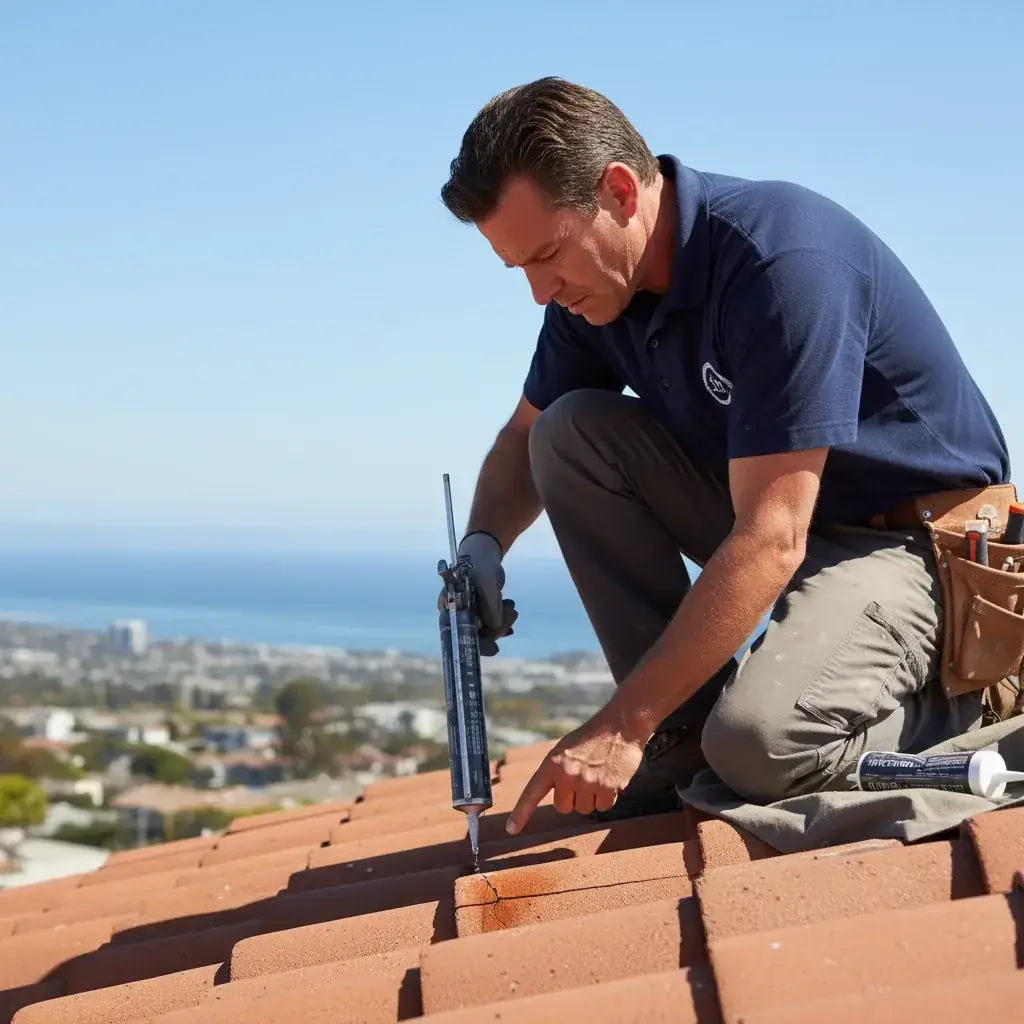
TL;DR: what a roof repair costs in San Diego
Most San Diego County repairs are a named part, not a whole roof. A pipe boot is not a valley. A valley is not a chimney rebuild. The repair type, access, tile vs shingle, and coastal metal grade drive the bid more than the ZIP code.
We do not publish invented repair prices. A driveway guess is not a quote. Ask the matched independent roofer to walk the roof, name the failed component, and write what will be removed and replaced. Call (760) 750-5557. Top Pro Roofing SD matches homeowners with C-39 roofers. We do not do the work.
If you are weighing repair against a reroof, read roof repair vs replace and the 25 percent rule in California roofing.
Repair types: compare these, not a blended average
These ten scopes cover most residential calls in the county. Use the table to make three bids describe the same job.
| Repair type | What a complete scope usually includes | Ask the matched roofer |
|---|---|---|
| Pipe boot or vent collar | New boot, seal, surrounding shingles or tiles reset | Rubber vs lead or silicone, and how many vents they will check |
| Step flashing | New L-pieces through the courses, wall intersection | Linear footage, reuse vs new field units |
| Chimney flashing rebuild | Step and counter flashing, new reglet, mortar or sealant bed | Stainless or copper on the coast vs galvanized inland |
| Valley metal | Courses stripped, new underlayment, new valley metal, weave-back | Ice-and-water at the valley, metal type, both sides opened |
| Skylight reflash | Head, side, and sill kit or saddle, courses reset | Glass vs flashing: which actually failed |
| Broken tile section | Matched tiles, underlayment patch under the area | Matching source, and whether felt under the field is also done |
| Shingle patch | New shingles, starters, sealant tabs | Blend vs a larger rectangle so the patch does not read as a stamp |
| Solar mount reseal | Panel lift, reflash, remount | How many feet, whose solar crew, leak test after |
| Gutter section | Reseat, hangers, end caps | Repair vs full replacement: gutter installation |
| Emergency tarp | Battens into deck, edges sealed, shed direction | How many days of weather it is meant to buy |
If a leak traveled, the total is not always the sum of every line. A crew already in an open section can often correct a neighbor detail without a second trip. Ask them to look while they are open.
Quotes well under a careful neighbor’s bid often skip underlayment or flashing replacement. Quotes well over may include hidden deck rot, after-hours response, or a different product. Ask, do not assume.
Cost per area vs cost per part
When the work is a field patch, roofers talk in square feet or squares (100 square feet). When the work is a boot or a chimney, they talk in parts and linear feet. Do not compare a per-foot tile valley to a per-foot shingle valley without naming the field material.
Small jobs carry a trip minimum. That is why a tiny patch can look expensive per foot. Tile walks slower and surrounding tiles break if someone rushes. Coastal linear work often needs a metal upgrade. Ask every bid whether the unit is a component, a linear foot, or a square.
The ten repairs you will actually see
1. Pipe boot or vent collar
The common one. Rubber collars around plumbing vents crack in San Diego sun. The fix is a new boot and a reset of the surrounding course. Pitch, two-story access, and tile vs shingle change labor. Symptoms: pipe boot leaks.
2. Chimney flashing rebuild
Often under-specified. A real rebuild cuts a reglet, installs new step flashing course by course, and beds new counter flashing. Caulk over failed metal is a short delay, not a rebuild. Coastal jobs should name stainless or copper. Detail: roof flashing repair cost.
3. Step flashing
L-shaped pieces at roof-to-wall. Failure shows as a stain well inboard of the wall. Repair means lifting courses, replacing steps, and often replacing damaged field units.
4. Valley metal
Valleys carry more water than the field. Proper work opens both sides, replaces underlayment, and sets new metal. Cut-up roofs in Poway and La Jolla take longer than a simple gable. Ask them not to “seal the valley” as a substitute for metal.
5. Skylight reflash
Glass is rarely the leak. The curb flashing is. Ask for a named kit or a rebuilt saddle on the uphill side for wide units.
6. Broken tile section
Field tile can outlast the felt under it. A small tile swap with intact underlayment is one job. The same patch plus a slip-sheet of new membrane is another. Matching discontinued profiles can add lead time. See tile roof repair in Carlsbad and tile leak causes. Coastal context: best roof material for coastal climates.
7. Shingle section patch
From one missing tab to a couple of squares. Wind-lifted tabs in Ramona and El Cajon are common. Old color blends never match perfectly. Full shingle repair guide: shingle roof repair cost.
8. Solar mount foot reseal
Arrays add many penetrations. Solar crews are not always roofers. Reseal means lift, reflash, remount. Ask how many feet they opened and who warrants the roof vs the array.
9. Gutter section
Sag, pulled hangers, end caps. Full replacement is a different page.
10. Emergency tarp
Battens into the deck, edges sealed, oriented to shed. A tarp with a few weights is one storm, not a repair. Emergency roof repair is the service path for tarping.
What drives a repair bid up
Access. A single-story bungalow with a garage to stage from is not a three-story Craftsman with no drop zone.
Height and pitch. Steeper work is slower and needs harnesses. Ask if a pitch premium is in the labor line.
Tile vs shingle. Tile is heavier and slower. A tile valley is not a shingle valley.
Age of the field. Weathered units crack when you fold them back. The repair either grows or you accept a callback risk. Ask reuse vs replace.
Coastal metals. Stainless or copper flashings and fasteners belong on the marine strip. Galvanized that “looks the same” is a different product.
| Scope driver | What to ask |
|---|---|
| Two-story vs one-story | Staging, haul path, extra labor |
| Steep pitch | Fall protection, production rate |
| Tile field | Breakage plan, matching |
| Discontinued material | Salvage vs blend |
| Hidden deck rot | Per-sheet rate, how they document it |
| Coastal metal upgrade | Named alloy, not “metal flashing” |
| Same-day or after hours | Whether emergency labor is a separate line |
Why coastal repairs cost more
From Imperial Beach through Coronado, La Jolla, Del Mar, Encinitas, Carlsbad, and Oceanside, salt eats galvanized flashings and nail heads. Inland metal that looks fine can fail early on the coast.
Ask that coastal repairs specify:
- Stainless or copper flashings, not unnamed galvanized
- Matching fasteners
- Drip edge that belongs in salt air
- Underlayment rated for that exposure
A cheaper galvanized chimney job that fails early is not a savings. Patterns: coastal roof salt damage.
How to read a repair quote
Scope. “Repair flashing” is not a scope. “Remove step and counter flashing, install new 26-gauge stainless step (state the feet) and counter flashing, cut new reglet” is a scope.
Material spec. Gauge, underlayment product, fastener type. On the coast this matters more than the hour count.
Reuse vs replace. Reused shingles that are already brittle crack. Ask which units are new.
Warranty. Repair warranties should name the repair area, not the whole roof. Ask years and what is excluded.
License. C-39 at the CSLB license check. No number on the quote is a stop. IBHS publishes damage guidance worth reading on older roofs.
When repair stops making sense
Stacking repairs on a field that is already at the end of its cycle can cost more than a planned reroof. Ask the matched roofer for repair cost next to a replacement option on the same visit when the roof is old and several details are failing.
Tile is a different conversation. Field tile can still be good while felt is not. An underlayment refresh can beat a full new-tile roof. Math: roof repair vs replace.
| Roof situation | Lean |
|---|---|
| Young roof, one failed part | Repair |
| Mid-age, one system, rest sound | Repair, and ask what else they saw |
| Shingle field with several aging valleys | Ask for a replacement option beside the patch |
| Tile with tired felt, sound tile | Repair / lift-and-relay conversation, not automatic new tile |
Maintenance vs waiting for a leak
Boots, sealants, and flashings fail on a schedule you can see from the roof. Catching a split boot early is a smaller job than a stained ceiling and wet deck. Ask the matched roofer for a simple inspection cadence for your material and exposure. Background: what causes roof leaks and roof leak repair cost.
How to get a quote that means something
- Someone gets on the roof. Driveway numbers are guesses.
- Show interior stains. The stain location is a map.
- Give the roof’s age and any solar, skylight, or prior patch history.
A ten-minute number is a placeholder. A real repair quote takes a walk and a written scope.
Request path: roof repair, flashing and vent repair, tile-specific tile roofing.
FAQ
How much does the average roof repair cost in San Diego? There is no useful county average. A boot and a valley are different jobs. Compare like scopes.
How much does roof repair cost per square foot? Only when the work is an area patch. Component repairs are not per-foot jobs. Ask which unit the bid uses.
Why are coastal repairs more expensive? Named corrosion-resistant metals and fasteners. Ask every inland-priced bid whether that spec is actually in it.
Is it cheaper to fix several issues at once? Often. Staging is the fixed cost. Ask them to price adjacent details while they are set up.
Will insurance cover it? Sudden events sometimes. Wear usually does not. Photograph before you file.
Can I patch it myself? An accessible boot or a couple of shingles, maybe. Flashings, valleys, tile, and underlayment: usually no. Can I patch a roof myself.
How long should a repair last? As long as the surrounding system has left, if the repair used new flashing and membrane as needed. Early failure usually means thin scope.
Do I need a permit? Small work often does not. Sheathing, structure, or a large area often does. The roofer should handle the counter, not hand you a form and walk away. Ask the city if the bid is silent.
If you have a specific leak or missing tile, call (760) 750-5557. We will connect you with an independent roofer for a walked, line-item quote across San Diego County. Verify their license. Replacement overview: San Diego roof replacement cost guide.