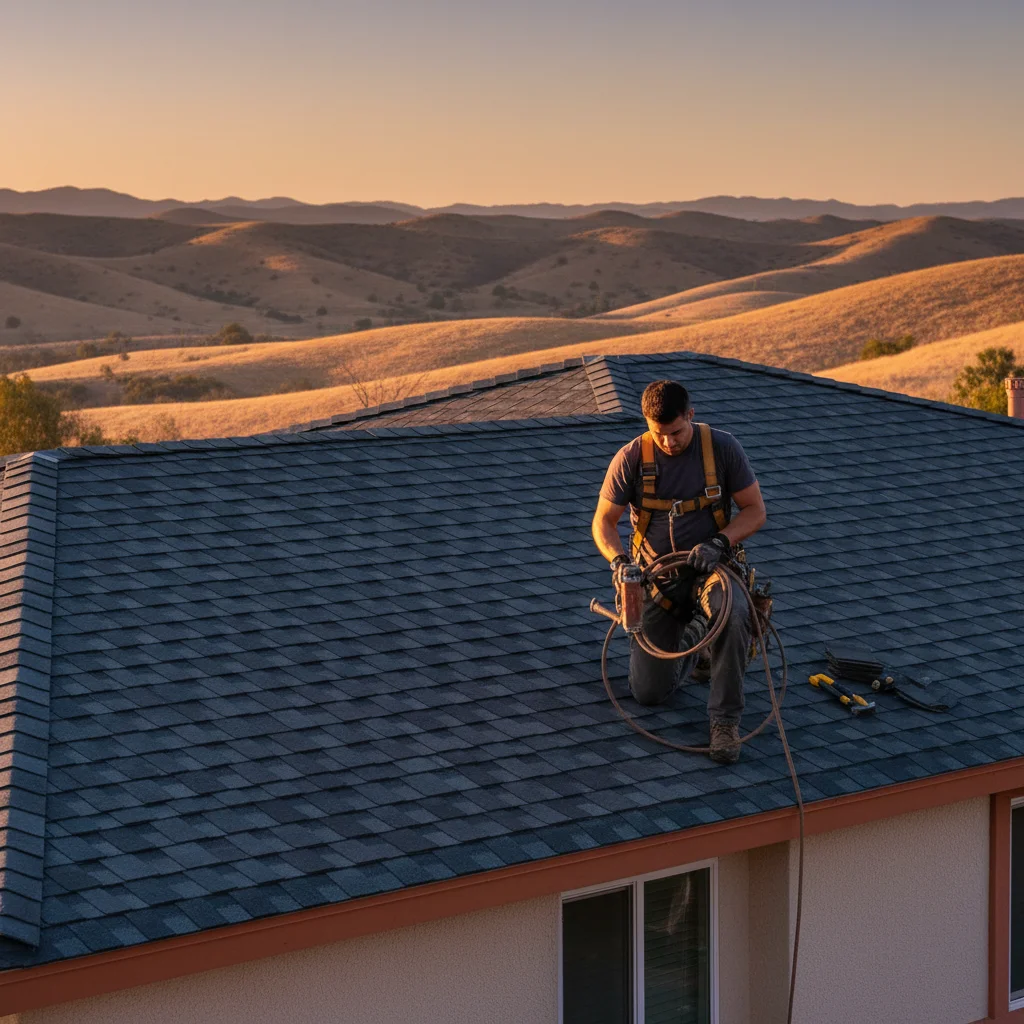
El Cajon roofs work in East County heat, not a coastal marine layer. Summer peaks run among the hottest in the county. Dark attics run much hotter than the street. Santa Ana winds funnel through East County canyons and across the valley floor. A lot of the housing is mid-century tract on a second or third covering. That is a different job than La Jolla or Point Loma.
Top Pro Roofing SD is a referral service. We connect El Cajon homeowners with independent C-39 roofers. We do not install, set prices, or promise a 2026 rate card. Call (760) 750-5557.
This guide is for 92019, 92020, and 92021: what the streets actually look like, how to read a bid, and how to vet a contractor after a wind event. We will not invent repair, replacement, conversion, or claim totals.
What El Cajon roofs look like
The working neighborhoods are Fletcher Hills (later tract, some tile), downtown and the central residential blocks (older mixed shingle and tile), Bostonia (1950s-60s tract), the Mt. Helix-adjacent corridor (mixed custom and tract), Broadway Heights, and the Crest-adjacent edge (newer tract plus fire-zone questions).
Composition shingle is common on El Cajon single-family. Concrete tile is the other large share. We will not invent a 60/40 split. Walk the block. Some households choose longer-life coverings (tile conversion, metal) when they plan to stay. That is a household decision, not a demographic rule we will print as a statistic.
The useful El Cajon fact: asphalt often wears faster here than the year count printed on the wrapper. UV and thermal cycling chew binder. If the roof is approaching the age where granules are heavy and the field is shiny, plan an inspection. Do not wait for a national 25-year mark as if this were a milder climate. Replacement path: roof replacement in El Cajon. Remaining life is an inspection call.
The Santa Ana wind factor
El Cajon sits in the path of many Santa Ana events that hit the county. Hot, dry, downslope winds from the desert accelerate across the valley. We will not invent sustained-mph or gust figures for your street. After an event, the damage categories are familiar:
- Lifted or blown-off shingles. Three-tab fails earlier than architectural. Lifted tabs expose underlayment.
- Detached ridge caps. Often first to go. Reset quickly so the ridge does not become a leak.
- Slipped or cracked tiles. Less common than shingle lift, still real on older barrel with short fastener schedules.
- Edge metal and gutter. Wind catches loose drip edge and pulls it off the fascia.
Ask bidders whether they are specifying a wind-rated architectural product and high-temp underlayment for this heat, not a coastal leftover. Class 4 impact ratings and any insurance credit are carrier and product questions. Do not assume a discount. See 150-mph wind-rated shingles and Santa Ana wind roof damage.
Tile conversion is a different job: longer covering life, more weight, structural check, different look. We will not invent a percent more than shingle or a 10-year stay-or-go rule. Get the structural letter and the bid in writing.
The fire-zone edge
Most of El Cajon proper is not the same conversation as Crest, Wildcat Canyon, or the El Capitan corridor. Those edges sit closer to wildland. The California Building Standards Commission publishes California Building Code Chapter 7A for wildland-urban interface construction. Read the current live text. Confirm with the matched licensed roofer, the City of El Cajon or County AHJ (whichever governs the parcel), OSFM, and the insurer whether this parcel is in a designated area and what covering that path requires. Do not treat Class A as a countywide fact or Chapter 7A as automatic. Ember-resistant vents and eave detailing are parcel calls, not a blog spec.
Carriers have tightened roof-age and assembly questions statewide. Assembly documentation on replacement is common even off a mapped high-risk polygon. Confirm with your insurer. Context: insurance non-renewal and roof age.
How to read 2026 El Cajon roofing bids
Your number depends on squares, layers, deck repair after tear-off, valleys, and access. We will not print flashing, boot, shingle, tile, WUI-upgrade, or claim ranges.
Ask every bidder to separate:
- Roof repair in El Cajon of a discrete leak versus a field that is done
- Pipe boots as their own line
- Premium architectural shingle versus a tile conversion with a structural check
- Tile lift-and-relay versus new tile
- Assembly paperwork the carrier actually asked for
Deeper cost variables (still no invented El Cajon totals on this page): 2026 El Cajon roof replacement cost and new roof cost 2026.
El Cajon is its own city. Do not apply City of San Diego Information Bulletin 123 to a Fletcher Hills permit. Ask Development Services in El Cajon (or the County if the parcel is unincorporated) what this scope needs.
Common El Cajon repair calls
Lifted shingles after Santa Ana events. Replace the lifted section, check neighbors on the same slope, document for the carrier if it may be a covered peril.
Pipe boot UV failure. Rubber boots cook in this sun. Lead or other long-life boots are a common upgrade during replacement. We will not invent a year count. Look at the boot.
Granule loss on aging shingles. Loose mineral in gutters and at downspouts is binder talking. If it is heavy and the roof is clearly late, replacement is the conversation, not a handful of shingles. Shingle granule loss.
Fascia rot and gutter pull. Undersized drip edge lets water curl back. Wind finishes the gutter. Scope is fascia, proper drip edge, rehang. Not a tube of caulk.
Repair versus replace: roof repair vs replace.
Insurance claims in El Cajon
Wind work is regular here. It is still the carrier’s file, not ours. California Department of Insurance guidance: report promptly, make temporary repairs to limit further damage, photograph before and after, keep a call log (residential claims guide). Consumer line: 1-800-927-4357.
A practical order:
- Document from the ground. Roof photos only if it is safe.
- Get a C-39 damage assessment with photos and a written scope.
- File with the carrier.
- Quote the approved scope. Hidden deck damage found in tear-off is a supplemental conversation, not a surprise upcharge without paper.
- Schedule after you know what is covered.
We will not invent adjuster arrival windows or “two to three weeks to start.” Broader reading: California roof insurance claim guide and public adjuster guide.
How to vet an El Cajon roofer
Verify the C-39. Active license, name matching the contract, no surprise discipline: CSLB.
Ask about East County heat and Santa Ana work. A coastal-only book will underspec underlayment and wind fastening. Ask for recent El Cajon addresses.
Get the assembly in writing. Product line, underlayment type, flashing metal, fastener, warranty the roofer and manufacturer actually offer. Top Pro Roofing SD offers none.
Watch storm-chasers after Santa Ana events. East County sees door-knockers. Out-of-state crews, expired licenses, high-pressure “sign today.” Verify the C-39. Get a second bid. Red flags: roofing contractor red flags in San Diego.
Frequently asked questions
How much does a roof cost in El Cajon?
It depends on size, layers, deck, and material. We will not invent a typical-home total. Get a diagnostic inspection and a line-item bid.
Do I need HOA approval in El Cajon?
Some tracts and attached housing do. Most older single-family streets do not. Read the CC&Rs for your address before a visible color or material change. If there is no association, the City (or County) permit path is still separate.
Is Class 4 shingle required?
Not as a citywide slogan. It is a product and insurance conversation. Ask the carrier what documentation they want on this policy.
How do I get an estimate in El Cajon?
Call (760) 750-5557 or request a quote. We match you with a licensed independent roofer who inspects and writes the number. Top Pro Roofing SD does not perform the work.
Get connected
We match El Cajon homeowners with licensed independent roofers who know Fletcher Hills, Bostonia, central blocks, and the Crest-adjacent edge: heat-rated underlayment, wind fastening, and claim photos. No obligation on the call. No published price list.
Call (760) 750-5557 or request a quote.
Nearby: El Cajon roofing service hub.