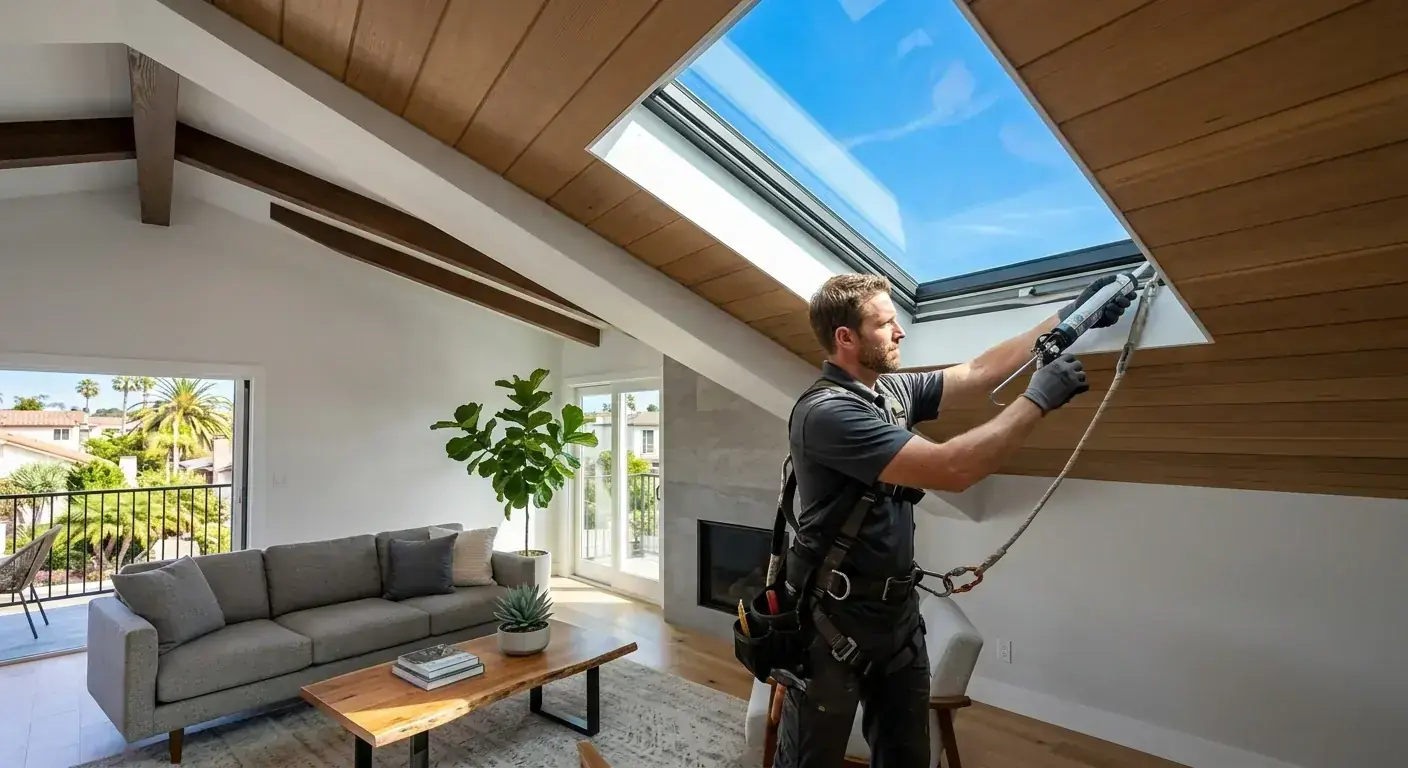
If the dome is yellow, the dual pane is fogged, or the drywall shaft keeps staining, you are usually past caulk. Replacement is the conversation. This page is how to read a San Diego County skylight bid: unit type, flashing, deck, tile vs shingle, permits, and Title 24 glass. It is not a price list.
Top Pro Roofing SD refers. We do not install. We do not invent unit or labor totals. Call (760) 750-5557.
What you are buying
A like-for-like replacement means: same opening, same size, new unit, manufacturer flashing kit for that roof covering, interior finish as written. Cost moves when any of those change.
Ask the bid to separate:
- The unit. Fixed vs venting, glass vs leftover acrylic, solar or hard-wired motors if you want venting.
- The flashing kit. Matched to shingle, low-profile tile, high-profile tile, metal, or low-slope. Hand-formed flashing is how last decade’s “cheap swap” becomes this decade’s leak.
- Deck and framing. Pulling the old unit shows the sheathing. Rot is a change order unless the proposal already names how discoveries are priced.
- Curb vs deck-mount. Many 1970s and 1980s domes sit on a wood curb. Reusing a rotten curb is not a savings. Rebuilding for a modern deck-mount is extra work and often the drier detail.
- Tile reset. Kensington, Point Loma, Coronado, and other tile neighborhoods need a crew that can lift and reset without a trail of broken S-tile.
- Shaft, insulation, drywall. The light well is part of the job if water or missing insulation is there.
- Electrical. Powered venting and rain sensors are not a dry-in-only quote.
- Permit and inspection. Same-size swaps are treated differently than enlarging an opening. Confirm the jurisdiction. We do not invent a permit fee.
A one-line “swap the skylight” number with no flashing kit named is a reason to keep shopping.
Replace vs repair
Replace when:
- The unit is original 1970s or 1980s acrylic in Clairemont, La Mesa, Mira Mesa, Allied Gardens, and similar ranches, and the plastic is yellowed, cracked, or brittle.
- Dual-pane glass is fogged. That is a failed seal. There is no field repair for the IGU.
- Two or more leak repairs have already failed.
- The frame is bent, the wood curb is soft, or you are already tearing off the roof (do the opening on the same permit and staging when you can).
Repair when:
- The unit is relatively new, glass is clear, and the leak is at flashing that can be detailed without a new unit.
- A Velux, Fakro, or similar unit is still under a manufacturer document the contractor can show you.
Diagnosis: skylight leak repair in San Diego. New openings (not replacements) are a different scope: skylight installation. Broader leak logic: what causes roof leaks.
Unit types that change the bid
| Type | What to confirm on the quote |
|---|---|
| Deck-mount fixed | Size, glass spec, flashing kit SKU for this covering |
| Deck-mount venting, manual | Operator, interior finish, flashing kit |
| Deck-mount venting, solar or electric | Wiring or solar pack, rain sensor, Title 24 and electrical permit if required |
| Curb-mount | Whether the existing curb is sound, or whether they will rebuild |
| Tubular (Solatube-class) | Dome, tube, and ceiling diffuser as a kit, not a site-built shaft |
| Custom size or shape | Fabricator, glass spec, who warrants the flashing, lead time |
| Impact or laminated glass | Whether the jurisdiction or your insurer actually requires it |
Deck-mount vs curb-mount. Modern deck-mount units sit to the deck with an engineered kit. Curb-mount sits on built-up wood. If you switch from curb to deck, expect framing and dry-in work, not a drop-in. Independent roofers in the referral network generally do not specify new acrylic domes. UV yellows them. Ask for current glass that can pass inspection.
Mission Hills, Hillcrest, Kensington mid-century. Odd sizes often have no catalog twin. Paths: rebuild the opening to a standard Velux or Fakro, or fabricate a custom unit. Custom preserves the look and shifts warranty onto the shop and the installer. Get that in writing.
Brands: compare documents, not a blog ranking
| Brand | What to ask |
|---|---|
| Velux | Current no-leak and unit documents, flashing kit for this roof, accessory lead time |
| Fakro | Size match to the opening, dealer support, flashing kit, warranty PDF |
| Sun-Tek and similar | Warranty length in writing, available sizes, flashing approach |
| Local custom glass | Who details the roof, who comes back for a leak, what the glass U-factor and SHGC actually are |
We do not pick a winner. We do not publish “usually this many dollars cheaper.” Put the PDFs next to the proposal.
Title 24, not a remembered U-factor
California Title 24, Part 6, applies to replacement fenestration, including skylights, not only new houses. U-factor and SHGC limits depend on climate zone and the current code cycle. San Diego County is not one number for every opening. Ask the matched roofer and the building department for the values that apply to this address this year. Most current Velux and Fakro deck-mount glass packages are sold as code-capable. Custom shops must prove the glass, not assume it.
Cool-roof and openings: cool roof Title 24.
Do not count on a federal energy credit for a 2026 install unless your tax professional confirms a current-year program. Credits change. Keep itemized invoices if you believe you still have a filing for a prior year. This referral brand does not enroll tax credits.
Permits and HOAs
Like-for-like, same opening, no electrical, is often lighter review than a new hole in the roof. That is not a blanket exemption. Confirm:
- City of San Diego and other cities in the county each run their own counter.
- Coastal zones (parts of Encinitas, Solana Beach, Del Mar) can add review when the roof penetration changes.
- HOAs (Carmel Valley, Scripps Ranch, Rancho Bernardo, and others) often want a packet even when the city is quiet.
- Historic overlays add process.
You should expect a permit conversation when you enlarge the opening, add powered venting, or fold the skylight into a reroof that already needs a permit. The independent contractor should say who pulls it. Verify C-39 status at CSLB.
How a like-for-like day usually runs
Times vary. This is sequence, not a clock we warrant.
- Protect the room and shaft.
- Remove unit, old flashing, old sealants. Inspect deck.
- Repair sheathing or blocking if needed.
- Integrate underlayment and the ice-and-water or equivalent detail the manufacturer requires around the opening.
- Install the flashing kit in the order the instructions show, woven with shingles or tiles.
- Set and fasten the unit.
- Reset covering at the cut edges.
- Interior shaft, trim, drywall as scoped.
- Cleanup and a walkthrough of interior and roof.
Tile adds lift-and-reset time. Crews who rarely work tile break more units. Ask. Related tile cost context (still not a skylight total): tile roof replacement cost. If you suspect deck damage before anyone opens the roof, a drone roof inspection can document from above. It does not replace a look at the opening once the unit is out.
FAQ
How long does a new unit last?
Ask for the manufacturer documents. Glass seals and flashing both age. Workmanship terms are the contractor’s, not ours.
Can I replace a skylight without a reroof?
Yes, when the flashing kit can tie into sound existing covering. If a reroof is already on the calendar, combining the opening with that staging is usually cleaner. Ask for both sequences in writing.
Will the new one leak?
Risk drops when the kit matches the covering and the crew installs to the instructions, including the underlayment tie-in. Risk rises with site-bent flashing and skipped details. No referral page can promise a dry opening.
Should I add shaft insulation while it is open?
If the well is open, ask what insulation the energy code and the manufacturer allow at that chase. Price it as a line, not a surprise.
Can I enlarge the opening?
That is not like-for-like. Framing, header, permit, and interior finish all change. Treat it as a small structural project.
Are solar-powered venting units worth it?
They avoid a new electrical run to the roof. Confirm model, rain-sensor behavior, and any current utility or tax item with the contractor and a tax pro. We do not enroll credits.
Get a written replacement quote
If the unit is yellowing, fogging, or staining the shaft, get a roof walk that names the opening, covering, and flashing kit. Top Pro Roofing SD matches San Diego County homeowners with licensed independent roofers, including tile-roof openings. We do not set the unit. Call (760) 750-5557 or see skylight installation and replacement. Coastal covering context: best roof material for coastal climates.